The Saree Atlas · A story in pictures
How a Saree Is Made
From Silk to Saree
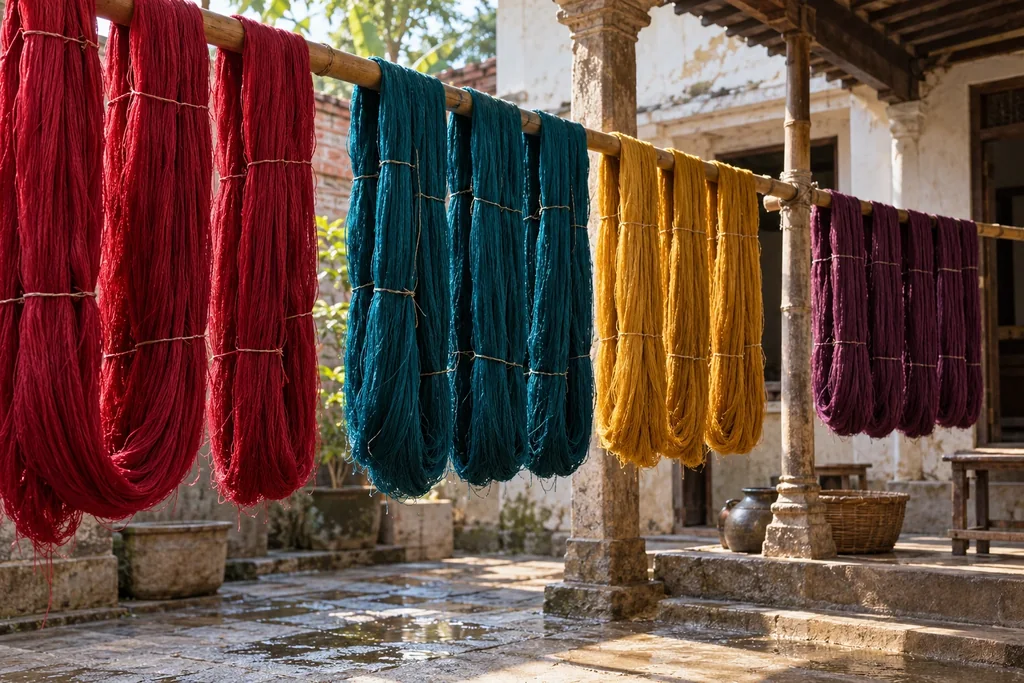
Before a silk saree reaches a shop it passes through many hands: cocoon to thread, thread to colour, colour to loom, and loom to six yards of cloth. Follow the journey in pictures.
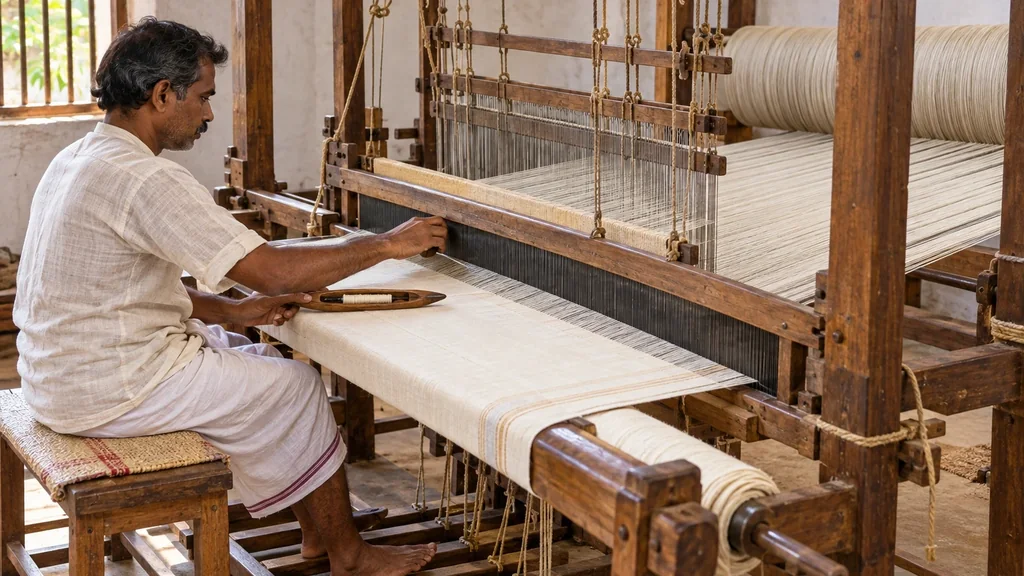
Chapter I: Silk becomes thread
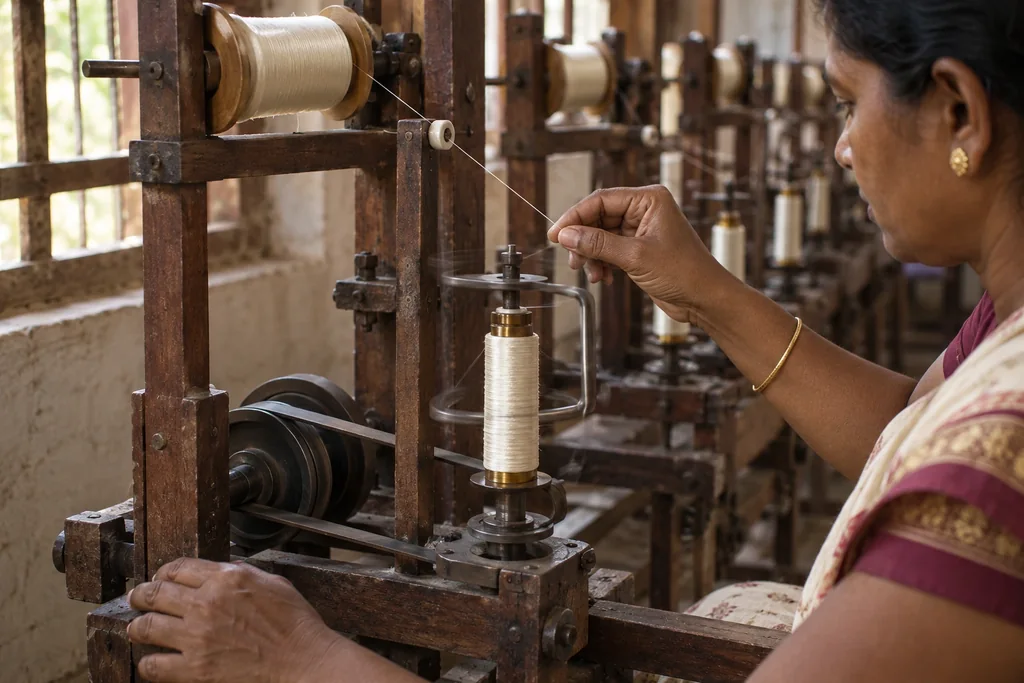
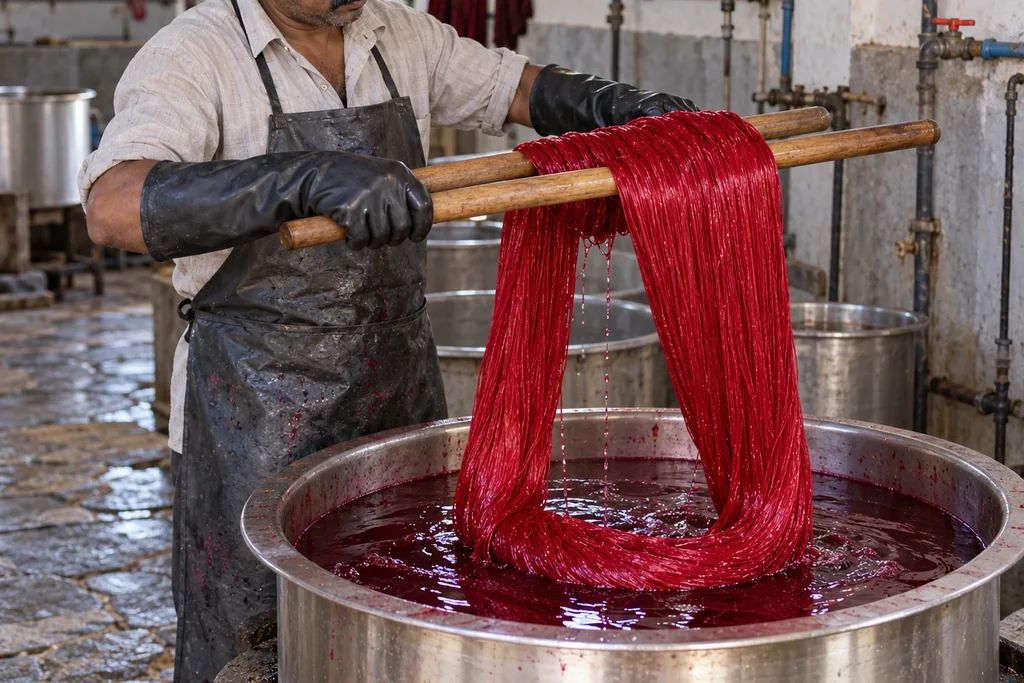
A silk saree begins with thousands of cocoons, and a great deal of patient work before the loom.
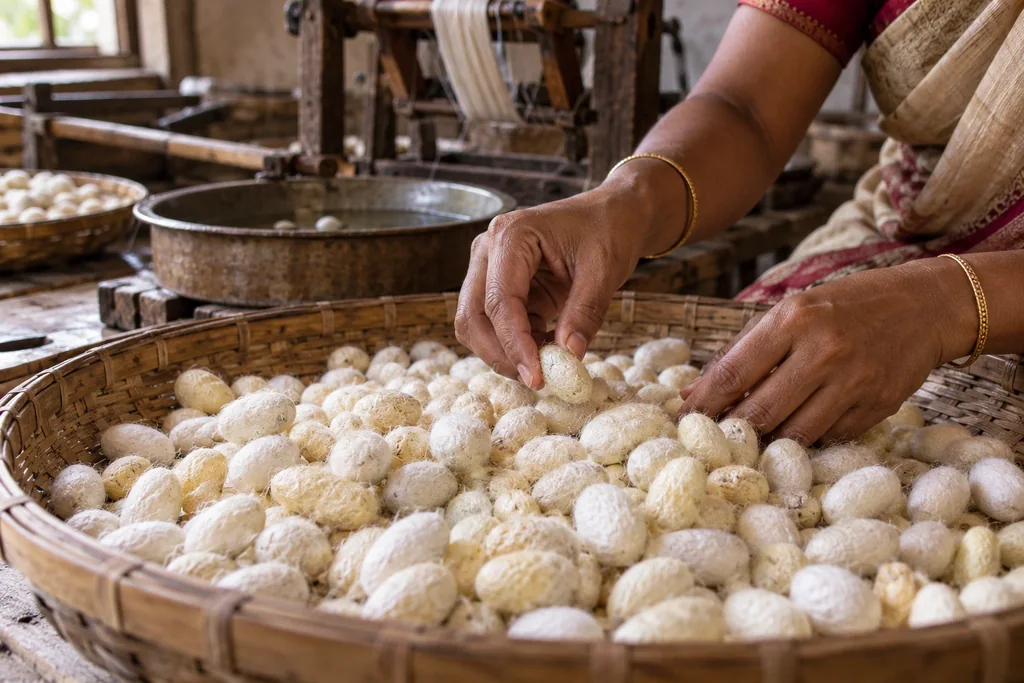
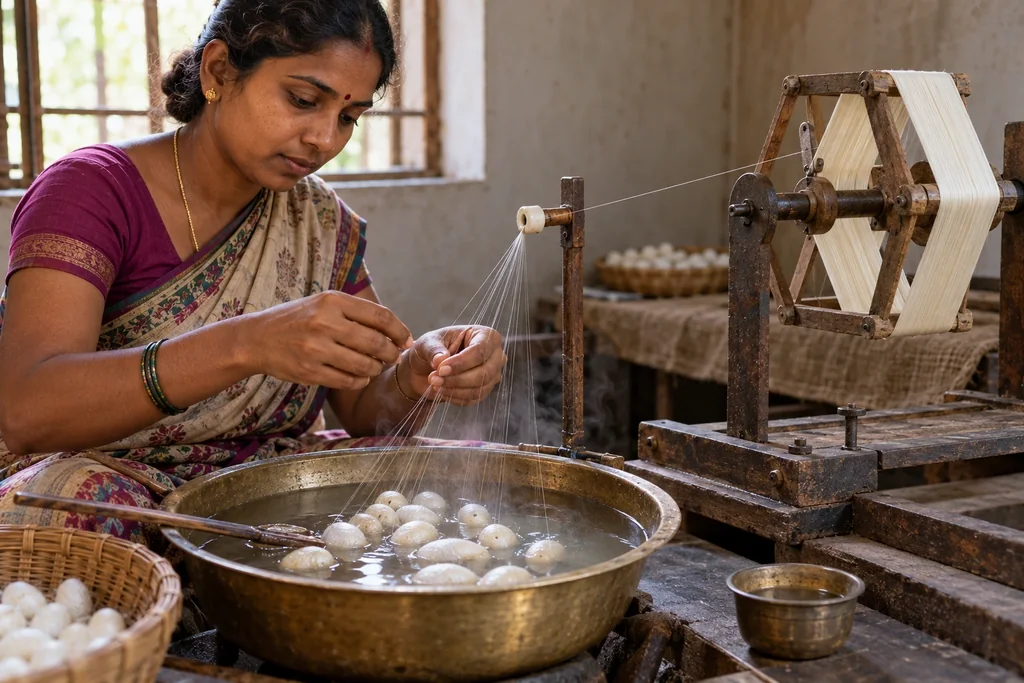
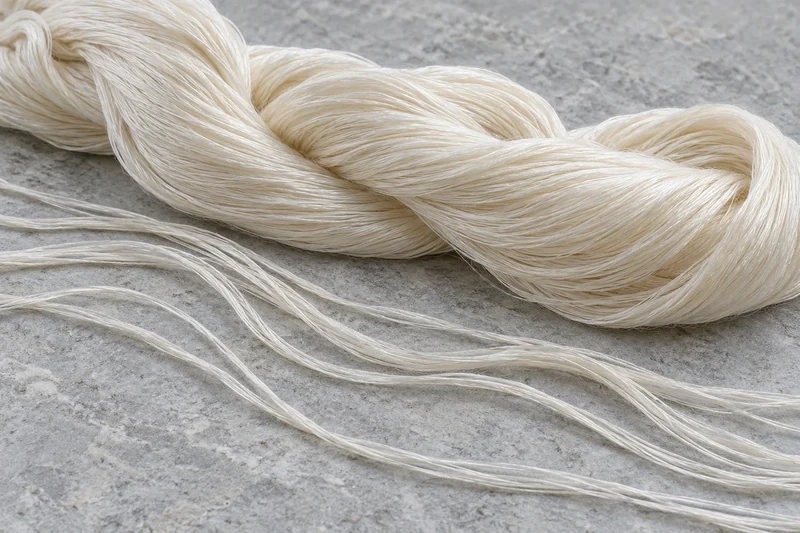 Reeled silk: long, smooth, continuous filaments.
Chapter II: Preparing the loom
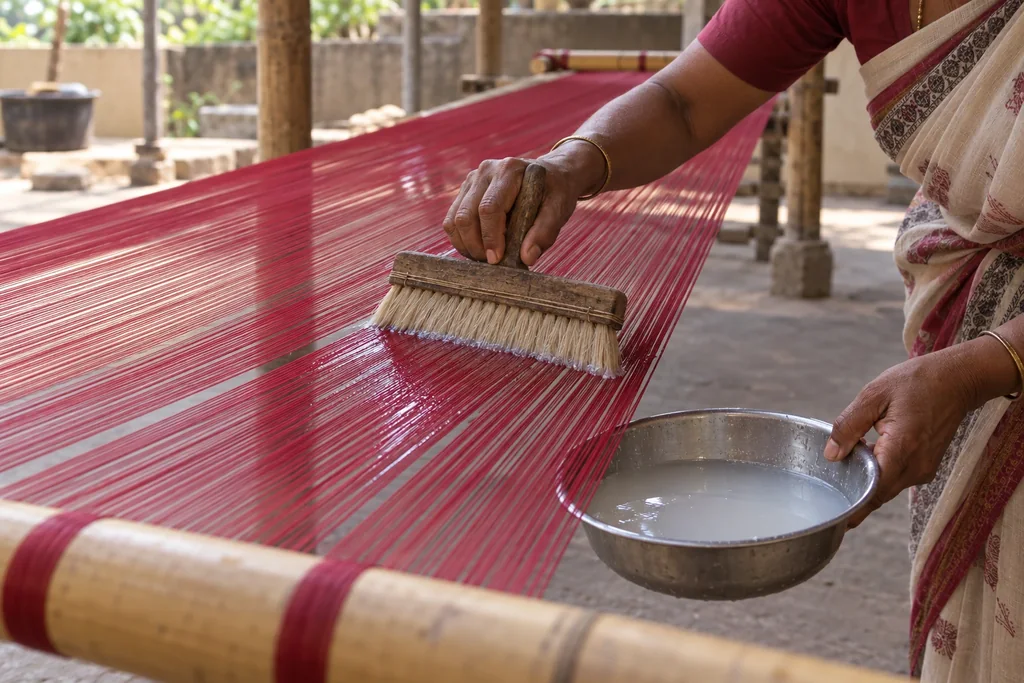
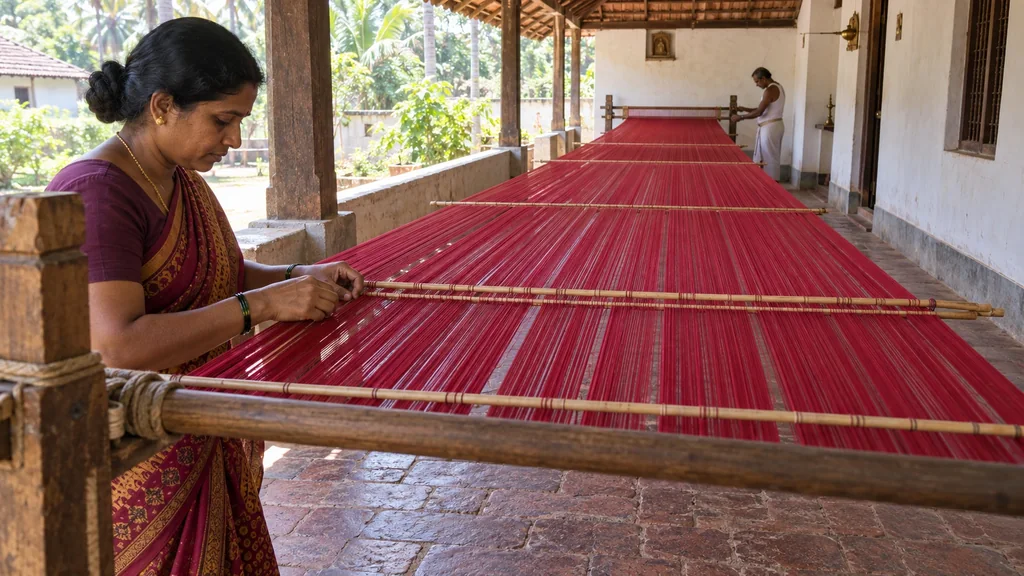
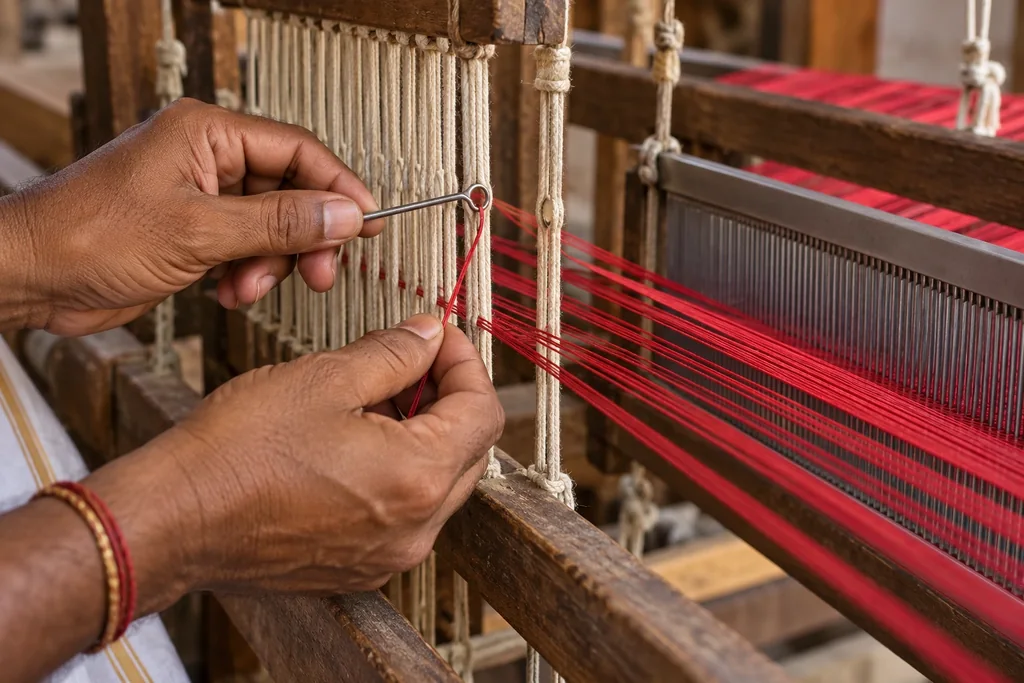
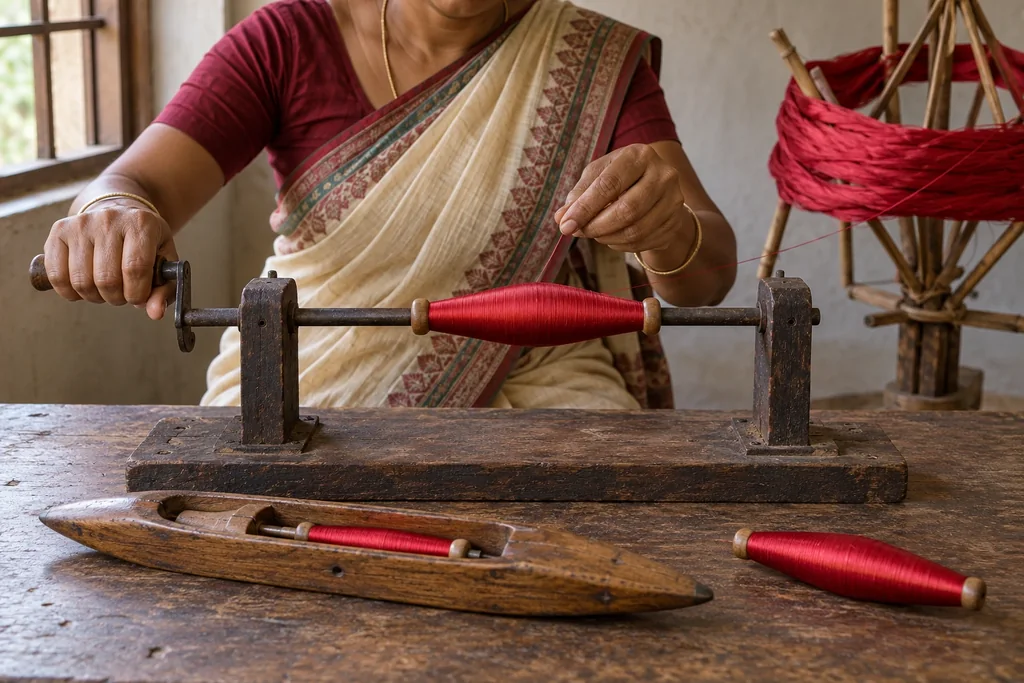
Weaving needs two sets of threads. The lengthwise set, the warp, is prepared first, and with great care: its threads run the length of the cloth, so they are measured and laid out before weaving can begin.
How cloth holds together
Warp and weft
Every woven cloth is two sets of threads at right angles. The warp runs the length of the saree, held tight on the loom; the weft crosses it, over one thread and under the next, then turns at the edge and comes back.
Chapter III: The art of weaving
With the warp threaded and the shuttle filled, the loom comes to life.
The handloom in operation
Lift, pass, beat, change
Every handwoven saree grows through four movements, repeated thousands of times. On a handloom the weaver makes each of them, with hands and feet. First, the loom itself.
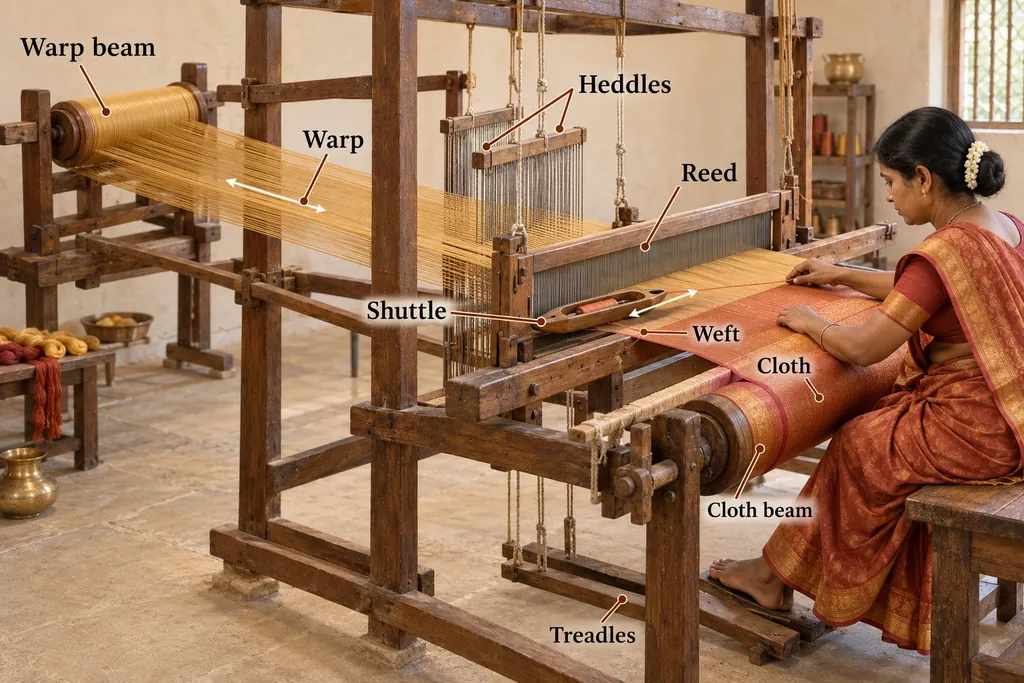
What each part does
- Warp beam holds the long warp and lets it out as the cloth grows
- Warp the lengthwise threads, held tight
- Heddles lift one set of warp threads at a time
- Reed a fine comb that keeps the warp in order and beats each new thread in
- Shuttle carries the crossing thread from side to side
- Weft the crossing thread
- Cloth the woven saree, growing towards the weaver
- Cloth beam rolls up the finished cloth
- Treadles foot pedals that move the heddles
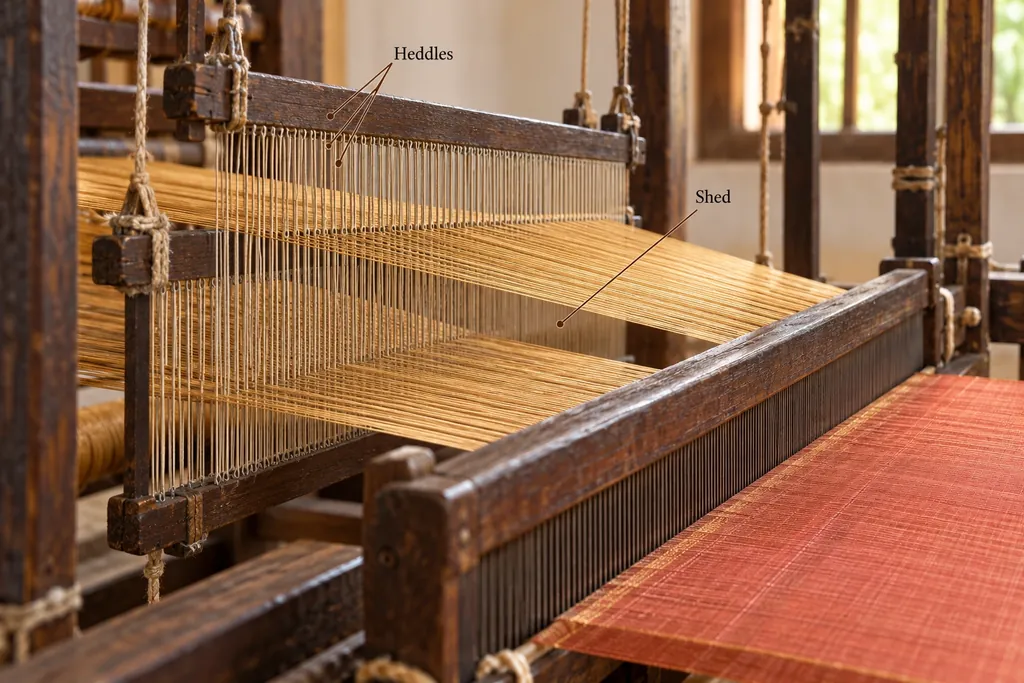
Step 1
Lift
The weaver presses a treadle, and the heddles raise one set of lengthwise threads, opening a space between them: the shed.
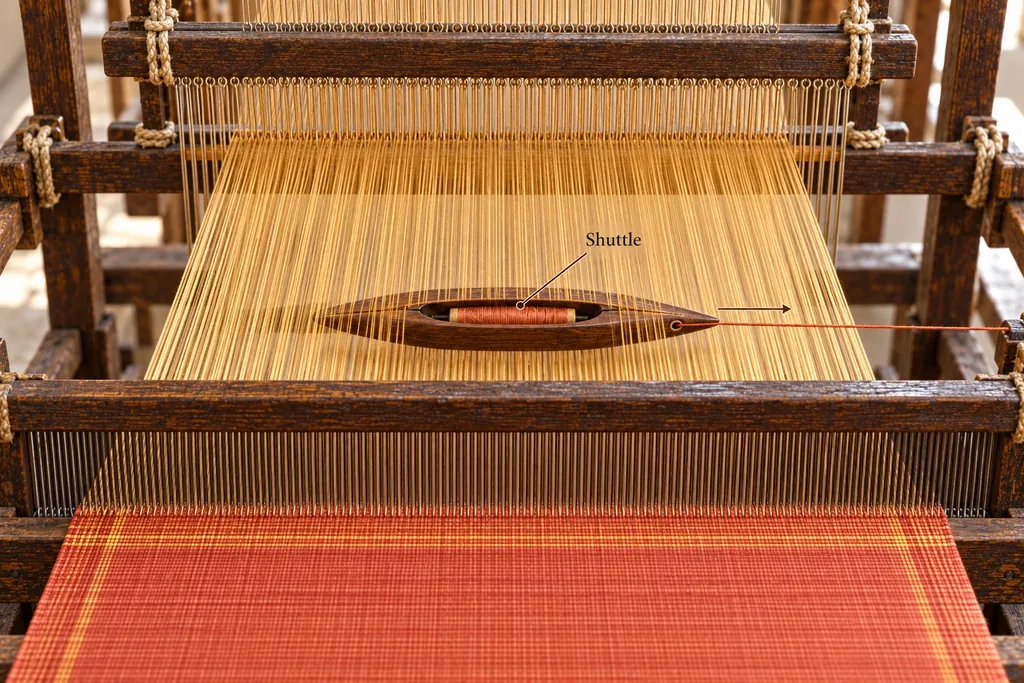
Step 2
Pass
The shuttle carries a new crossing thread, the weft, through that opening.
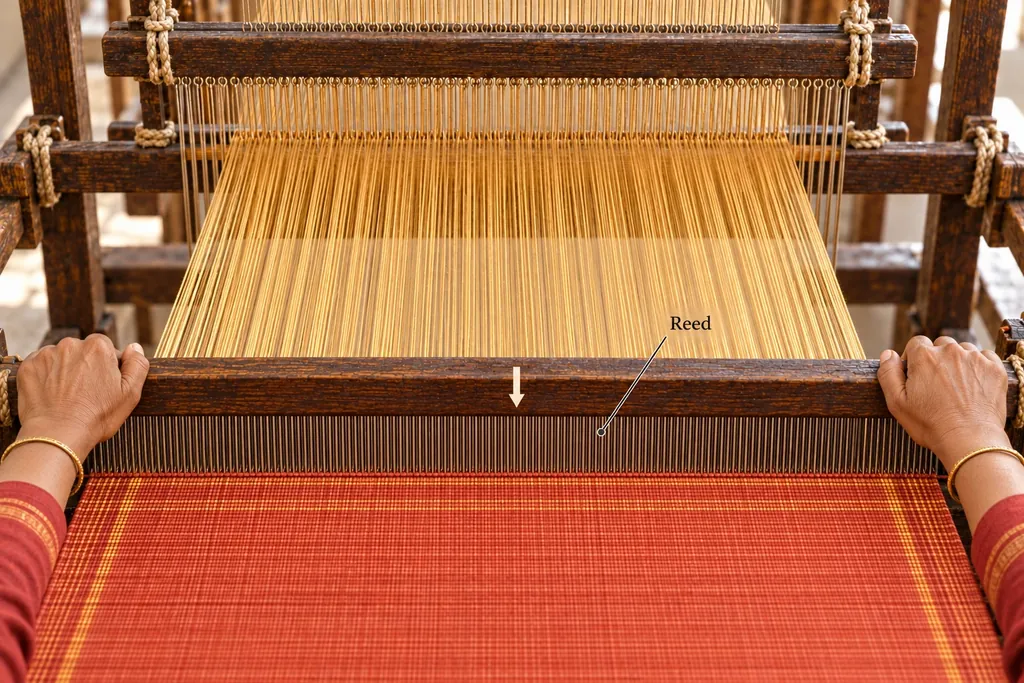
Step 3
Beat
The reed pushes the new thread firmly against the growing cloth.
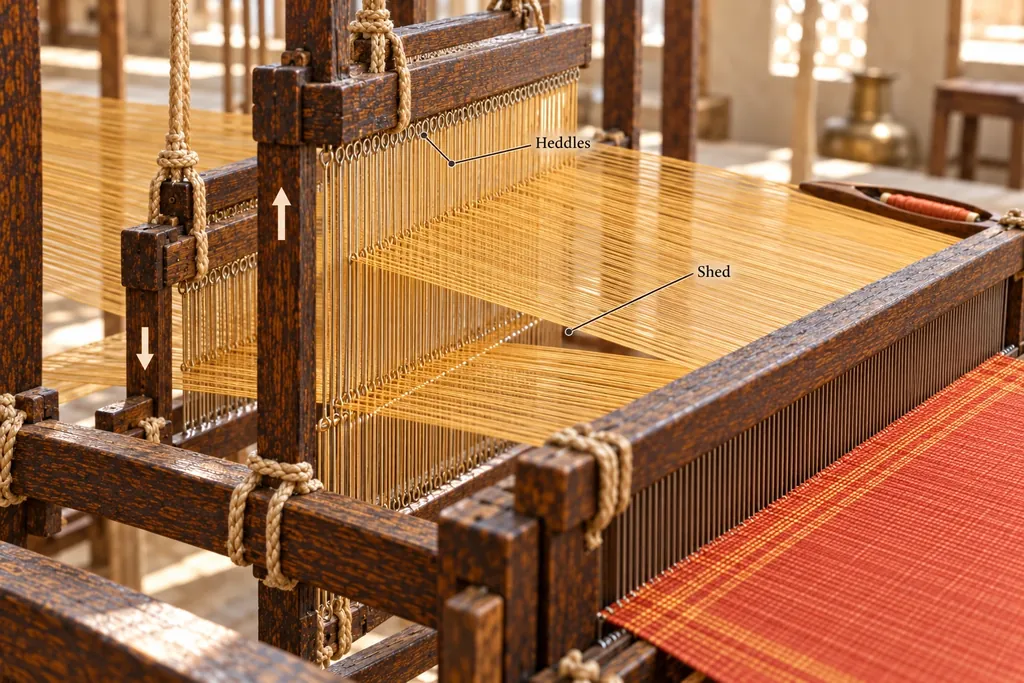
Step 4
Change, and repeat
The opposite set of threads rises, holding the new thread in place, and the weaver repeats the sequence.
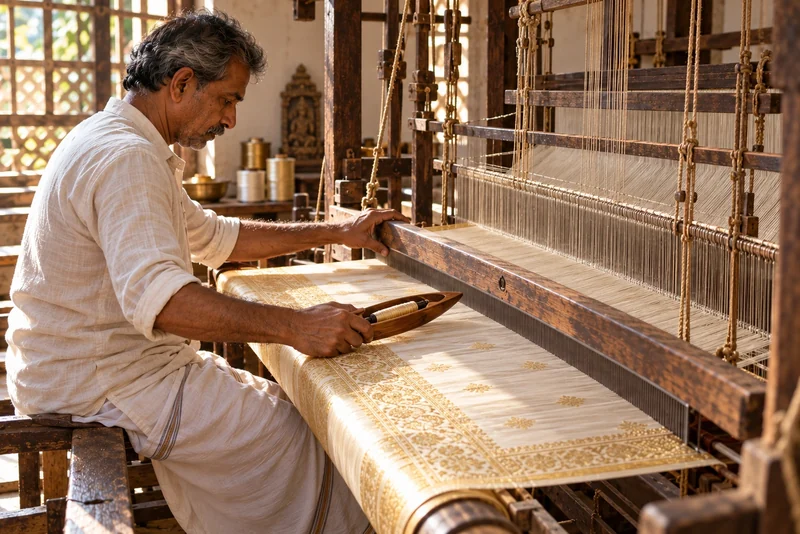
Patterns on the loom
Jacquard
The four movements above lift the same two sets of threads in turn, which is all plain cloth needs. A large woven pattern needs a different choice of lengthwise threads, often thread by thread, for almost every row. A Jacquard, mounted above the loom, makes that choice from a chain of punched cards, one card for each row.
It selects warp threads, nothing more: it adds no decorative thread of its own, and it is not a source of power. The weaver still passes the weft and works the loom, and a Jacquard can be fitted to a handloom or to a powerloom.
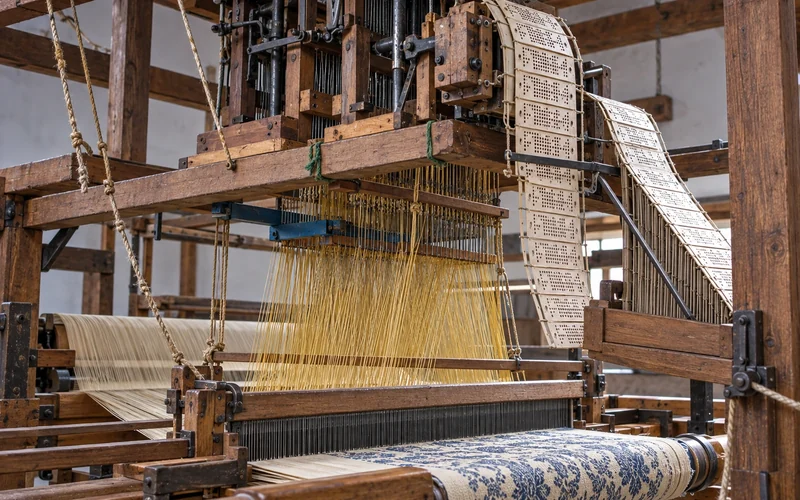
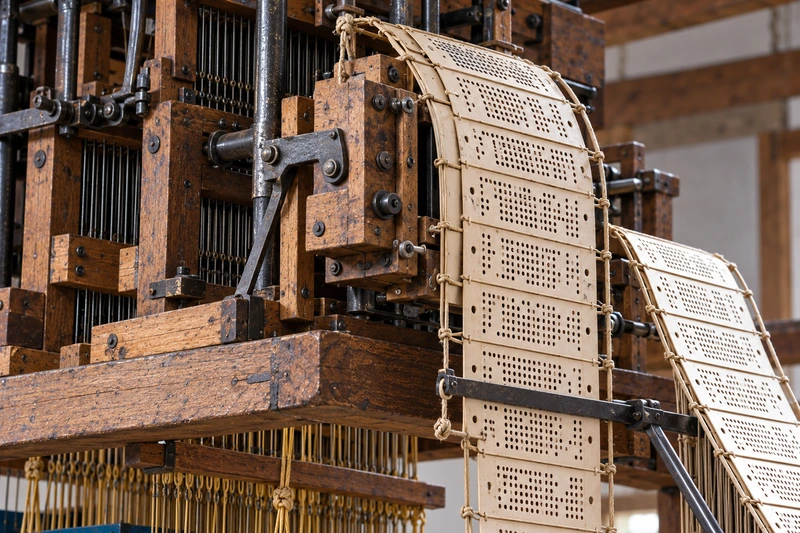
Who decides where the holes go?
From drawing to punched cards
Every hole in a card is a decision made long before weaving, and it begins with a drawing.
1 Draw. A designer draws the motif: a flower, a creeper, a geometric figure.
2 Plot. The drawing is copied onto squared paper, where each square is one thread-selection position: across, one lengthwise thread (or a group lifted together); down, one pass of the weft. A filled square means “lift this thread in this row”.
3 Punch. Working from the squared design, a card cutter punches one card for each row: a hole for every filled square, solid card elsewhere. The cards are laced into a chain in weaving order.
4 Weave. Card by card, the holes decide which warp threads rise for each pass; the weaver sends the weft through, and the flower appears. The cards only choose: every thread is already on the loom or in the shuttle.
Modern electronic Jacquards skip the cardboard: the design reaches the loom as a digital file.
How the cards choose
From card to cloth
Reader needles feel each card in turn. A rising knife then lifts only the hooks the card left in place, and with them their warp threads; the weaver passes the weft beneath. The cards select; the weaver operates the loom.
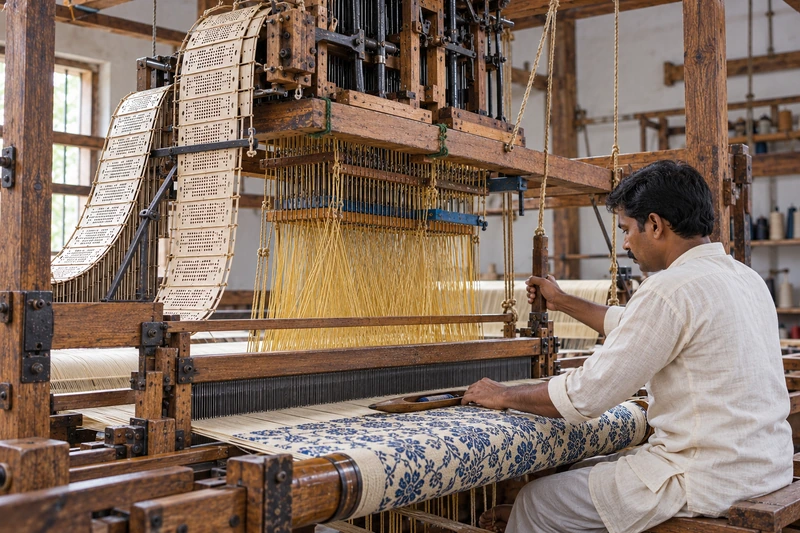
Woven in, not sewn on
How borders and pallus take shape
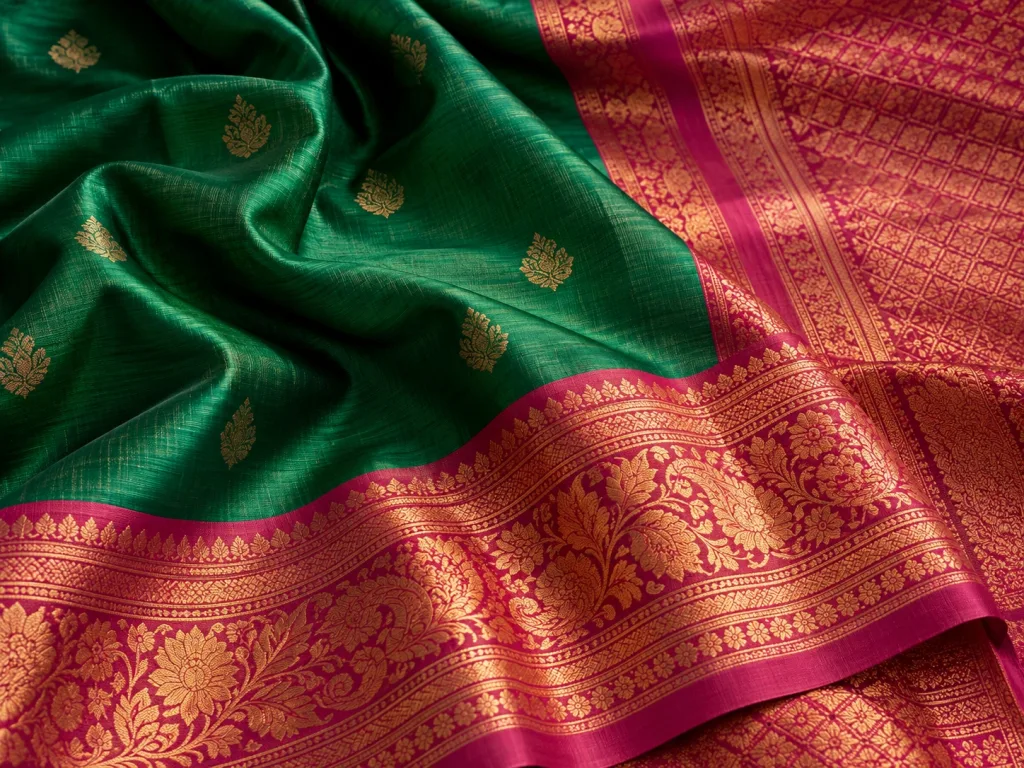
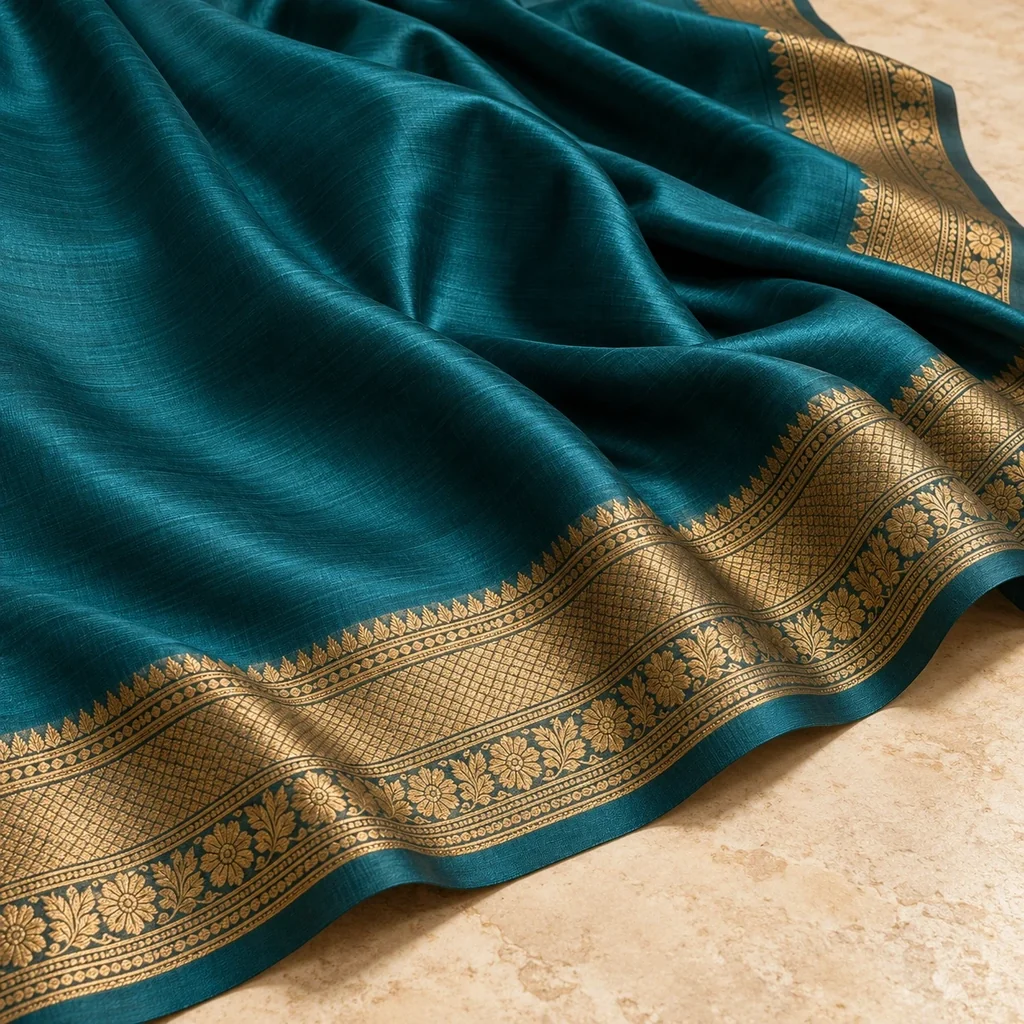
Most borders and pallus are made in the ordinary course of weaving: coloured lengthwise threads at the edges make a border, and a change of crossing threads makes a pallu. Korvai and petni go further. Each builds a true junction into the cloth, and the two run in different directions.
Along the length
Korvai: a border with its own crossing thread
An ordinary border shares the body’s crossing thread. In traditional korvai, the body and each side border have their own, each carried by its own shuttle, and the two hook round each other at every row. That is how a border in a completely different colour is woven in the same moment as the body.
Across the width
Petni: new lengthwise threads for the pallu
An ordinary contrasting pallu keeps the body’s lengthwise threads and changes the crossing threads. Petni changes the lengthwise threads themselves: new threads in the pallu colour are woven in alongside the body’s for a short stretch, and the body’s threads are then cut and their ends finished.
Chapter IV: Beyond the basic weave
Some patterns are dyed into the threads before weaving; others are woven in with extra pattern threads. Each belongs to particular sarees; none is a stage in every one.
Pattern before weaving
Ikat
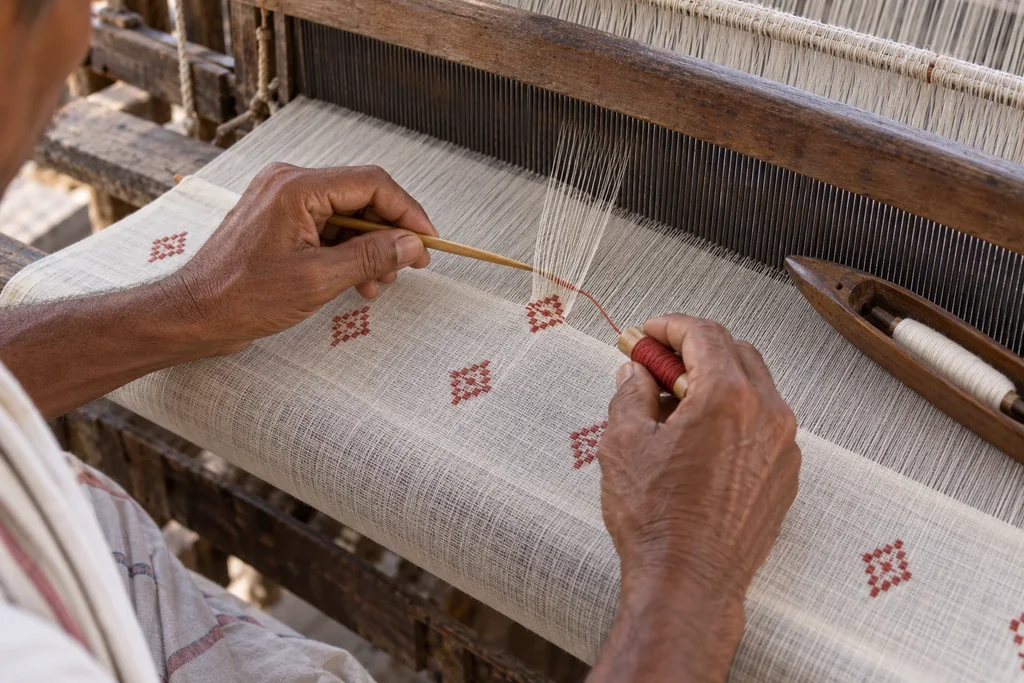
In ikat the design exists before a single row is woven. Bundles of thread are tied tightly where colour must not go, then dyed; untied, each thread carries its share of the pattern.
Pattern one set of threads and it is single ikat. Pattern both, and align them as they cross, and it is double ikat, the method of Patan Patola.
Ornament woven in
Brocade and its motifs
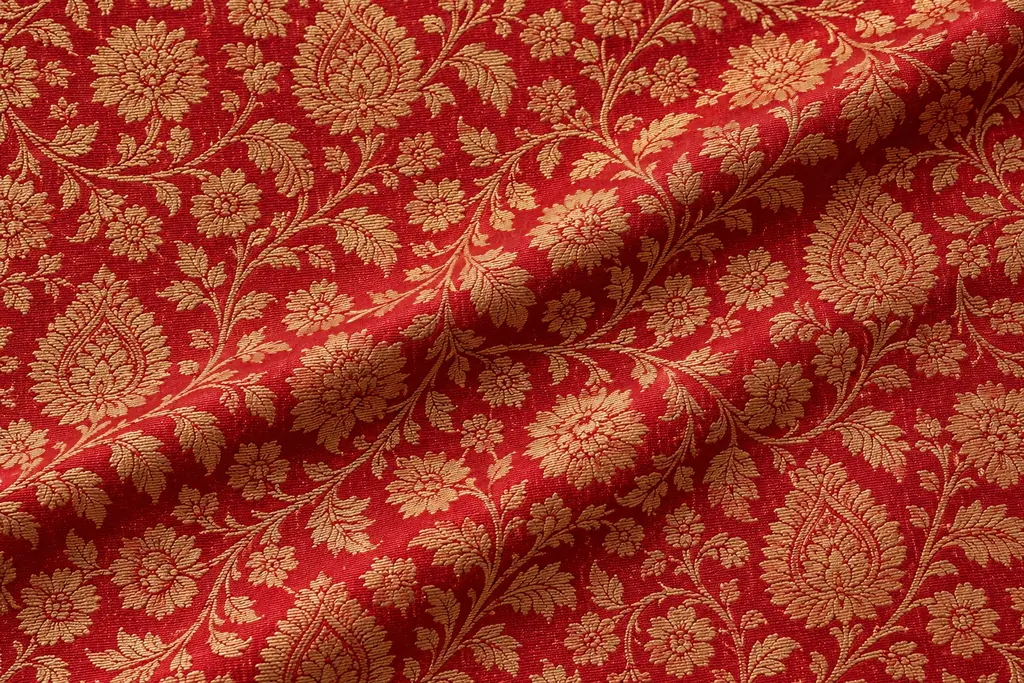
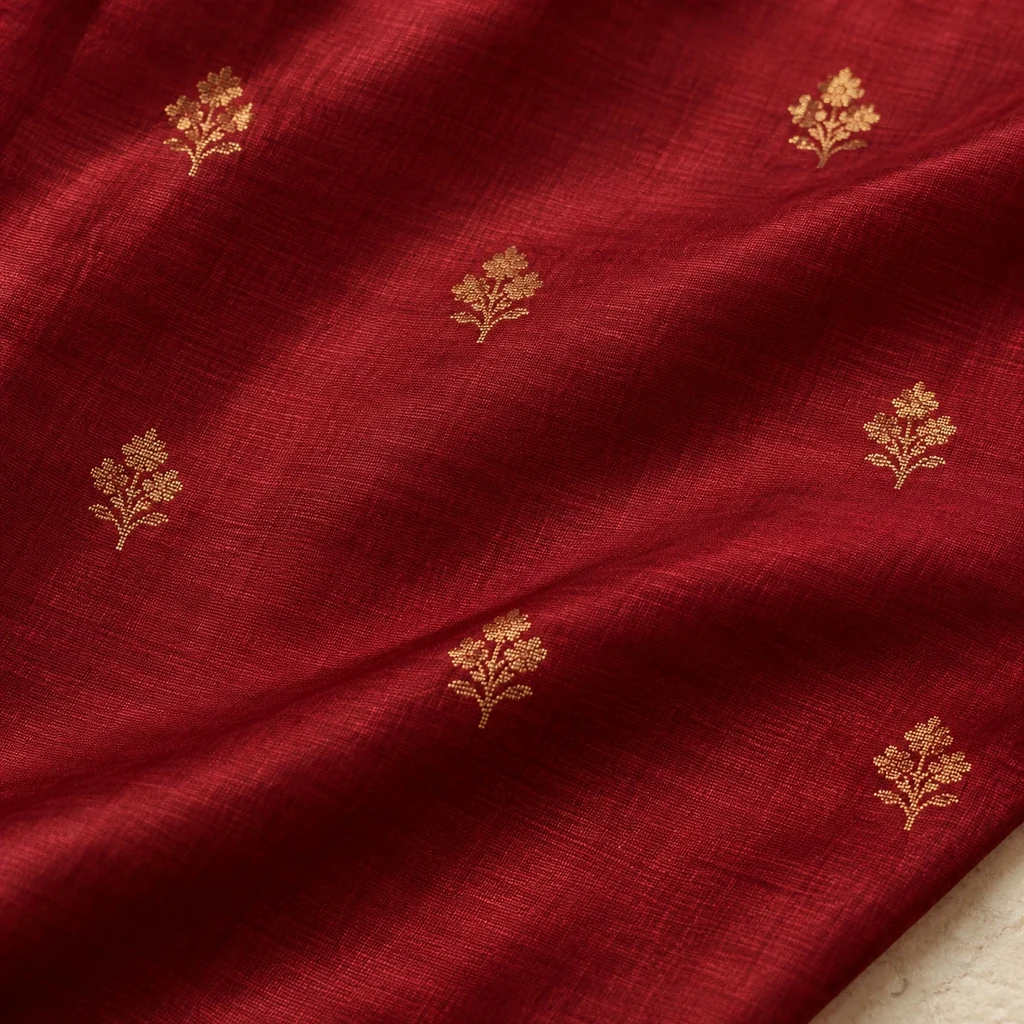
Brocade is the broad name for cloth whose ornament is woven in with extra pattern threads, often zari. They are added to the ground and show on the face only where the design needs them, so the ornament is part of the cloth, not printed or embroidered on top.
A Banarasi distinction
Kadwa, fekwa and cutwork
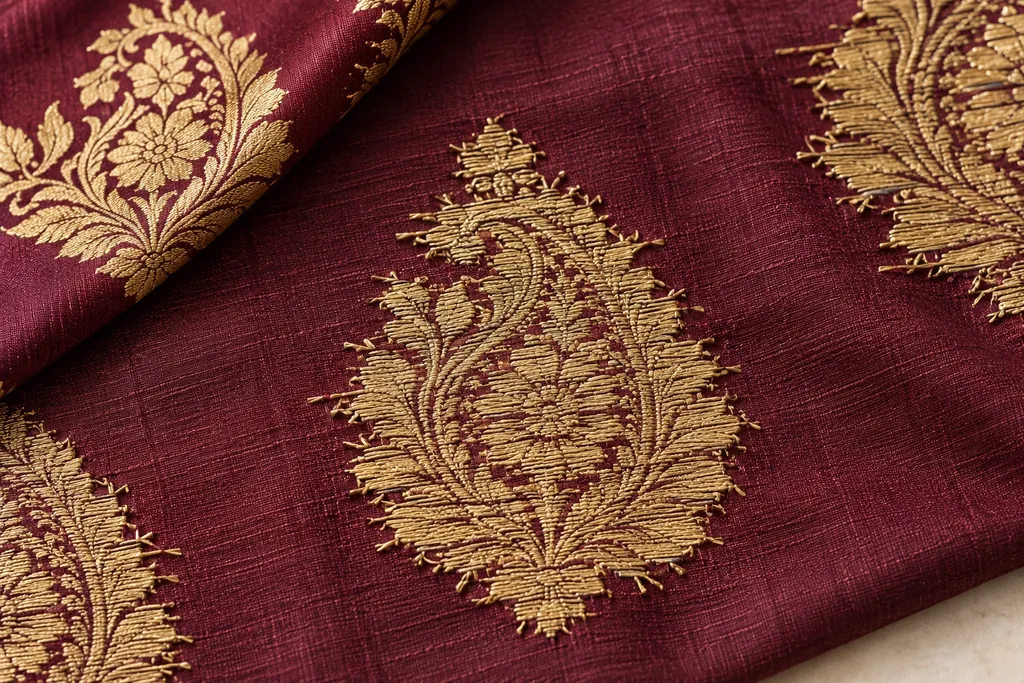
Within a Banarasi brocade, the same gold motif can be woven in different ways. From the front the results can look alike; the back of the cloth shows the difference. In kadwa, each motif is woven with its own thread, so nothing runs between them. In fekwa, the pattern thread travels on from motif to motif, lying behind the cloth across the gaps. Cutwork describes what is often done to fekwa next: those carried lengths are clipped after weaving.
Kadwa’s close relative
Jamdani
Jamdani builds its motifs on the same principle as kadwa. A pattern thread is laid in only where a motif is needed, worked back and forth within it and turned back at its edge, while the ground runs from edge to edge. The specialist name for both is a discontinuous supplementary weft.
What differs is the tradition around it. Jamdani’s best-known expression is fine cotton from Bengal and Bangladesh, its motifs seeming to float on an almost sheer ground, and in classic cotton Jamdani the pattern thread is inserted by hand. Kadwa is a way of working the motifs of Banarasi silk brocade, often in zari. This drawing shows a Jamdani motif from the front; the kadwa panel above shows the same kind of thread from the back.
Off the loom
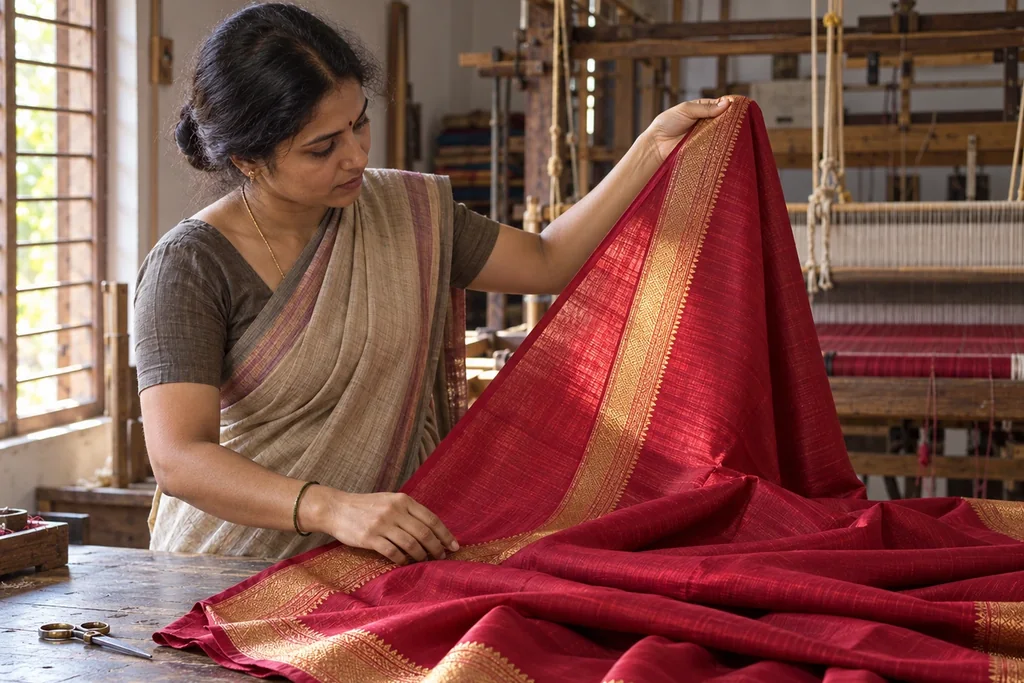
Behind every handwoven saree are reelers, twisters, dyers, warpers and weavers, and days, weeks or months at the loom. That is worth knowing when you hold one.
Keep exploring
- Before the weaveHow silk becomes yarn, and why the yarn matters
- Zari and ornamentHow zari is made, and the motifs woven with it
- KanjivaramKorvai, petni and the temple town’s silks
- Handloom and powerloomWhat to ask when a loom matters to the price
To see a weaving community at work, visit Kanjivaram Sari (opens in a new tab), a photographic story by Dastkari Haat Samiti on Google Arts & Culture (text by Aloka Hiremath and Jaya Jaitly, photographs by Chirodeep Chaudhuri).