The Saree Atlas
Search

The practical companion

The Buyer’s Field Guide

What to decide, inspect, ask and verify — from the moment you walk in to the day you fold it away. Six short stages, each complete on its own.
Two pages for your phone or handbag. Made on your device; nothing is uploaded.
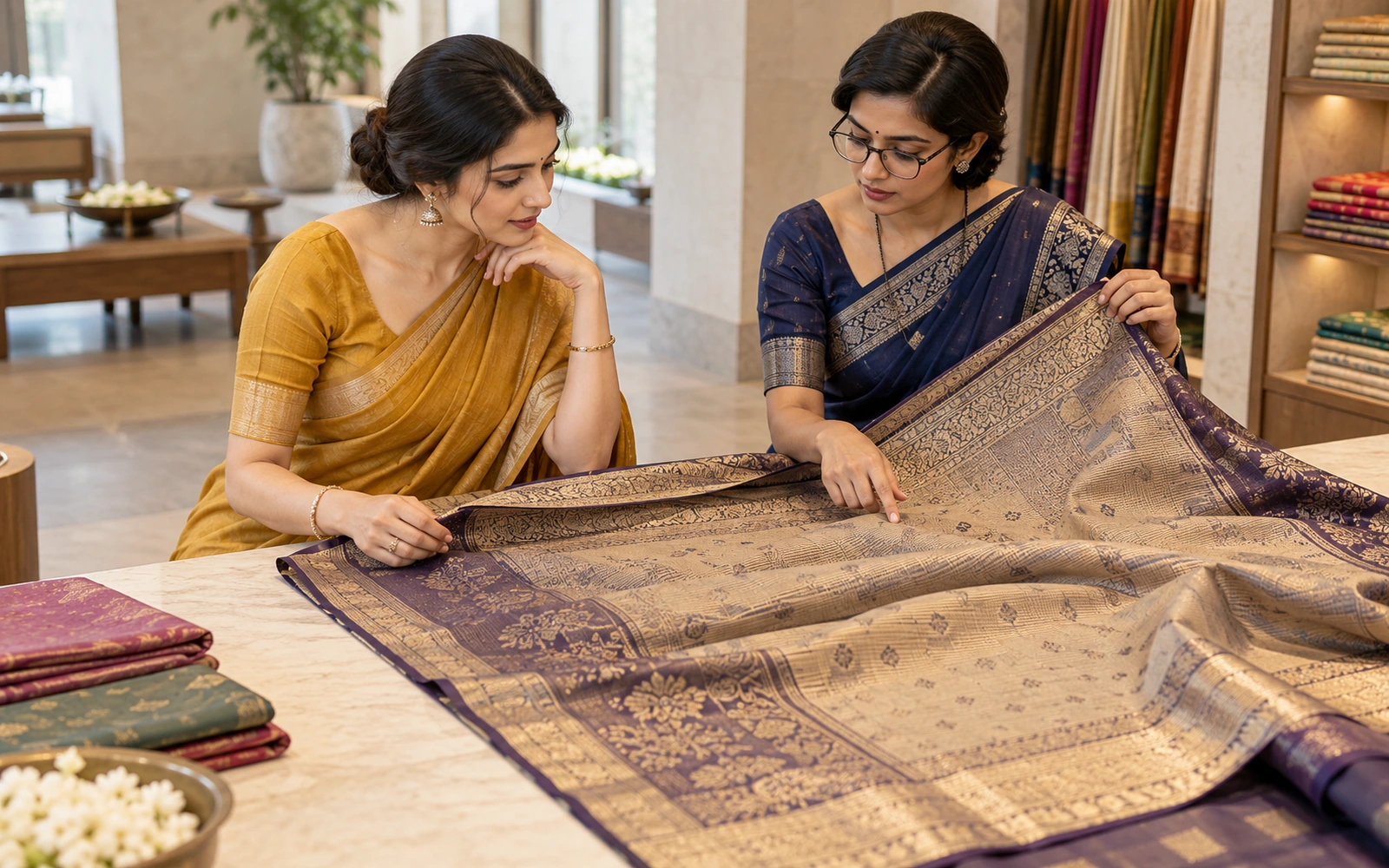
Two saree enthusiasts examining the pallu and craftsmanship of a silk saree before purchase

Most regrettable sarees were chosen for the showroom, not for the life they would actually lead. Settle five things before the first bolt is unfolded.
  1. The occasion. A wedding, a festival, office, a dinner, travel? Formality decides weight, sheen and how much zari is welcome.
  2. How often it will be worn. Once a year can justify a heavy brocade. Once a month needs something that drapes easily and forgives a long day.
  3. Climate and season. Heavy silk and dense zari are hard work in humid heat; cotton, Chanderi, Maheshwari or a soft silk will be worn more.
  4. Colours she already owns. Four red silks is a collection with a gap. Note what is missing before you go.
  5. A budget with a margin. Leave room for the blouse stitching, fall and pico finishing — and decide your ceiling before anyone says “today only”.
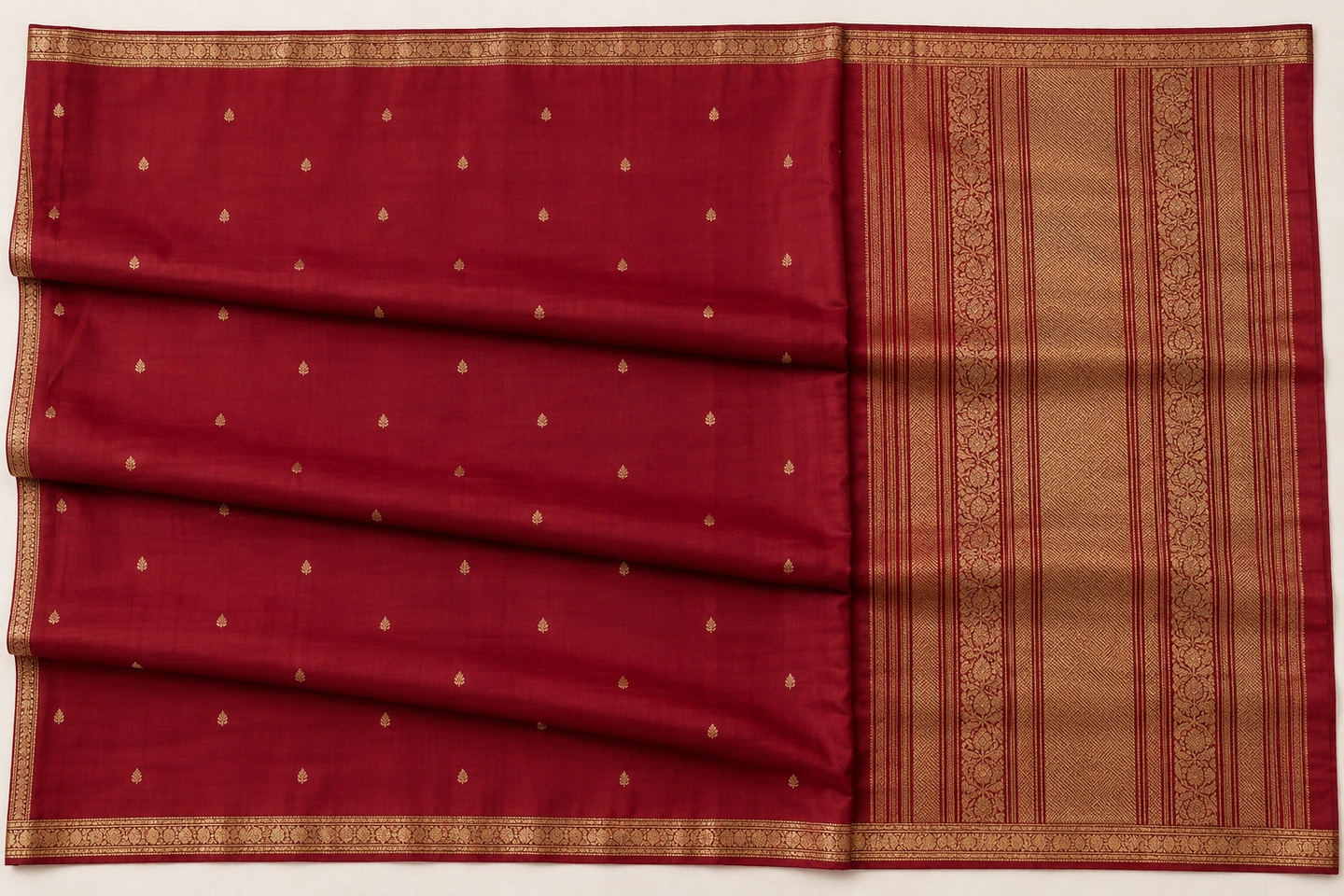
Illustrative understated silk saree laid out in gentle folds
Simple need not mean ordinary. Look at the fabric, fall and craftsmanship.

Sensible starting points

Weddings & big festivals
Kanjivaram, Banarasi Katan brocade, Paithani
Daytime & office
Cotton Jamdani, Chanderi, Maheshwari, light Tussar
Evening & parties
Tissue, organza, chiffon or georgette, a jewel-toned silk
Travel & long days
Soft silk, Mysore silk crepe, fine cotton

Test it in the shop

  • Drape a metre over the shoulder in front of a mirror — in daylight if you can.
  • Feel the weight in the hand; heavy can mean rich work or simply stiff finishing.
  • Gather the body into pleats: do they fall, or spring back?
  • Step back. Choose at conversation distance, not nose-to-cloth.

Warning signs

  • You are choosing for the photograph, not the evening.
  • “It’s a wedding” has become the reason for the heaviest saree in the shop.
  • The budget moved twice before you sat down.

Further reading: Style & Occasion · Fabrics & Silks

A single sentence — “pure Katan Banarasi with real zari, handloom” — contains four separate claims: a fibre, a yarn, a place-name and a metal. Each needs its own answer. Separate them like this.

You hearWhat it actually claimsAsk
“Pure silk”A fibre: natural silk (mulberry, Tussar, Eri or Muga), not polyester or viscose “art silk”.Which silk? Is there a Silk Mark label?
“Katan”A yarn: two or more twisted mulberry silk threads. Not a region and not a weave.Katan in warp and weft, or only one?
“Handloom”A making method: woven on a hand-operated loom.What supports that — Handloom Mark, India Handloom Brand, the weaver or cooperative?
“Kanjivaram”, “Banarasi”A tradition and a place of origin. Many styles are made far from these towns.Was it woven there — and what can you show me: a label, a cooperative, a producer named on the bill?
“Pure zari”, “real zari”A metal: traditionally silver wire or strip, often gilded.What is the silver and gold content, and is there a test report?
“Tested zari”Usually a copper-based metallic thread, plated for colour — a respectable mid-range choice, but not pure.Copper core with silver plating? Gold-toned finish?
“Kadwa”, “Korvai”, “double ikat”A specific weaving technique — often the reason for the price.Where on this saree is that work, and what record supports it?
“Designer”, “export quality”, “premium”Nothing technical at all.Which fibre, loom and zari, please?

The useful habit: for every adjective, ask whether it describes the material, the construction or the origin — and then ask how that is known.

Further reading: Decode Showroom Speak — ten annotated sales conversations.

Ask for the saree to be opened fully — body, both borders, pallu and selvedges. A good seller expects this.
What to look at — and what to ask about it

  • Condition first. Body, both borders and pallu in good light: snags, thin patches, stains, fading or repairs. This is about the cloth you are buying, not proof of how or where it was made.
  • Ground and ornament. Ask which yarns make the ground and which make the pattern, and whether the design is woven, embroidered or printed. Seeing the pattern on the back can start that conversation; it does not settle it.
  • The edges. Selvedges can be very neat on a handloom and imitated on a powerloom. Treat what you see as a reason to ask how the saree was woven and what supports that.
  • The joins. If korvai, petni or tope teni is part of the price, ask the seller to point to the junction on this saree. A contrasting border or pallu alone does not show it.
  • Ikat and print. Feathered or crisp outlines are clues to discuss, not proof: ask which yarns were resist-dyed before weaving.
  • The zari. Gold-coloured zari can contain different materials. Ask what the metallic yarn contains and what supports a precious-metal claim; colour and a visible frayed end do not establish composition. Never scrape, rub or burn a saree to find out.
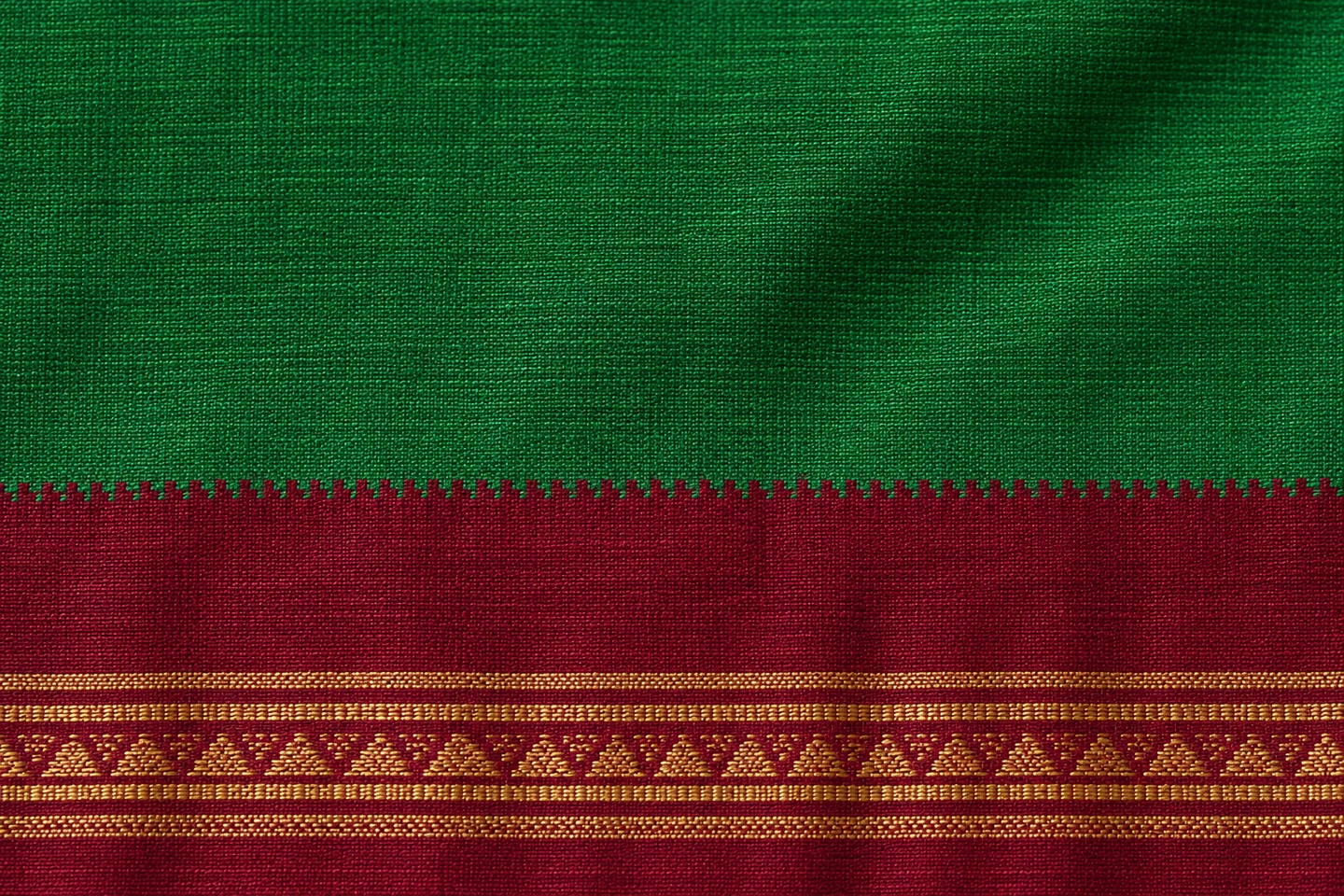
Illustrative contrasting border junction on silk
Visible details can prompt good questions; they do not independently establish technique or origin.

What only paperwork can prove

Silk Mark

A label issued through the Silk Mark Organisation of India (Central Silk Board) assuring pure natural silk; each carries a hologram and a unique number. It says nothing about handloom, zari or regional origin — and a missing label does not by itself mean a saree is synthetic.

Handloom Mark

Indicates a handwoven product. It is not a silk-purity label. Ask whether the label belongs to this piece.

India Handloom Brand

A government quality brand for registered handloom products meeting set standards. Registration can be checked.

GI

Protects a regional name. It does not authenticate an individual saree unless the seller is an authorised user and documents it.

Warning signs

  • A tag that is loose, photocopied or “kept in the office”.
  • Reluctance to open the saree fully or show the reverse.
  • “Everyone knows it’s real” offered in place of an answer.
  • Claims that will not be written on the invoice.

Further reading: Materials & Verification · See the Difference

A ₹12,000 saree and a ₹45,000 saree may both be called “Banarasi”. The name tells you almost nothing about the price; these six things tell you nearly everything.

  1. FibrePure mulberry, Tussar or Muga silk, a blend, or synthetic.
  2. LoomHandloom work takes days or weeks; powerloom takes hours.
  3. TechniqueKadwa, korvai, double ikat or jamdani inlay multiply the weaver’s time.
  4. ZariPure silver-gilt, copper-based tested, or imitation metallic yarn.
  5. Density & weightHow much of the cloth is patterned, and how heavy the silk is.
  6. Maker & provenanceA named master weaver, cooperative or documented origin adds value — and accountability.

Why a handloom saree can cost more — and when it shouldn’t

On a handloom, the weaver drives every movement by hand and foot. A plain handloom saree may take a few days; an elaborate brocade, a korvai border or a double ikat can take weeks or months, sometimes with two weavers at one loom. That time, and the skill to make decisions thread by thread, is what a fair handloom premium pays for.

It also keeps techniques alive — kadwa brocade, jamdani inlay, tapestry pallus, korvai joins — that are slow or impractical to mechanise, and it supports weaving families working at a small scale.

A powerloom is motor-driven: faster, more consistent and usually more economical. That is not a flaw. A well-designed, well-made powerloom saree in good fibre can be more beautiful, and better value, than a poorly woven handloom one.

So pay for the craft, not the word. A handloom premium should be supported by something you can check — a Handloom Mark, a cooperative or producer label, or a clear invoice line — and by workmanship you can see. Small irregularities alone are not reliable proof of handweaving.

The two-saree test

If you are torn between two sarees, write both on the same six lines above. If the dearer one cannot point to a difference on at least one line, you are paying for the showroom, not the saree.

SCENARIO A

₹12,000 vs ₹45,000

Two Banarasi-labelled sarees can be genuinely different products. Compare the declared composition and construction, not just the price gap.

SCENARIO B

Printed Patola?

A Patola-inspired print is not the same process as single or double ikat. Similar design vocabulary does not imply similar manufacturing work.

SCENARIO C

“Real gold zari”

A metallic appearance does not establish silver or gold content. Ask for the precise composition and supporting documentation.

These are hypothetical buying scenarios; none is an offer, quotation or authenticated specimen.

Further reading: Price & Value — worked examples and indicative ranges.

A seller who can answer these calmly is worth more than a pile of superlatives. Tick them off on your phone as you go.

Ten questions to ask the seller

Invoice essentials

  • Seller’s name, address and GSTIN; date and bill number.
  • The tradition name and the fibre (“pure mulberry silk”).
  • Making method: handloom or powerloom.
  • Zari type: pure, tested or imitation — as stated.
  • Any Silk Mark or handloom label number.
  • Price, taxes, and the return or exchange terms in writing.

Warning signs

  • “Last piece, today’s price only.”
  • A discount for skipping the bill.
  • Return terms that become vague once you mention them.
  • The description on the bill is shorter than the sales pitch.

If a claim matters to the price, it belongs on the invoice. If the seller will not write it, treat it as poetry.
Within the return window

  • Unfold it fully at home in daylight; check it against the invoice description.
  • Keep the bill, any Silk Mark label and the packaging until you are sure.
  • If something is not as described, contact the seller promptly and in writing.

Before the first wear

  • Have the fall and pico done if you want them; cut and stitch the blouse piece if one is included.
  • Ask the maker or seller how this fibre, dye and zari should be cleaned before the first wash or dry-clean.

For the long run

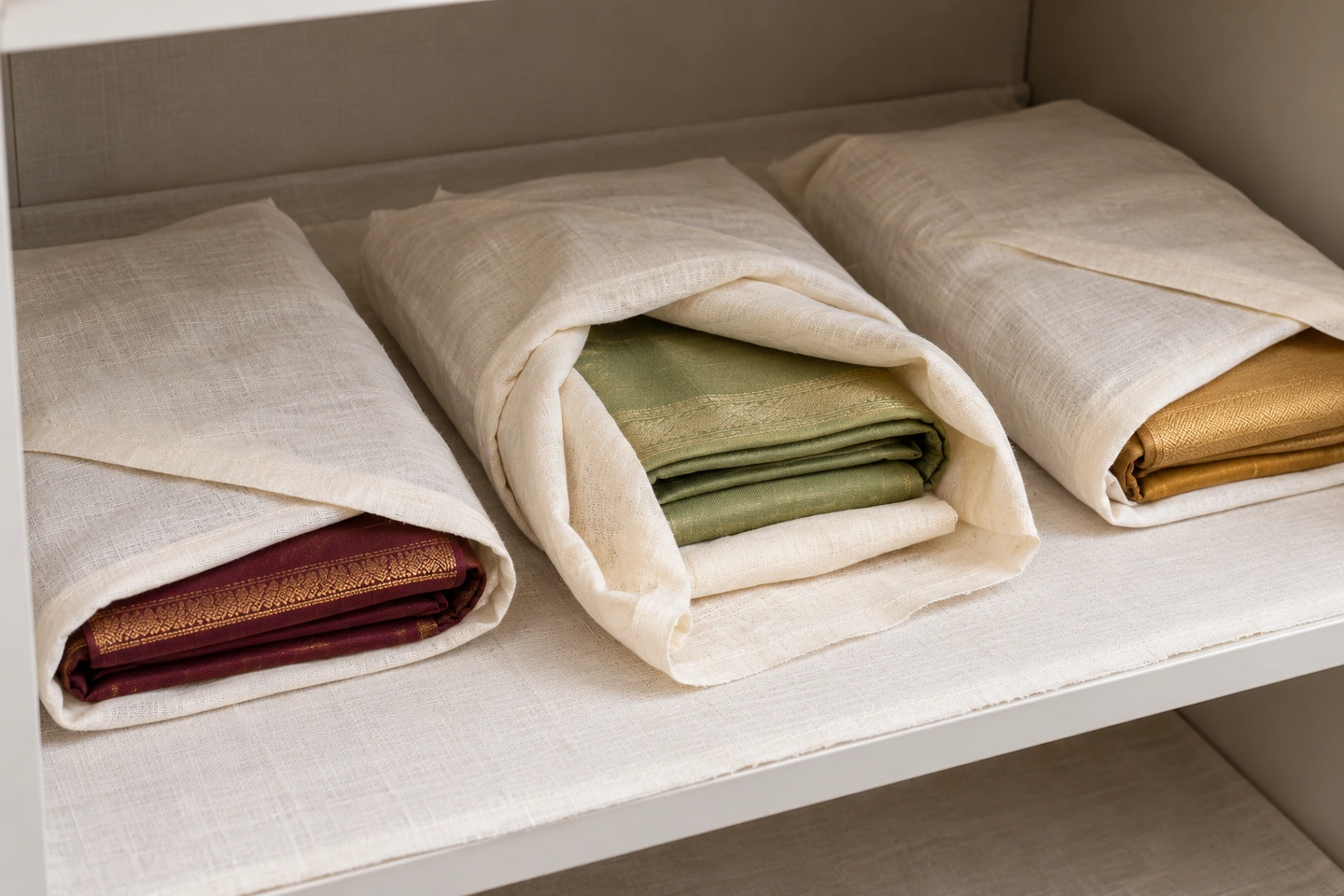
  • Store it clean and dry in breathable wrapping, away from damp — sealed plastic can trap moisture.
  • Check stored sarees from time to time and ease fold lines gently when the cloth is sound; there is no fixed refolding calendar, and fragile pieces need less handling, not more.
  • Keep out of direct sunlight; keep perfume and deodorant off the fabric.
  • For silk, zari, stains or heirlooms, a specialist cleaner or textile conservator can advise on the actual piece.
  • Avoid placing mothballs directly on silk or zari.
Loosely wrapped sarees on a muslin-lined shelf
Support, space and breathable muslin. Care depends on fibre, dyes and zari — follow advice for the actual saree.

Further reading: Saree Care — folding, storing and cleaning by fabric.

One last rule: a great saree should make you happy to wear it. The terminology is there to help you choose, not to spoil the pleasure.