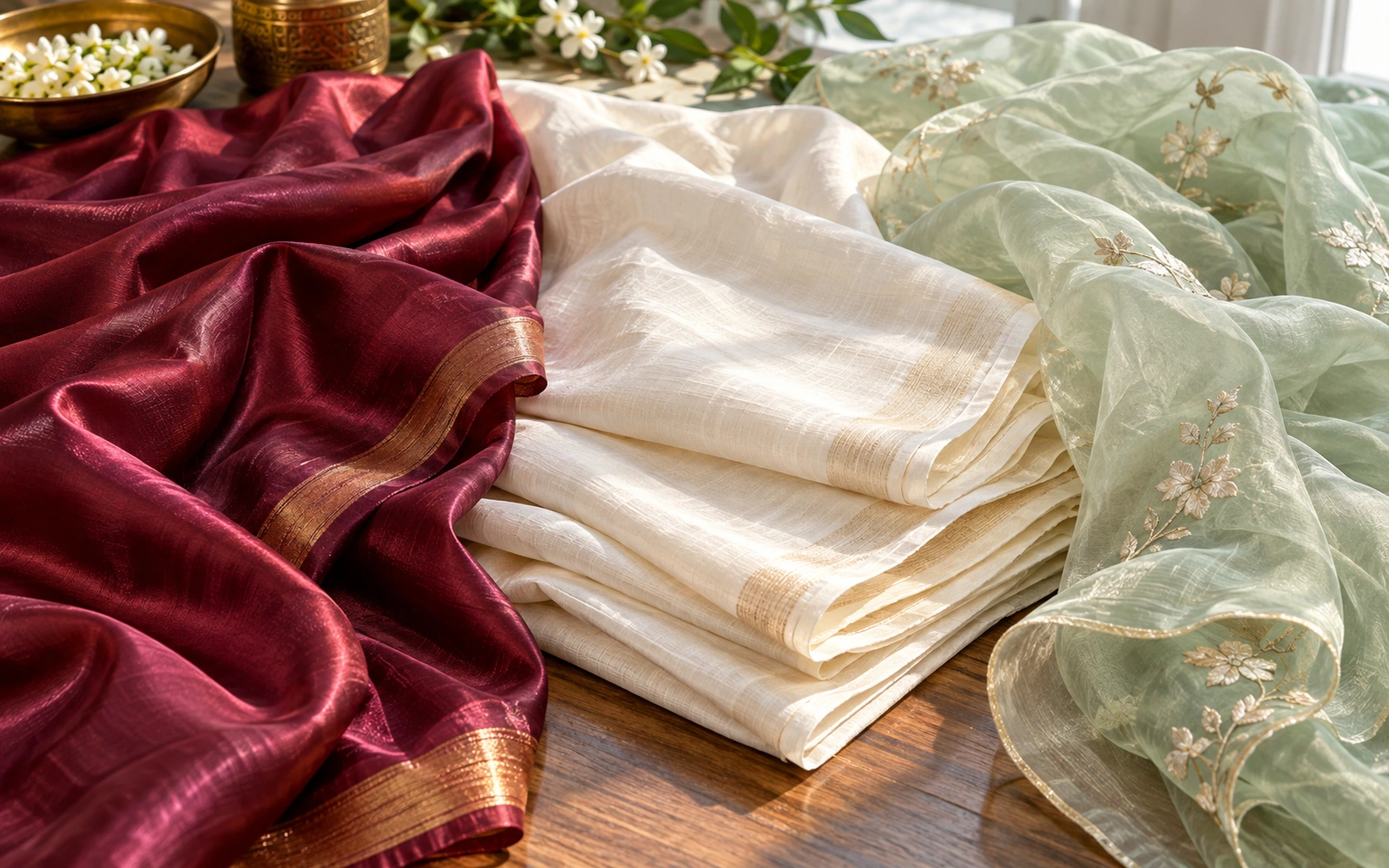
See how fibres, yarns and fabric construction change the feel and fall of a saree.
THE SAREE ATLAS · ILLUSTRATED REFERENCE
Fabrics and silk varieties
The fabric library: what the cloth looks and feels like
Fabric is best understood through three properties: what the surface looks like, how the cloth feels in the hand, and how it hangs when worn. A folded photograph captures only the first of these.
The illustrations in this chapter are drawn studies of each cloth’s character. They are not photographs of particular sarees, and no picture can confirm a fibre.
Soft: Pleasant and yielding to touch. Crisp: Feels slightly firm and keeps a fold or puffed shape. Fluid: Falls into loose, moving folds. Sheer: You can see through it to some degree. Lustrous: Reflects light attractively; it does not necessarily contain metallic threads.
Another useful word is slub: a thicker bit along a thread, creating small, visible uneven lines. That texture can be deliberate, especially in fabrics sold as dupion or raw-silk styles.
The hierarchy: two lists that must not be mixed up↗
Fibre families (ingredients): Mulberry silk, Tussar, Muga, Eri; cotton; linen; viscose and other regenerated fibres; polyester and other synthetics; blends.
Fabric kinds (the resulting cloth): Organza, chiffon, georgette, crepe, satin, brocade, voile, muslin and others.
For example, silk chiffon and polyester chiffon belong to different fibre families, but both are called chiffon because of the type of fabric. Similarly, silk satin and polyester satin both have a characteristic glossy surface, yet are made of different fibres.
Some useful names sit across categories. Katan is a yarn-related name that is also used for a type of silk saree. Khadi refers to hand-spun, handwoven cloth, not one particular fibre. Kota Doria identifies a cloth-making tradition with a recognizable small-check appearance, often made in cotton or cotton–silk.
This is the most common silk used in many well-known Indian silk sarees. It comes from silkworms that usually feed on mulberry leaves. When the silk is carefully reeled into long filaments, it can be exceptionally smooth and lustrous. That is why a polished silk saree often catches the light so evenly.
How it may look: Smooth, sometimes shiny, sometimes subdued; the finish and fabric construction change its appearance dramatically. How it may feel: Anything from soft and flowing to firm and substantial. Where you hear the name: Kanjivaram, Mysore silk, Banarasi and many other silk traditions.
Remember: “Mulberry silk” tells you the silk source, not whether the saree will be transparent, heavy or embroidered.
Tussar / Tasar — silk with a quieter, earthy character
Tussar / Tasar — silk with a quieter, earthy character↗
Tussar is a family of silks produced by certain non-mulberry silkworms. Many Tussar fabrics have a slightly uneven surface and a softer, less mirror-like shine than polished mulberry silk. Natural beige, honey and brownish tones are associated with it, though Tussar is also dyed in strong colours.
How it often feels: Slightly textured or crisp, sometimes rather light. Where you see it: Tussar sarees, including many sold through Bhagalpur and eastern Indian silk markets. Easy misconception: Not every beige, rough-looking saree is Tussar; and not every Tussar saree is rough or beige.
Muga is strongly associated with Assam. Its natural warm golden colour is one of its best-known features. The colour is within the silk itself; it is not the same as weaving gold-coloured zari over an ordinary cloth.
Look and feel: A characteristic golden glow, often with a firm but elegant feel, depending on the finished fabric. It is frequently used in special-occasion Assamese textiles. Remember: A golden-looking saree is not necessarily Muga; other silks can be dyed gold or decorated to look similar.
Eri is another non-mulberry silk strongly associated with northeastern India. It is often spun into yarn rather than used as one very long, smooth filament. That commonly gives Eri cloth a softer, warmer, less glossy appearance than the polished silk people usually imagine.
Look and feel: Often matte to softly lustrous, comfortable and sometimes almost cotton-like in surface character. Some Eri textiles feel substantial; others are light. Remember: Eri is a natural silk fibre, not an embroidered style or a weave.
Katan — a silk-yarn name, not a new species of silk
Katan — a silk-yarn name, not a new species of silk↗
Imagine the raw material is mulberry silk. Silk filaments can be combined and twisted into stronger yarn. Katan is a traditional name associated with twisted silk yarn and, by extension, sarees woven from it, especially in the Banarasi trade.
Appearance: A relatively smooth, closely woven silk surface that can carry sharply defined woven decoration. It often has enough body to look rich without needing to be stiff like organza. Important distinction: Katan does not mean a separate type of silkworm or a fixed saree weight. A plain Katan and a densely brocaded Katan can look very different.
Kora — a name often used for airy, sheer silk cloth
Kora — a name often used for airy, sheer silk cloth↗
Kora literally means untreated, undyed silk. In Banarasi silk terminology, Kora generally refers to a light, relatively crisp, sheer silk ground, commonly discussed alongside silk organza. The word can be used more loosely elsewhere. It is not a separate silk species, a guarantee of pure silk, or evidence that the cloth is handwoven: confirm fibre composition and construction with the seller.
What it often looks like: an airy, translucent ground that holds a little shape and shows decorative zari or coloured motifs clearly. Compared with Katan, Kora is usually more see-through and crisp, while Katan is typically denser and more opaque. Synthetic organza may achieve a similar appearance without sharing its fibre content.
Organza is the fabric you notice when a saree makes a slightly puffed, architectural shape instead of collapsing into soft folds. It is thin, sheer and crisp. There are silk organzas and synthetic organzas.
Look: See-through, sometimes lightly shiny. Feel: Firm for its light weight; some versions have a faint dry or papery touch. Typical use: Dressy printed, embroidered and lightly decorated sarees where the airiness is part of the appeal. Compared with chiffon: Organza stands away from the body; chiffon tends to fall softly against it.
In Indian saree shops, tissue usually describes a fabric with a noticeable metallic-like glow. It may involve zari or other shiny threads woven throughout the cloth; composition and exact construction vary. The shimmer can be delicate and luminous or strongly metallic.
Look: A surface that glints as it moves, sometimes appearing gold, silver, rose-gold or another metallic shade. Feel: Can be crisp and airy or more fluid depending on the construction. Compared with organza: Organza is defined more by its sheer crispness; tissue by its all-over shimmer. One fabric can display both qualities. Do not assume: “Tissue” means actual precious metal.
Chiffon is very light and sheer, but unlike organza it usually drapes in loose, flowing folds. It can be made from silk or manufactured fibres. In a good chiffon saree, the cloth seems to move easily when the wearer walks.
Look: Delicate, translucent and soft-edged. Feel: Light, sometimes faintly grainy depending on yarn and finish. Typical use: Sarees with a relaxed, flowing drape; printed and embroidered styles. Compared with georgette: Chiffon is often smoother and lighter; georgette is commonly slightly heavier and grainier.
Georgette — flowing, with a lightly grainy surface
Georgette — flowing, with a lightly grainy surface↗
Georgette looks fluid like chiffon but usually has a slightly pebbled texture that you can see or feel when looking closely. Its twisted yarns help produce that characteristic surface. It may be made of silk or synthetic fibres.
Look: Softly flowing, with a subdued rather than mirror-like shine. Feel: Lightly grainy, often with a little more body than chiffon. Typical use: Printed, embroidered and occasion sarees; useful when a soft drape is wanted without an entirely smooth surface.
Crepe — the family of crinkled and pebbly fabrics
Crepe — the family of crinkled and pebbly fabrics↗
Crepe is a broad family name rather than one exact fabric. What links many crepes is a crinkled, rippled or finely pebbled surface, produced through yarn twist, construction or finishing. Some are light and flowing; others are comparatively weighty.
Look: Fine surface irregularity that breaks up the shine. Feel: May be dry, springy, fluid or textured depending on the particular crepe. Compared with georgette: Georgette is one familiar crepe-like fabric; the word crepe covers a much wider range. If a seller just says “crepe”, the next useful question is whether it is silk, viscose or polyester crepe.
Satin — a glossy surface, not a guarantee of silk
Satin — a glossy surface, not a guarantee of silk↗
Satin describes a way of making cloth that leaves long lengths of thread visible on the surface. This makes one side unusually smooth and shiny. Silk satin can feel wonderfully fluid; polyester satin can also look glossy.
Look: A clean, almost liquid-looking shine. Feel: Usually slippery and smooth, though weight varies. Typical use: Evening sarees and contemporary formal designs. Main distinction: Silk is a fibre; satin is a fabric construction. A glossy satin saree is not necessarily silk.
Brocade is richly patterned cloth where decorative shapes are formed as the fabric is woven, rather than added afterwards as an ordinary surface print. Many Indian silk brocades use extra coloured or metallic-looking threads for flowers, leaves and geometric forms.
Look: Designs can appear raised, richly reflective or strongly textured against the background. Feel: Ranges from relatively light to heavy depending on how much decorative yarn is present. Common misconception: Brocade does not mean a particular silk fibre, and every brocade is not necessarily gold or heavy.
Dupion / Dupioni — silk with visible uneven lines
Dupion / Dupioni — silk with visible uneven lines↗
Dupion silk often has little thick-and-thin variations in its threads. In a finished saree these create faint horizontal or vertical lines that catch the light unevenly. The result feels more textured and less polished than a very smooth silk satin.
Look: Small slubs and subtle irregular streaks. Feel: Often a little crisp or firm; weight varies. Typical use: Structured silk sarees and dressy contemporary designs. Remember: Visible slubs are a feature of many genuine fabrics, but slubs alone do not prove handloom manufacture or silk purity.
Matka is usually a textured silk fabric made with spun silk yarn, commonly from shorter silk fibres or processing leftovers. The thread is not always as smooth and continuous as reeled silk filament, so the cloth can have a slightly rustic surface.
Look: Uneven, softly nubby texture; sometimes matte. Feel: Often firmer and more substantial than chiffon, with a natural-looking surface. Compared with dupion: Both may show unevenness, but Matka often has an overall spun-yarn texture rather than isolated slubs in otherwise smooth yarn.
Raw silk — a useful description, but a loose shop label
Raw silk — a useful description, but a loose shop label↗
In strict silk processing, raw silk can mean reeled silk that still contains its natural gum. In retail saree language, however, “raw silk” is often used more loosely for cloth with a natural, matte, slightly coarse or uneven-looking surface. The exact meaning varies.
Look: Often textured and less polished. Feel: May be crisp, dry or substantial. Do not confuse: “Raw silk” in a showroom does not necessarily identify a separate silk species or a standardized fabric. If the feel matters, compare actual swatches; if composition matters, check the declared fibre content.
The following names regularly appear on saree labels. They do not all describe different kinds of silk. A mulberry silkworm produces a natural fibre; a spinner turns fibres into yarn; a weaver makes chiffon, satin or other fabric from yarn. Many of the names below describe those later stages rather than a new fibre.
Shop name
What the name primarily describes
What it usually looks or feels like
Important distinction
Mulberry silk
Natural silk fibre
Smooth, lustrous in fine yarns
Many other silk fabrics use mulberry silk
Tussar / Tasar silk
Natural silk family
Often textured, earthy, less glassy shine
A fibre, not a prescribed weave
Muga silk
Natural silk family
Distinctive natural yellow-gold
Genuine Muga differs from simply gold-dyed silk
Eri silk
Natural silk family
Often matte, warm and softly textured
Can be spun into different fabric types
Raw silk
Processing or retail description
Often a slightly uneven surface
Not a separate silkworm species; sellers use loosely
Dupion / Dupioni
Silk yarn and fabric construction
Visible thick-and-thin lines or slubs
Can be luxurious despite an irregular surface
Organza silk
Sheer fabric made from silk
Crisp, translucent, holds shape
Organza can also be polyester
Chiffon silk
Sheer fabric made from silk
Thin, soft, floating drape
Not the same as stiff organza
Satin silk
Satin-weave fabric made from silk
Smooth, shiny face
Satin may equally be synthetic
Charmeuse silk
Lightweight satin-faced silk fabric
Very glossy front, less shiny back; flowing
Charmeuse is a kind of fabric, not a silk fibre
Mango silk
Ambiguous retail/marketing name
Depends on the product
No established independent natural silk family by this name
Matka silk
Spun-silk yarn / textured fabric
Softly uneven, matte or muted shine
Texture varies by yarn and finishing
Ghicha / Gicha silk
Coarse or irregular silk yarn and fabrics
Pronounced uneven texture
Often associated with Tussar production
Noil silk
Silk made from shorter fibres
Soft, nubbly, comparatively matte
Still natural silk when the fibre content is silk
Katan silk
Twisted-filament yarn and resulting trade fabric
Often smooth and relatively substantial
Not another silkworm species
Kora silk
Retail cloth description, often sheer silk
Airy, translucent, often crisp
Often overlaps with silk organza
Georgette silk
Fabric made with highly twisted silk yarn
Flowing with a gently grainy surface
Polyester georgette also exists
Crepe silk
A fabric family
Fine pebbled/crinkled surface; variable drape
Many crepe constructions exist
Khaddi crepe silk
Regional/trade fabric name
Often textured, light, supple
“Khaddi” does not itself certify a fibre or handloom status
Tissue silk
Fabric effect, often metallic-looking
Shimmering, reflective, sometimes crisp
Metallic-looking does not automatically mean real silver zari
Mashru silk
Traditional mixed-fibre/fabric category
Smooth silk-rich face in many examples
Often silk/cotton; do not assume pure silk
Sico silk / Sico saree
Retail abbreviation of silk-cotton
Character depends on blend and construction
A blend; not 100% silk
Art silk
Silk-look manufactured fibre or fabric
Variable, often shiny
Usually not natural silk
Illustrated studies
Nine names that need a closer look
The table above is the quick reference. The studies that follow take the names most often misunderstood at the counter — Charmeuse, Ghicha, Noil, Mashru, Sico, Khaddi crepe, Mango silk and Raw silk, with Matka, Dupion and Ghicha compared — and explain what each word actually describes, what the cloth is usually like and what to ask before you pay for the name.
Charmeuse: why it is not simply another name for satin
Charmeuse: why it is not simply another name for satin↗
Charmeuse is a lightweight satin-weave fabric with a highly reflective face and a noticeably duller back. When made with fine silk it falls in long, liquid-looking folds and feels sleek against the skin. Satin is the broader construction; charmeuse describes a characteristic lightweight version of it. Neither name, used alone, proves natural silk content. For recognition, compare the front and reverse under light and let the fabric fall over the hand: a typical charmeuse flows readily instead of puffing out like organza.
Ghicha (also spelled Gicha or Gheecha) commonly refers to yarn made from silk filaments that cannot be reeled as a long, even continuous strand, often in the Tussar silk context. The resulting cloth may have visible thick-and-thin sections, knots and an earthy surface. This is not necessarily a defect: irregularity is often the main aesthetic attraction. Ghicha is therefore closer to a yarn description than to a fifth natural silk species. It can appear alongside Tussar, Eri and other silk terms in compound fabric names.
When silk is processed, some fibres are too short to be reeled as long, continuous filament yarn. They can be spun into noil yarn. Noil silk fabric often resembles a fine, nubby linen or cotton with a soft touch and understated shine. It is useful for everyday sarees that are less glossy than fine filament silk. A noil saree may still be made of natural silk; the name tells you about the kind of yarn, not its purity by itself.
Left to right: dusty-rose Matka, antique-gold Dupion and sage Ghicha — texture studies, not fibre analysis.
All three can look textured, but in different ways. Dupion often shows individual horizontal slub lines interrupting an otherwise smoother surface. Matka tends to have a more continuous, spun-yarn grain, sometimes reminiscent of handwoven linen. Ghicha can show stronger irregularities and thicker yarn effects. These are tendencies, not foolproof tests; finishing, blend and weaving technique alter the result.
Mashru: silk appearance with a different construction
Mashru: silk appearance with a different construction↗
Traditional Mashru fabrics are often distinguished by a glossy silk-rich face and a cotton side, made by combining different yarns in a particular fabric structure. The word is associated with historic traditions in Gujarat and elsewhere. A shop may sell a contemporary all-silk or artificial-fibre variation under the same name. Ask for the exact fibre content rather than assuming Mashru means pure silk.
Sico is a trade shorthand for silk–cotton. Some sarees use silk lengthwise and cotton crosswise; others blend the materials differently. Depending on proportions and construction, a Sico saree may have silk's slight sheen with cotton's more grounded, breathable feel. The name alone cannot tell you the percentages.
Crepe describes a finely crinkled or pebbled fabric effect produced through its yarn and construction. Khaddi or Khadi in saree retail may point to a handloom-associated version, especially in Banarasi crepe/georgette descriptions. It is not a recognized separate silk-fibre category, and the commercial expression is not used with uniform precision. A typical Khaddi crepe silk saree has some grain under the fingers and a supple, flowing drape. Ask whether it is natural silk, whether it is handwoven and which fabric construction is actually being described. Those are three different facts.
Mango silk: do not confuse a product name with a fibre
Mango silk: do not confuse a product name with a fibre↗
The phrase Mango silk occurs on some Indian retail websites, but it is not an established fifth major silkworm silk alongside mulberry, Tussar, Muga and Eri. It may be used to suggest a soft, textured or lustrous finish, and sellers do not consistently define it. The term may also be confused with Raw Mango, which is a fashion label, or a mango/paisley motif, which refers to the design rather than the cloth. A trustworthy listing should specify the actual fibre content and fabric construction. If all it says is 'Mango silk', the composition remains unverified.
In silk processing, raw silk has a technical meaning relating to silk before degumming. In shops, however, raw-silk look often means a textured surface with visible irregularities, including on blended or synthetic fabrics. Ask whether the saree is 100% natural silk, and if so which silk and which yarn. The visible texture alone cannot establish the answer.
Habutai (Habotai) is a relatively light, smooth plain-weave silk often used as a base for printing. Crepe de Chine is a soft, finely textured crepe; crepe-back satin has a glossy satin face and a more crepe-like reverse. Chinakari/China silk is a variable retail expression rather than a reliable silk classification. Bangalore silk and Mysore silk usually point to place or trade traditions, not different silkworms. Pattu is a South Indian word for silk, used in names such as Pattu saree; it should not be treated as a fibre species.
NATURAL SILK FIBRES
  Mulberry | Tussar | Muga | Eri
      ↓
THREAD / YARN FORMS
  Reeled filament | twisted Katan | spun Matka | noil | irregular Ghicha
      ↓
FABRIC TYPES, IF MADE FROM SILK
  Organza | chiffon | georgette | crepe | satin | charmeuse | tissue
      ↓
REGIONAL SAREE IDENTITIES
  Banarasi | Kanjivaram | Paithani | Mysore silk | Chanderi | ...
The layers overlap. A Banarasi saree might be silk organza; a Mysore silk saree might have a crepe-like finish; a tissue saree may be made with silk and metallic yarn. These are descriptions of different aspects of a product, not rival entries on one ladder.
Cotton is a natural plant fibre. Fine cotton yarn can make soft, airy, almost transparent cloth; thicker yarn can make firm, opaque everyday sarees. Cotton often absorbs moisture well and can be comfortable in warm weather, but different finishes and constructions change its behaviour considerably.
Look: Can be matte, smooth, slightly textured, printed, checked or brightly coloured. Feel: Often breathable and less slippery than satin-like silk fabrics. Remember: Calling a saree “cotton” does not tell you whether it is mulmul, voile, Kota Doria or a heavier handloom fabric.
Mulmul usually refers to a very light, soft cotton cloth. When you gather it in your hand, it compresses easily and does not feel rigid. It is especially associated with comfort and effortless drape.
Look: Light, often slightly translucent, with gentle folds rather than a sharp silhouette. Feel: Soft and airy. Compared with voile: Both are lightweight, but voile may feel a little crisper or more structured, depending on the finish.
Muslin — a historic name for very fine cotton cloth
Muslin — a historic name for very fine cotton cloth↗
Historically, fine muslins were celebrated for extraordinarily delicate cotton yarn and a barely-there feel. Modern sellers use the word muslin for a wider range of lightweight cotton fabrics, not all of which match those historic examples.
Look and feel: Fine, light, often soft and translucent. Compared with mulmul: Retail use overlaps considerably; they are not always two reliably separate fabric types. Instead of relying on the name, look at softness, thickness and transparency.
Voile is a lightweight, usually plain-woven cloth commonly made with fine cotton yarn or blends. It can look smooth and slightly crisp while remaining airy.
Look: Fine, even surface; often semi-sheer. Feel: Airy, sometimes a little firmer than mulmul. Where encountered: Light printed sarees and fine cotton drapes. Remember: “Voile” is a fabric name; the fibre should still be stated.
Khadi — how the cloth is made, not which plant it comes from
Khadi — how the cloth is made, not which plant it comes from↗
Khadi is cloth made from hand-spun yarn and woven by hand; it can be cotton, silk, wool or combinations. Many people think “khadi” necessarily means thick, rough cotton, but fine and soft khadi fabrics also exist.
Look: Can show gentle texture and a less uniform surface, though examples vary. Feel: Depends strongly on the fibre and yarn. Most useful distinction: Cotton is a fibre; khadi describes a production tradition. A cotton saree need not be khadi, and khadi need not be cotton.
Kota Doria is associated with Kota and nearby weaving centres in Rajasthan. Its most recognisable feature is a very fine, regularly checked structure called khat. From a distance, many examples look plain and exceptionally light. Up close you can see the tiny squares.
Look: Sheer and delicately checked. Feel: Very lightweight, airy, sometimes lightly crisp. Materials: Commonly cotton or cotton–silk constructions, among other commercial versions. Compared with organza: Both can be airy and transparent, but Kota Doria's tiny square structure is the giveaway.
Linen — the cool-looking, naturally creasing cloth
Linen — the cool-looking, naturally creasing cloth↗
Linen comes from the flax plant. It tends to have a dry, fresh feel and a more visible texture than highly polished silk. It also develops recognizable creases, which many people consider part of its relaxed elegance.
Look: Often matte to softly lustrous, with a natural-looking surface. Feel: Cool, slightly firm initially; it can soften through use. Typical use: Daytime and understated formal sarees. Compared with cotton: Linen often creases more sharply and has a distinctive dry, lightly textured touch.
A silk–cotton saree uses both fibres. One common arrangement is silk running along the length and cotton across it, but many other combinations exist. This can combine silk's lustre with cotton's comfortable feel.
Look: Often a gentle shine rather than the pronounced gloss of a polished all-silk fabric. Feel: Depends on the proportions, yarn thickness and weave. Where encountered: Many Chanderi, Maheshwari, Gadwal and other traditions. Important: Two “silk–cotton” sarees can feel completely different; the term alone does not guarantee a certain silk percentage.
Viscose / rayon — made from cellulose, not natural silk
Viscose / rayon — made from cellulose, not natural silk↗
Viscose is made by processing cellulose—usually from wood pulp—into new fibres. It is sometimes called rayon, although rayon is a broader family of terms. It can produce fabric with a very soft, flowing drape and a pleasing sheen.
Look: Smooth, often fluid and lustrous. Feel: Soft and absorbent, though different finishes vary. Why it confuses shoppers: A shiny viscose saree can resemble silk in a photograph. That resemblance does not make it silk.
Modal and lyocell — other cellulose-based manufactured fibres
Modal and lyocell — other cellulose-based manufactured fibres↗
Both start with cellulose but use different manufacturing processes from ordinary viscose. They are widely associated with smooth, soft, drapable fabrics, although saree construction and blends matter more than the fibre name alone.
Look: Often gentle, fluid folds. Feel: Soft and comfortable in many constructions. Remember: Modal and lyocell are not cotton, not linen and not natural silk; they are regenerated cellulose fibres.
Polyester — a synthetic fibre, not a fabric style
Polyester — a synthetic fibre, not a fabric style↗
Polyester can be made into organza, satin, georgette, chiffon and many other kinds of cloth. That is why describing a saree simply as “polyester” tells you much less about its appearance than the fabric construction does.
Look and feel: Extremely variable—from airy transparent cloth to shiny satin or textured crepe. Practical note: Many polyester textiles are comparatively easy-care; comfort in heat varies with construction and finish.
Art silk means artificial silk: a commercial name for silk-like material made from manufactured fibres. It is often viscose or polyester, sometimes blended. It does not mean pure natural silk.
Look: May mimic the shine and fall of silk quite effectively. Feel: Depends on its real composition. Useful translation: When a label says “art silk Kanjivaram-style,” you are being told about a silk-like material and a design influence, not necessarily a pure-silk Kanjivaram.
There is a meaningful difference between what a fabric is made from, how it looks, and how much workmanship went into it. But there is no trustworthy ladder in which every silk saree is better than every cotton saree or every organza is more luxurious than every georgette.
Here is a practical way of thinking about price and quality without misleading yourself:
Question
What matters
What it does not settle
Is it natural silk?
Whether the fibres are actually silk
Whether it is handloom, expensive, or comfortable in heat
What kind of silk?
Mulberry, Tussar, Muga, Eri and their usual characteristics
Whether one is universally superior to the others
What fabric is it?
Whether it is crisp, sheer, flowing, glossy or textured
Whether it contains silk unless composition is stated
What work does it carry?
Printed design, elaborate weaving, embroidery, etc.
Whether it automatically looks good on the wearer
Is it well made?
Consistency, finish, material quality, workmanship
Whether a famous region or luxury label guarantees it
Example: A simple pure-silk organza saree may be light, transparent and comparatively inexpensive to decorate. A complex cotton Jamdani may involve far more painstaking work. A polyester satin saree may look glossy but use no natural silk. These three can all be attractive, yet their prices and value come from different things.
In a showroom, separate material value, craftsmanship, and your own preference for the look. Those are three useful judgments, not one prestige ranking.