Learn to notice woven patterns, borders, pallus and the decorative details that make each textile distinctive.
THE SAREE ATLAS · ILLUSTRATED REFERENCE
Patterns, motifs and ornament
Patterns, motifs, borders and decorative work
You do not need to learn how a loom operates to understand saree patterns. Start by asking three simple questions: What shape do I see? Where is it placed? How was it put on the cloth? A paisley might be woven, printed or embroidered; its paisley shape remains recognisable even though the method changes.
A motif is one design, such as a small flower. The pattern is what happens when that flower is repeated: evenly scattered across the body, arranged in rows, linked by vines or crowded into an all-over design. The same flower can therefore make several very different-looking sarees.
Imagine three sarees:
The first has a tiny gold flower every few inches. These are scattered butis. Most of the silk background remains visible.
The second has large flowers linked by curling vines. That is a connected floral pattern, often described using words such as bel or jaal.
The third is covered almost completely in dense leaves and blossoms. It may be described as an all-over floral design or, in some silk traditions, Jangla.
The words below are grouped by what your eye notices, not by obscure manufacturing categories.
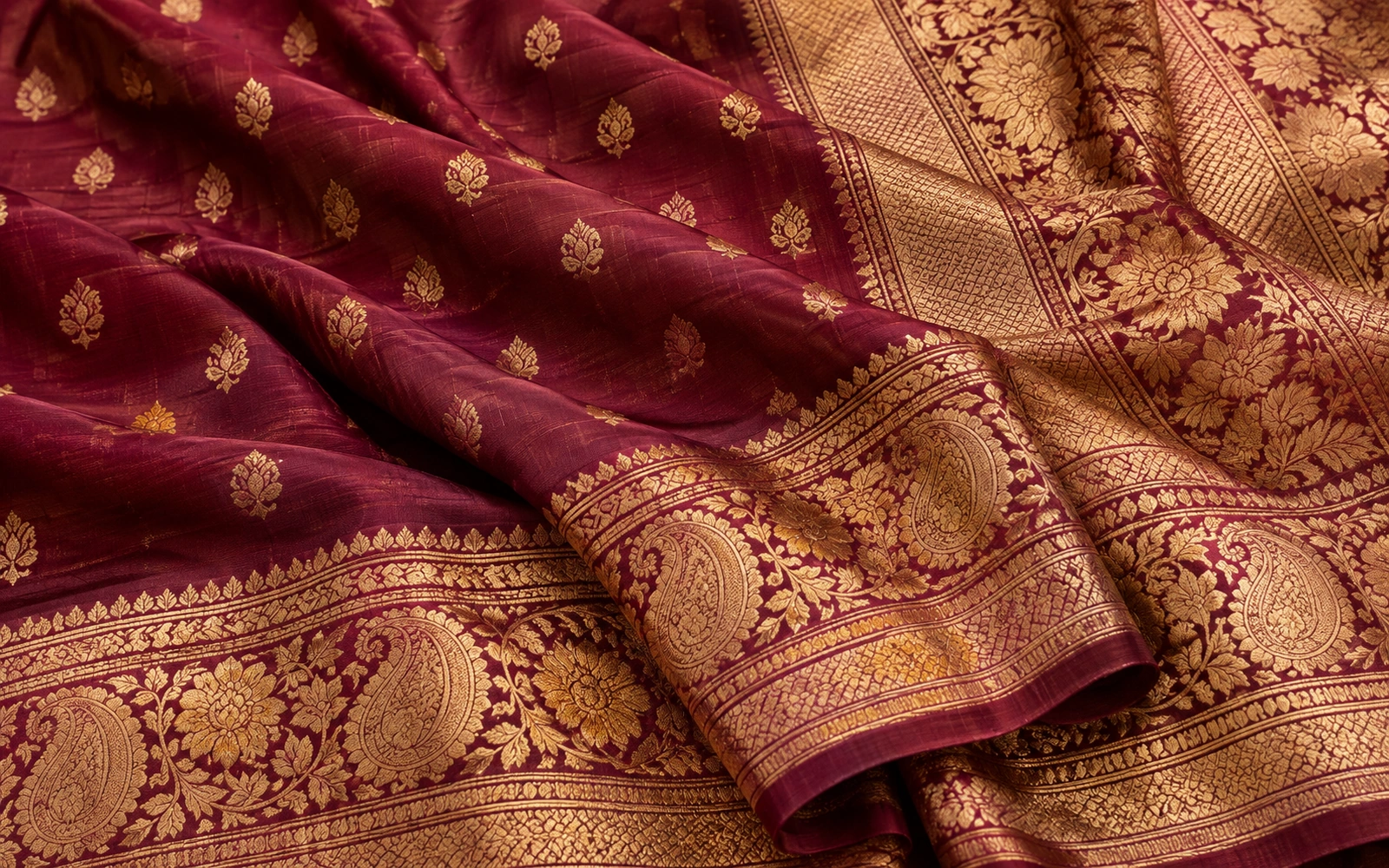
A buti is a small motif, often a flower, leaf, star or paisley, repeated across the body of the saree. Think of neat little decorations separated by stretches of plain fabric. If a salesperson says “gold butis on a green body”, picture small gold-coloured shapes scattered over green cloth.
Compared with a buta: Butis are usually smaller. A saree with very widely spaced butis may look restrained; closely packed butis create a busier, richer-looking surface.
A buta is generally a larger individual decorative design: perhaps a big flower, a bouquet or a broad paisley. It becomes a feature you notice from across the room, rather than a tiny repeating speck.
A saree can have large butas in its pallu and small butis in the body. The terms refer mainly to size and form, not whether they are made from silk, zari or embroidery.
Paisley is the familiar curved teardrop shape, with a wider rounded end and a pointed tip that often curls. Indian names include kairi and ambi, relating to the mango shape. It may be plain inside or filled with little flowers and lines.
Paisleys appear in Kashmiri-inspired patterns, brocades, printed cottons and many other traditions. A paisley print alone does not make a saree Kashmiri.
The lotus is usually shown as an open flower with pointed petals, or as a simplified bud. In some sarees the petal outline is obvious; in others the shape becomes quite geometric. Lotus motifs may repeat in borders, appear as individual body designs, or form a large pallu feature.
Unlike the generic word floral, lotus names a particular flower. Do not assume every pointed-petal design has to be a lotus.
Peacock / Mor — the long-necked bird with a showy tail
Peacock / Mor — the long-necked bird with a showy tail↗
The peacock is one of the most recognisable Indian saree motifs. It may appear as a complete bird, as two facing birds, or mainly as a sweeping feathered tail. It is particularly familiar in decorative pallus, including Paithani, but appears across regions.
Two peacocks facing each other may look ceremonial; a scattering of tiny peacocks has a lighter feel.
Munia is used for small parrot-like birds in some textile traditions, notably Paithani design vocabulary. These are often depicted as rows of short, pointed-beaked birds on the border or pallu. The birds may be stylised rather than realistic.
Do not confuse munia with Meenakari: one is a bird motif, the other is a term used for coloured detailing in certain designs.
Elephants commonly look stately or ceremonial; horses may appear alone or within scenes; deer and other animals often belong to narrative patterns. Animals need not be literal portraits—many are reduced to simple shapes by the design method.
What matters is whether you see one repeated animal or an entire illustrated scene. The latter is discussed under Shikargah and narrative pallus.
A bel is a creeping or curling vine, often carrying flowers or leaves. Instead of separate flowers floating across the cloth, the designs are connected by winding stems. Bel patterns are especially common in borders, where they can run continuously from one end of the saree to the other.
Patti means leaf. Bel-patti usually suggests a leafy vine or scrolling leaf design. It is especially easy to recognise when a border consists of small connected leaves with only occasional flowers.
Bel versus bel-patti: They overlap in everyday speech. A seller may use either for a leafy creeper, so the appearance matters more than a rigid definition.
Jaal literally suggests a net. On a saree, think of flowers, vines or geometric shapes joined across the body, making a repeating network rather than separate floating motifs. The network may leave generous open spaces or cover most of the cloth.
Not all jaals are floral. A lattice of connected diamonds can also have a net-like effect.
Jangla is commonly used for rich, extensive patterns of flowers and winding plants, especially in Banarasi design language. The impression is closer to an interwoven garden or jungle than to neat little separate floral motifs.
Jaal versus Jangla: Both can be connected and all-over. Jaal is the broad idea of a network; Jangla commonly evokes more elaborate, natural-looking vegetation and curling vines. Shops may not draw exactly the same boundary.
All-over / jaal-dar body — very little plain ground
All-over / jaal-dar body — very little plain ground↗
All-over is ordinary descriptive language: a pattern covers almost the entire body. It could be flowers, checks, small butis, abstract shapes or dense brocade. The opposite is a more open design where much of the plain background shows.
A heavily patterned saree is not automatically heavier in weight; a printed all-over design may remain extremely light.
Checks are made by horizontal and vertical lines crossing each other. They may be tiny, broad, balanced or irregular. In some traditions the square structure is itself part of the cloth; in others the checks come from coloured yarns or printed lines.
Kota Doria's khat is a very fine square structure; a bold checked silk saree has a very different appearance. Both can accurately be called checks.
Stripes may run the length of the saree or across it, and they can be narrow, broad, coloured or metallic-looking. A striped body can look modern and minimal; striped pallus are a traditional feature of several regional styles.
Ask yourself whether the stripes are on the whole body, just the border or just the pallu; that often tells you more than the word striped alone.
A chevron repeats pointed V-shapes, often connecting into a zigzag band. It may be sharp and geometric or softened by dyed yarn effects. Zigzag borders can look quite different from straight stripes even when the same colours are used.
A diamond is a square turned onto one corner or an elongated four-sided figure. Repeated diamonds are common in geometric sarees and Ikat designs, but they can equally be woven directly or printed.
Important: A diamond pattern is a shape, not proof that the saree is Ikat or Patola.
A temple border commonly has repeated triangular or stepped shapes along the edge, inspired by temple towers or architectural outlines. Imagine a neat row of small peaks separating the body from the border.
They may be large and dramatic or tiny and understated. These borders are associated with several South Indian traditions, not one exclusive saree variety.
Konia refers to an ornamental element placed at a corner, especially where a border meets the pallu. It might be a paisley, flower or another large motif. Think of it as a location, not a particular floral shape.
Kalga — an ornamental plume or curved botanical design
Kalga — an ornamental plume or curved botanical design↗
Kalga is used for a stylised decorative form that can resemble a curling leaf, plume or elaborated paisley. Its exact appearance varies by design tradition. Rather than treating it as just another name for every paisley, look for the more elaborate, plume-like outline.
Ganga–Jamuna border — different colours on opposite edges
Ganga–Jamuna border — different colours on opposite edges↗
A Ganga–Jamuna saree has the two long borders in different colours, or sometimes different treatments, instead of matching each other. In the illustration, one edge carries a rani-pink border and the other a royal-blue one, both worked in gold around a cream body with small butis.
No particular pair of colours defines the style. Red with green, pink with blue or maroon with mustard can all be Ganga–Jamuna; what matters is that the two edges deliberately differ.
The name describes the two-edge arrangement. It does not tell you the fibre or region by itself.
Contrast border — a border in a noticeably different colour
Contrast border — a border in a noticeably different colour↗
A contrast border is easy to spot: a blue body with a bright pink border, for example. It can be narrow or broad, simple or decorated. Some traditions are famous for strong body-border contrasts, but many contemporary designs use them too.
Different from Ganga–Jamuna: With an ordinary contrast border, the two edges may match each other; with Ganga–Jamuna, they differ.
Shikargah describes designs depicting a hunt or related scenes, often with animals, riders, birds and trees arranged together. Instead of noticing a single repeated peacock, you may see several creatures interacting in a pictorial composition.
Shikargah is often discussed in richly figured silk brocades. It is a subject of design, not a new type of silk.
Narrative pallu — images arranged like story panels
Narrative pallu — images arranged like story panels↗
A narrative pallu carries scenes rather than only decorative shapes. These may show people, architecture or episodes from stories and mythology. Baluchari sarees are particularly known for such designs, often arranged in framed rows or panels.
Shankha means conch shell; Chakra means wheel or disc. These are traditional symbolic motifs, found particularly in some eastern Indian decorative vocabularies. A stylised conch can resemble a spiral or tapering shell; a chakra often has a rounded spoke-like or circular form.
These words name the design shape or symbol, not its fabric.
Woven: The design is made from threads as the fabric is produced. The pattern may be visible on both sides, although the reverse can look different.
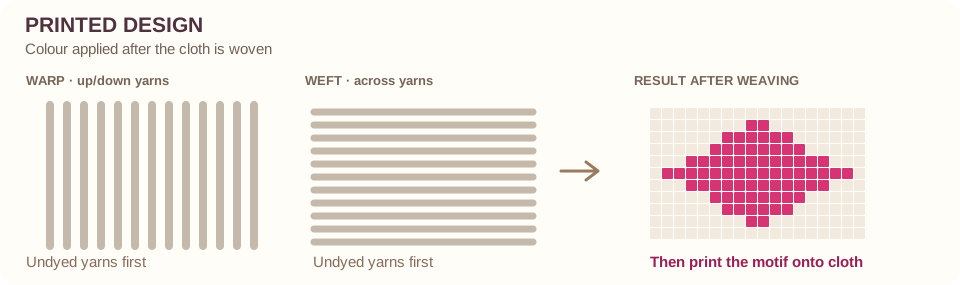
Printed or dyed: The pattern is created by applying or selectively withholding colour. Printing can be by hand or machine; some dyeing techniques are exceptionally labour-intensive.
Embroidered or attached: Decoration is added to the finished fabric with stitches, beads, metallic cords, mirrors or other materials. A printed flower and an embroidered flower can have the same outline but feel very different.
Do not assume a printed saree is always cheap, or that anything woven must be expensive. The details of craft and execution matter.
Ikat — colour patterns prepared on the threads before weaving
Ikat — colour patterns prepared on the threads before weaving↗
In Ikat, groups of yarns are tied or otherwise protected from dye in carefully chosen places before they are woven. The coloured sections line up to form the final pattern. Because those boundaries are built into the yarns, their edges often have a characteristic slightly feathered or softened look.
Look: Diamonds, chevrons, flowers or abstract forms with subtly blurred edges. Compared with printing: The colour arrangement is made in the yarn, rather than stamped on the finished fabric.
Single Ikat and double Ikat — one set of yarns or both
Single Ikat and double Ikat — one set of yarns or both↗
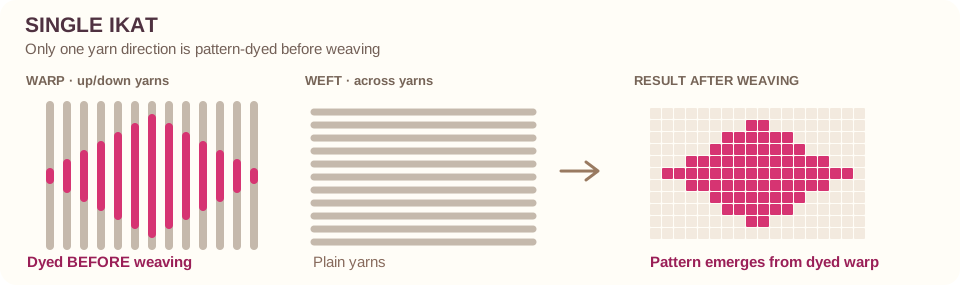
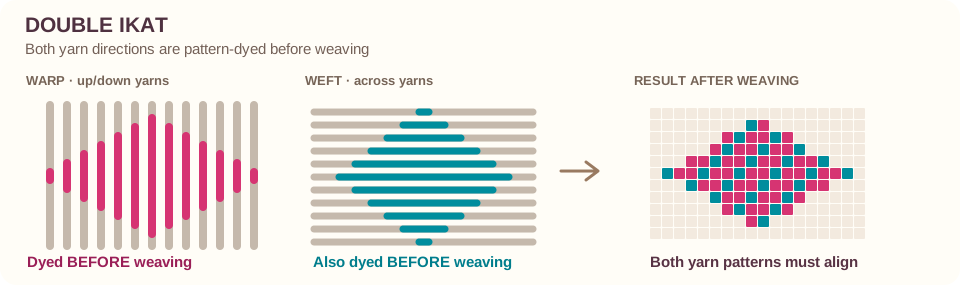
A saree has lengthwise yarns and crosswise yarns. In single Ikat, typically one set is resist-dyed to create the planned shapes. In double Ikat, both sets are dyed in advance and must line up when woven. Double Ikat is especially associated with Patan Patola.
What you see: Both can show characteristic Ikat edges. You usually cannot prove single versus double Ikat just by glancing at a finished saree photograph.
Technique explainedHow Ikat Is Woven
The design is dyed into the threads before the cloth exists. Instead of decorating a finished saree, the dyer ties tight bindings around chosen sections of yarn, dyes the bundle, then moves or adds bindings and dyes again. Wherever the yarn was bound, the dye could not reach. When the loom finally brings those coloured sections together, the pattern appears.
Warp ↓The threads stretched along the length of the loom — and the saree
Weft →The threads passed across, from side to side, as the cloth is woven
Warp ikat
Only the lengthwise threads are resist-dyed. They are laid on the loom with their colours already in place, and a plain weft is woven through. Because the pattern is fixed before weaving begins, warp ikat motifs tend to run cleanly along the length of the cloth.
Weft ikat
Only the crosswise threads are resist-dyed. The weaver must place each pass of weft so its coloured sections land in the right spot — a little looser in alignment, which is why weft ikat motifs often show a softer, more fluid edge. Many Sambalpuri and Pochampally sarees use weft ikat, sometimes with warp ikat borders.
Double ikat
Both warp and weft are resist-dyed, and the motif exists only where the two sets of colour meet precisely. Patan Patola and Odisha’s finest double ikat are the celebrated examples — and among the most demanding cloths woven anywhere.
Printed Ikat-style design: The cloth is woven first, and the appearance of Ikat is printed later. This can look beautiful but is not yarn-resist-dyed Ikat.
Single Ikat: One set of threads is tied and dyed in advance: either the warp or the weft. This diagram uses patterned warp as an example.
Double Ikat:Both yarn sets are tied and dyed in advance. Their dyed sections have to be aligned as the fabric is woven. That demands exceptional planning and precision.
Registration: keeping the colours in step
Every dyed section has to arrive at the right place, pick after pick, over six yards. Weavers adjust the warp tension and tease each weft pass into position so the colour boundaries register — line up — with one another. A slight drift produces the soft, feathered outline that is ikat’s signature; uncontrolled drift blurs the design.
Why fine double ikat is so exacting
Two complete sets of yarn must be mapped, tied and dyed — often in several colours, each needing its own round of binding.
Small motifs mean thousands of tiny dyed sections, each of which must meet its partner exactly.
Any error in tying is woven in for good; it cannot be painted over later.
The result reads almost equally on both faces of the cloth — one of the tells collectors look for.
Remember just this: single ikat dyes the pattern into one direction of yarn; double ikat dyes it into both. Neither word refers to the number of colours or layers. A printed “ikat-style” design is woven plain and patterned afterwards.
Simplified colour diagrams, not magnified photographs or proof of how any particular saree was made. Real ikat patterns can be far more complex, and single versus double ikat usually cannot be proved from a photograph.
Bandhani / Bandhej — tiny tied dots and patterned clusters
Bandhani / Bandhej — tiny tied dots and patterned clusters↗
Bandhani is made by tying small points on cloth before dyeing. The tied spots resist the dye, creating dots. Groups of these dots can form flowers, circles, grids, waves and elaborate ceremonial arrangements.
Look: Many little dots, sometimes in several colours, often forming larger designs. Compared with Ikat: Bandhani patterns are formed on the cloth; Ikat patterns are prepared on the yarns before weaving.
Leheriya is a Rajasthani tie-dye tradition especially known for diagonal, wave-like stripes, often in vibrant colours. The stripes are typically softer-edged than crisply printed lines.
Look: Repeated diagonal bands, like waves flowing across the cloth. Compared with Bandhani: Leheriya emphasizes long stripes; Bandhani is famous for dots and dot-built designs.
Ajrakh is a traditional resist and block-printing practice associated particularly with parts of Gujarat, Rajasthan and Sindh. Many well-known examples use deep indigo, madder-red, black and white in intricate geometric or floral arrangements. The process is more involved than simply stamping colour once.
Look: Dense repeating designs, frequently organized in strong geometric arrangements. Important: Not every navy-and-red printed saree is authentic Ajrakh.
Kalamkari — drawn or block-printed storytelling and flowers
Kalamkari — drawn or block-printed storytelling and flowers↗
Kalam refers to a pen; traditional Kalamkari includes hand-drawn work as well as block-printed practices associated with different centres. Sarees can feature scrolling flowers, trees, birds and elaborate narrative scenes, often in earthy tones.
Look: Illustrated motifs with the character of hand drawing or printing. Compared with brocade: Kalamkari's design is made with dyes and drawing/printing techniques, not usually by weaving metallic motifs into the cloth.
Shibori — patterns formed by binding or folding cloth
Shibori — patterns formed by binding or folding cloth↗
Shibori is a family of resist-dyeing techniques in which cloth is folded, stitched, bound or compressed before dyeing. The result may be irregular circles, stripes, textures or softly blended areas.
Look: Organic, often softly edged shapes. Compared with Bandhani: Both involve resisting dye, but Shibori encompasses a wider set of folding and binding methods and has a different historical vocabulary.
In batik, wax blocks dye from reaching selected areas of the cloth. When the wax is removed, shapes and colours remain. Some batik fabrics show fine crackle lines produced as the wax breaks during dyeing.
Look: Printed-looking motifs sometimes accompanied by a fine network of crackles.
Block printing uses carved blocks applied to cloth, often one colour at a time. It can produce beautiful repeated designs and small variations in registration. Digital printing places a design through a machine-controlled printing process; it permits fine detail, many colours and photographic effects.
Neither term tells you whether the underlying fabric is silk or cotton. Printed defects or slight irregularity do not, by themselves, prove a piece was hand-block-printed.
Embellishment: decoration added with other threads or materials↗
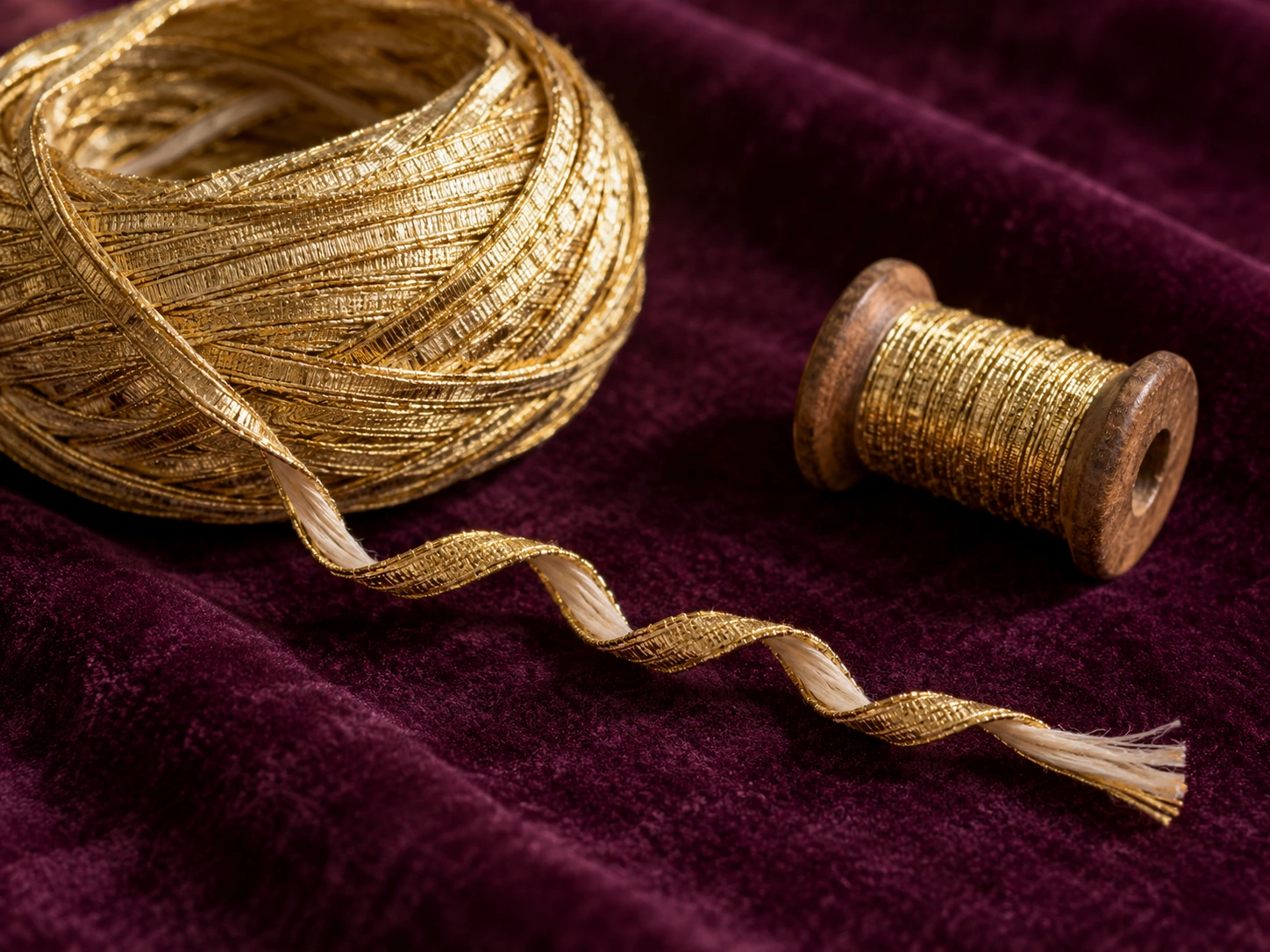
Zari — the metallic-looking thread
Zari — the metallic thread, and what it is made of↗
Zari is the gold- or silver-coloured thread that lights up borders, pallus and motifs. The word describes a material — a metallic yarn — not a way of weaving. The same zari can be woven in by many techniques (see Kadwa, Fekwa and Meenakari below).
The catch: “zari” covers everything from silver thread finished in gold to metallised plastic film. Colour and shine alone cannot tell you which you are looking at.
Wrapped metallic yarn A metallic-looking strip spiralling around a textile core. A generic illustration of how such yarn is built, not a universal zari recipe — composition varies and cannot be judged by eye.
Material explainedPure, tested and imitation zari
Most zari is built the same way: a fine metal (or metallic-looking) strip is wound tightly around a core thread. What changes — and what drives the price — is the metal.
Type
Typically made of
Look and behaviour
Worth knowing
Pure / real zari
Fine silver wire or flattened silver strip, usually electroplated with a thin layer of gold, wound around a silk core.
A soft, deep glow rather than glitter; heavier in the hand; silver can darken with age.
The costliest kind. Some traditions and standards specify minimum silver and gold content — ask for the composition and any test certificate.
Tested zari
Copper wire or strip, plated with silver and then given a gold-toned finish, on a silk, cotton or synthetic core.
Can look very close to pure zari when new; lighter on cost; appearance alone cannot tell it apart.
A respectable mid-range choice when honestly described. It is not pure zari, whatever the shine.
Imitation / metallic zari
Polyester film coated to look metallic, slit into fine strips and wound on a core (often called metallic yarn).
Light, bright, does not tarnish; sometimes a more glittery sparkle.
Inexpensive and practical for everyday sarees. It contains no meaningful silver or gold.
Two words you will hear
Badla — the flattened metal strip itself, traditionally silver or gilded silver. Used on its own it gives a flat, mirror-like sparkle.
Kasab — badla wound around a core yarn to make zari thread. Usage varies: in some markets “kasab” is used loosely for zari in general, so ask what is meant.
What looking can — and cannot — tell you
Gold-coloured zari can contain different materials. Colour, a visible frayed end, weight and a soft glow do not establish composition.
Ask what the metallic yarn contains and what supports a precious-metal claim. If a percentage is quoted, ask which component is being measured — the whole yarn, the metal wrapping or something else.
Never scrape, burn or rub a saree to test it. If the claim matters to the price, ask for it on the invoice.
Zari is the material. Kadwa, Fekwa and Meenakari describe how decorative threads are woven in; Zardozi and Gota Patti are embroidery or applied work, added after weaving.
Meenakari — small coloured details inside woven decoration
Meenakari — small coloured details inside woven decoration↗
In the language of certain silk brocades, Meenakari usually refers to coloured silk details added into the main decorative motifs. Picture a gold-coloured woven flower whose petals contain little pink, blue or green accents.
Look: Touches of colour within a larger ornamental pattern. Not the same as: A floral design is the shape; Meenakari describes coloured detailing in certain weaving contexts. The jewellery term has a related visual idea but is a different craft.
Chikankari is a traditional embroidery associated strongly with Lucknow. Many designs are floral or leafy, worked with a variety of stitches that can create flat, raised or shadow-like effects.
Look: Fine stitchwork, often gentle and subtle rather than glittery. It may be white-on-white or coloured. Important: Chikankari is embroidery; the base saree might be cotton, georgette or another fabric.
Kantha — running-stitch embroidery and storytelling
Kantha — running-stitch embroidery and storytelling↗
Kantha is associated with eastern India, especially Bengal. Running stitches create outlines, patterns and sometimes richly illustrated scenes. Some pieces have densely stitched surfaces that acquire a distinctive rippled texture.
Look: Tiny, repeated stitches following flowers, animals or figures. Feel: You may be able to feel the embroidered lines.
Zardozi is a form of richly decorative embroidery, historically using metal-related threads and materials, often with beads, stones or sequins. It is normally applied to finished fabric rather than created as the main weave.
Look: Raised, richly ornamented work that can look three-dimensional. Compared with woven zari: Zardozi is stitched on; a zari motif can be woven into the cloth.
Gota Patti decoration uses pieces of metallic-looking ribbon or trim attached to the cloth, commonly arranged as petals, leaves or geometric shapes. It is especially familiar in Rajasthani festive garments and sarees.
Look: Reflective appliqué patches that seem placed on top of the base cloth. Compared with zari weaving: Gota is attached trim, not necessarily a metallic yarn woven through the cloth.
The word cutwork can refer to actual cut-out embroidery in some textiles. In Banarasi silk commerce, it can also describe a brocade approach where unused decorative yarns between motifs are cut away, leaving individual designs. These are different uses of the same word.
Rule of thumb: Ask the seller what kind of cutwork is meant.
A few important decorative weaving words—without the machinery lesson↗
Kadwa / Kadhua — decorative motifs formed individually
Kadwa / Kadhua — decorative motifs formed individually↗
A Kadwa saree has motifs woven separately with their own decorative threads, rather than simply carrying one decorative thread across long empty spaces. This permits intricate individual designs, though there are different practices and commercial definitions.
What is the visible result? Small, clearly placed motifs can appear clean and individually worked. The reverse may help an informed person understand the method, but a photo alone is not definitive proof.
Fekwa / Phekua — decorative thread carried across wider areas
Fekwa / Phekua — decorative thread carried across wider areas↗
In Fekwa descriptions, supplementary decorative thread is often carried across larger portions of fabric, producing motifs with connecting floats visible on the reverse. These may be cut in some constructions.
Compared with Kadwa: It is a different way to create repeated woven ornament. Do not simplify it to “fake versus real”: both can be legitimate weaving techniques.
Tanchoi usually describes a silk weaving style with finely detailed, often continuous patterns made with multiple coloured yarns. Its surface can look richly figured even when it is not dominated by metallic zari.
Look: Many small interlocking flowers, paisleys or geometries, often on a colourful silk ground.
This is a traditional name associated with sumptuous, dense brocade in which decorative metallic threads can occupy much of the visible surface. Historically such textiles could be exceptionally costly.
Look: Rich, often heavy-looking patterned fabric with very little plain background visible. Note: It is a style and historic trade designation, not a species of silk.
Rangkat is associated with multi-colour arrangements, particularly in Banarasi textile vocabulary. A saree may show distinct bands or areas of contrasting colours integrated into the cloth, often with accompanying woven design.
Look: Large colour changes that are part of the textile design, not merely a contrast border.
Korvai is associated especially with traditional Kanjivaram-style silk sarees. It refers to a particular border joining method that can produce a strongly contrasting, clearly defined border. To a shopper, the most obvious effect is the emphatic body-and-border colour separation.
Important: A contrast border does not automatically prove Korvai construction; that is a production detail.
These are useful examples rather than a complete classification. Sellers, regions and weaving families use many more words, and the same layout can go by different names in different shops.
If someone says…
Picture this
Scattered butis
Small separate decorations with plain space between them
Buta pallu
One or more large motifs near the shoulder end
Floral bel border
A continuous line of flowers and leaves running along the edge
Jaal
Decorative shapes connected into a net across the body
Jangla
Luxuriant, intertwined leaves and flowers covering a substantial area
Patterns and regional identities can now be read together: a Paithani might feature a peacock pallu, while a Chanderi often uses scattered small motifs.