The Saree Atlas
Search

Heirloom masterpieces

The Coveted Ten

Ten heirloom masterpieces of Indian weaving. Not ten famous names, but ten particular expressions — a technique, a grade, a construction — that set the finest examples apart from the rest of their own tradition, and make collectors catch their breath.

Desirability is a matter of taste, scarcity and craft, not science. This is a discerning editorial list, not a ranking of value, and it contains no shop links. A higher price can reflect more demanding work; it never, by itself, makes a saree more authentic.

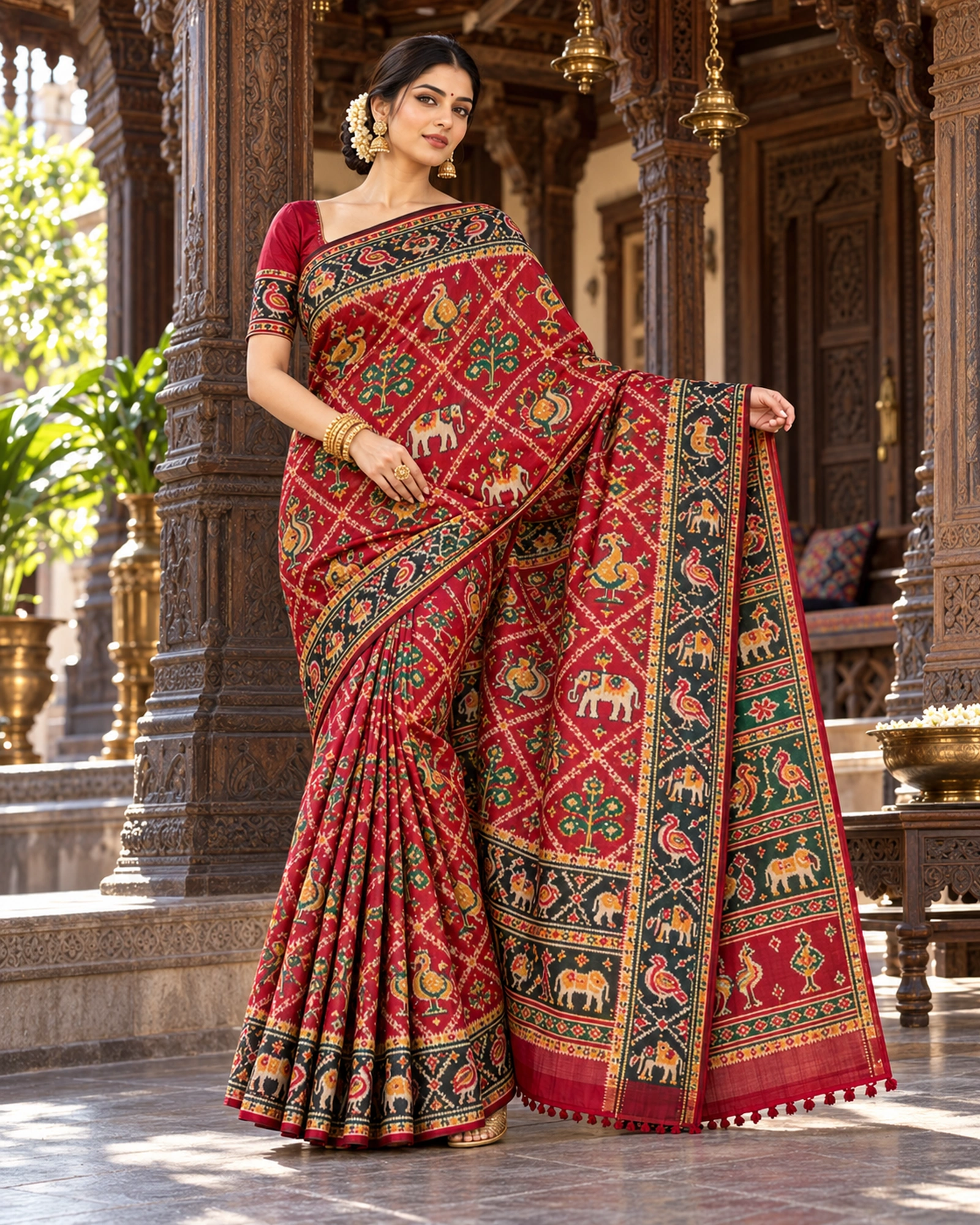
A model standing in a carved courtyard in a red double-ikat-style saree with elephant and parrot motifs

Patan, Gujarat

Patan Patola

Complex multicolour Patan double-ikat masterwork

Why this one is exceptional

In Patan double ikat the design is made twice before it is woven: once in the warp and once in the weft, each bound and dyed in sequence so that its colour segments arrive exactly where the drawing requires them. Weaving then becomes an act of continual registration, the cloth adjusted as it grows so that two independent maps of colour converge into one image. What makes a particular piece exceptional is not the name but the ambition of its planning — a dense figurative layout such as narikunj, held in register from selvedge to selvedge and from body into pallu.

Where it rewards close looking
Follow a single repeat across the full width and into the pallu. In a masterwork the intended meeting points hold throughout, so elephants, parrots and dancing figures keep their drawing; the softness at colour boundaries is the trace of resist-dyed yarn, not a substitute for precision.
An outstanding example
A complex figurative or lattice design resolved across the whole saree, saturated colour, sound silk, and a named Patan workshop that can describe the making of this particular piece.
Indicative budget
Approx. ₹1,50,000+Grade represented: An exceptional, complex multicolour or multi-motif Patan double-ikat masterwork, with the workshop, origin and specification confirmedPieces of this order are quoted individually. The starting figure is a provisional editorial estimate, not a verified minimum or ceiling. Simpler documented Patan double ikat (about ₹1,10,000–₹1,50,000) is the Regional grade, and Rajkot single ikat is a separate tradition.
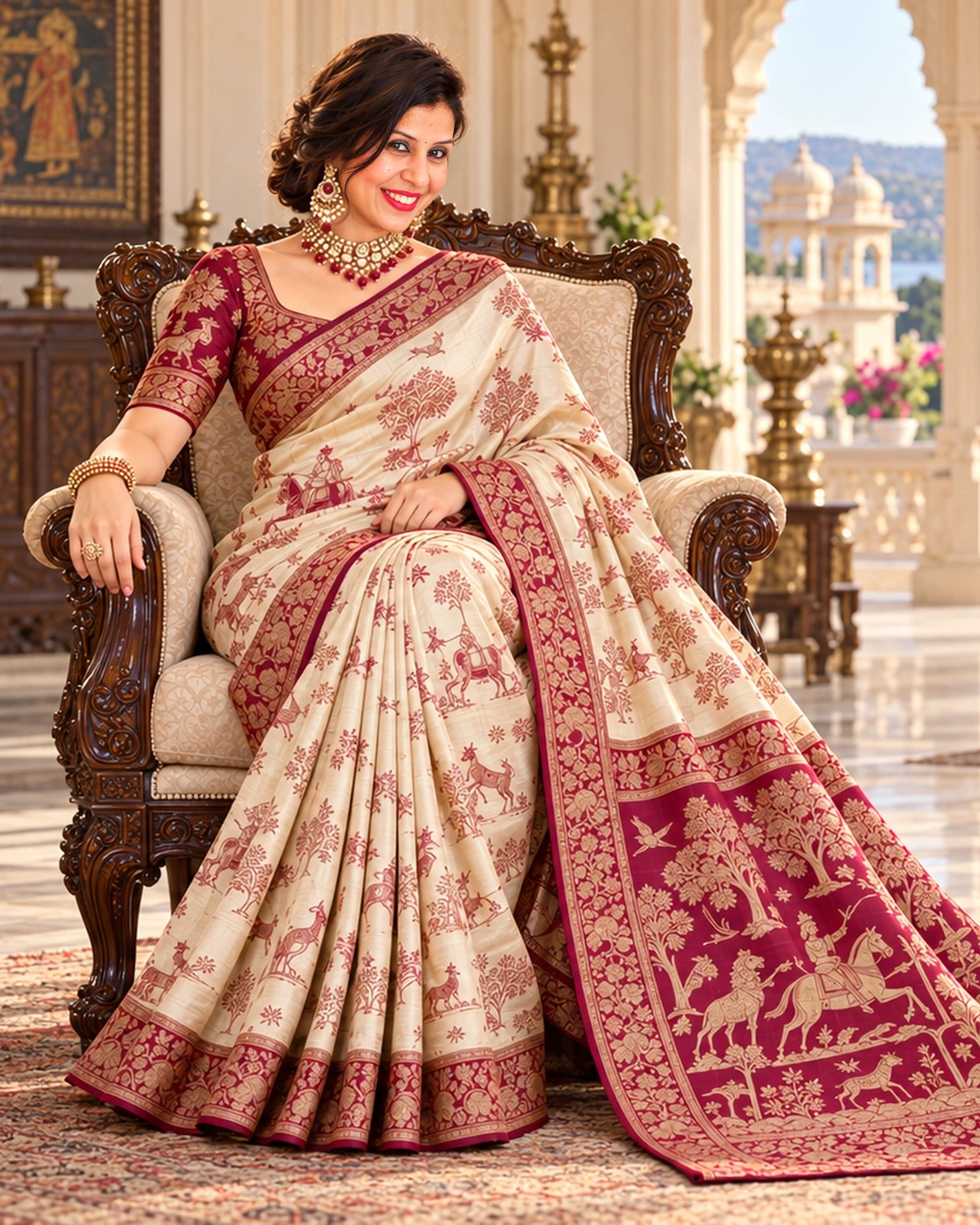
A model seated in a carved armchair wearing an ivory and wine Shikargah-style saree with a hunting-scene pallu

Varanasi, Uttar Pradesh

Banarasi Shikargah

Kadwa Shikargah brocade in Katan silk

Why this one is exceptional

Shikargah — the hunting ground — asks more of a Banarasi weaver than almost any other design: riders, deer, birds and trees must be drawn as a living scene rather than a repeating flower. Worked in kadwa, each figure with its own length of pattern yarn on a Katan silk ground, the composition can be paced like a narrative, with figures turning, overlapping and receding into foliage. The masterwork is the one whose drawing still moves when the cloth falls into pleats.

Where it rewards close looking
Look at how the figures are spaced and whether the scene continues across the pallu instead of breaking into filler motifs; ask which areas are kadwa and which use carried pattern yarn. Fluid drawing, secure pattern yarn and a supple ground matter more than weight or shine.
An outstanding example
Unhurried, well-proportioned hunting scenes, a pallu that develops the narrative, kadwa work wherever it is claimed, and zari whose specification is stated rather than implied.
Indicative budget
Approx. ₹30,000–₹85,000; real-silver-zari work about ₹1,65,000+Grade represented: Handwoven kadwa Katan Shikargah with a complex hunting-scene design; no precious metal assumedReal-silver-zari Shikargah is a separate tier from about ₹1,65,000; confirm the metal and the extent of the motif work for the piece itself, and do not call silver zari “gold-gilt” without that evidence.
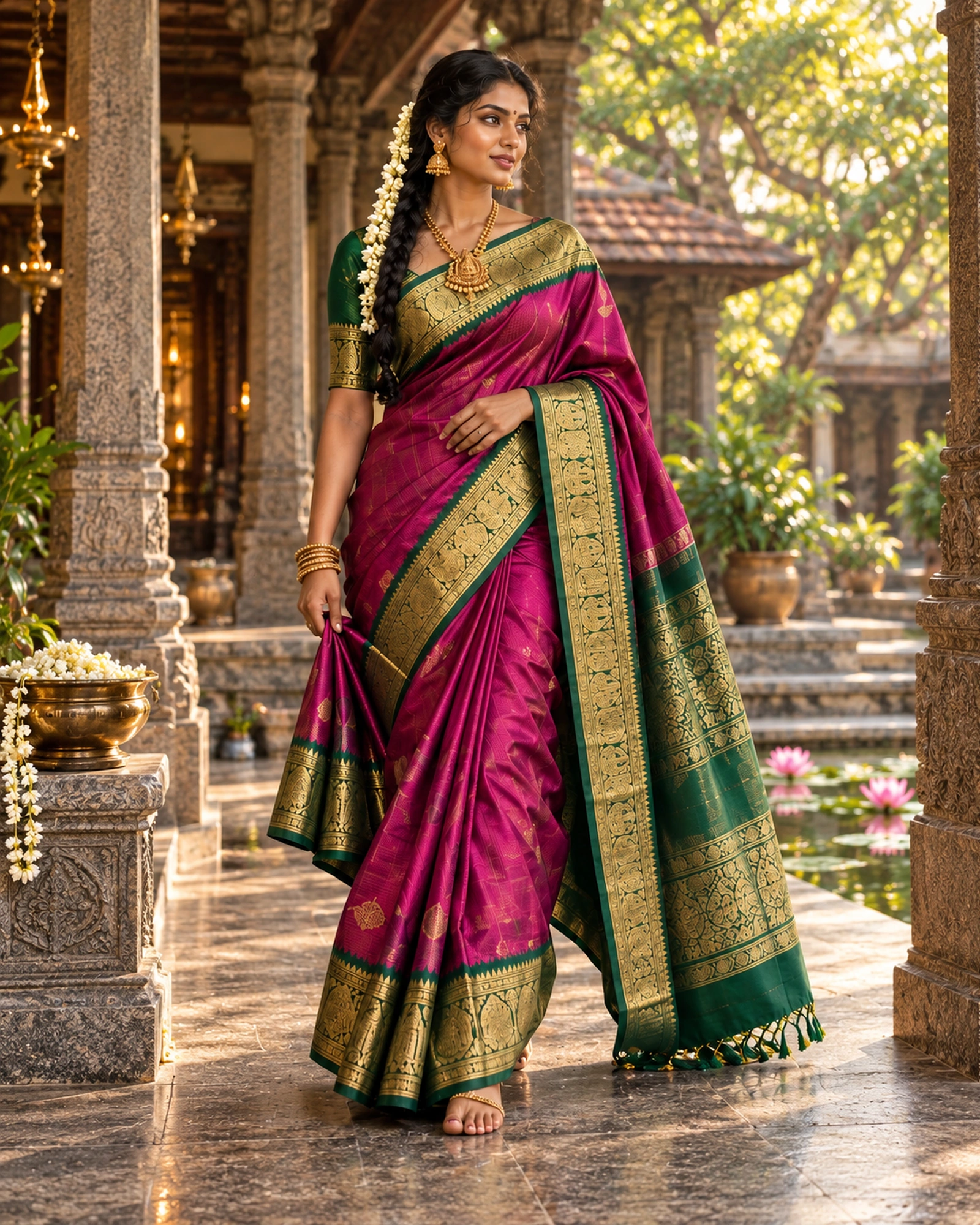
A model in a magenta saree with a contrasting emerald and gold border, standing in a temple courtyard

Kanchipuram, Tamil Nadu

Kanjivaram Korvai

Korvai contrast border with pure zari

Why this one is exceptional

Korvai turns the meeting of two colours into an act of weaving. Separate shuttles carry the body and side-border wefts, interlocking them at every pass, so a magenta field can run beside an emerald border without a seam; when the pallu changes colour too, its warp is changed in the documented petni junction. Combined with pure zari, the result is a saree whose structure is as deliberate as its ornament — architecture in silk.

Where it rewards close looking
Ask the seller to show where border and body meet along the length, and where the pallu’s warp begins; the junctions should be sound and consistent throughout. A temple border or a contrasting pallu is not, by itself, korvai or petni.
An outstanding example
Clean, continuous junctions, a cool and supple silk, a pallu whose design answers the border, and pure zari documented for this article.
Indicative budget
Approx. ₹30,000–₹80,000+Grade represented: Handwoven Kanjivaram with genuine contrast korvai and pure zari declared for the articleAn ordinary silk-thread korvai, however attractive, does not qualify on korvai alone. The ₹30,000 starting point is an editorial grade floor, not a promise that every pure-zari korvai is available at that price; heavier work is quoted individually.
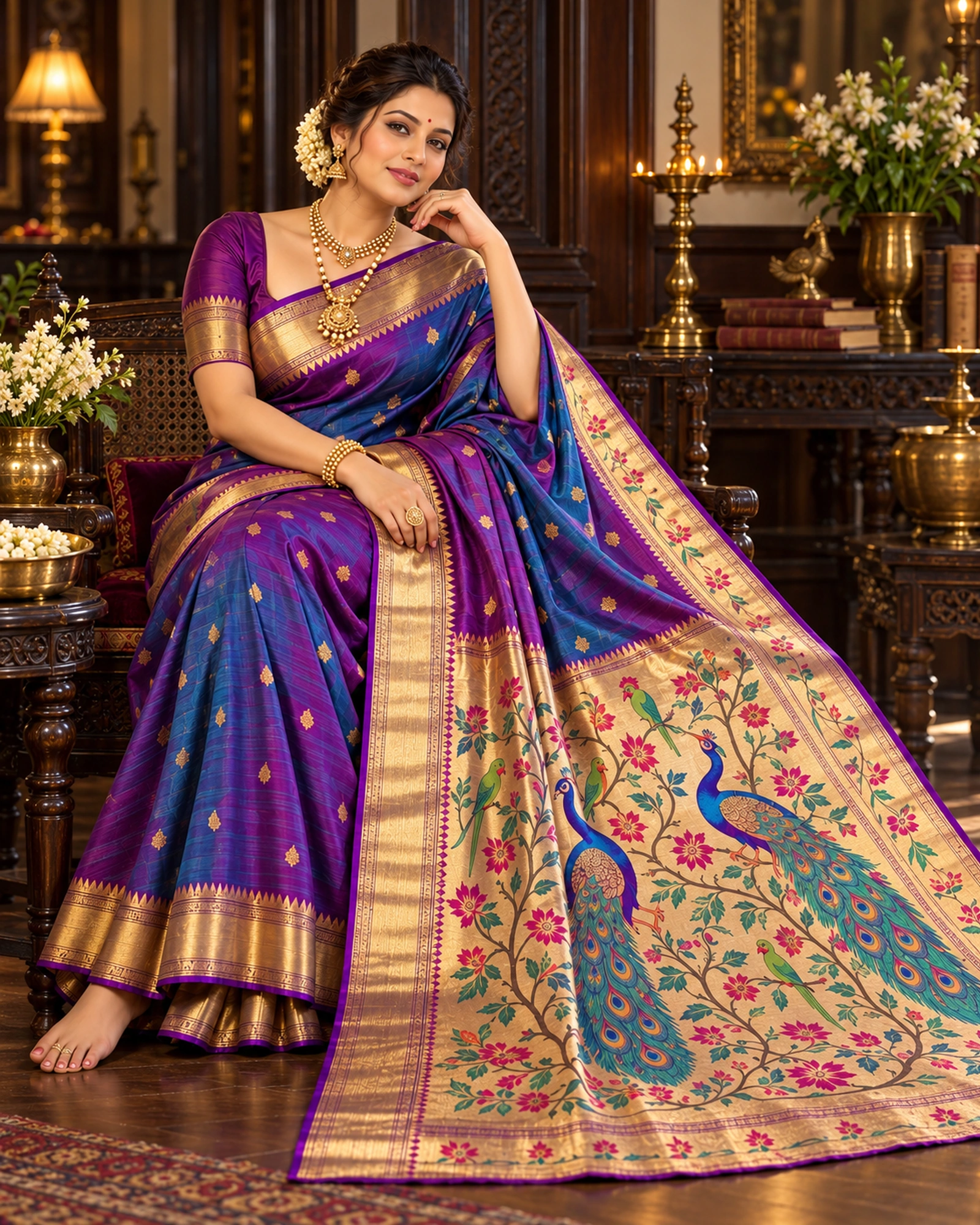
A model seated in a purple Paithani-style saree, its gold pallu woven with peacocks and flowering vines

Paithan & Yeola, Maharashtra

Paithani

Masterwork tapestry-woven Paithani pallu in pure silk

Why this one is exceptional

The Paithani masterwork is its pallu, woven like a tapestry: short lengths of coloured weft travel back and forth within each bird and blossom, meeting their neighbours along carefully managed boundaries on a gold-coloured ground. Peacocks (bangadi mor), parrots (muniya) and flowering vines (asawali) are neither printed onto the cloth nor floated across it; they are built into it, one colour area at a time. The finest pieces sustain that discipline across a broad pallu without losing the liveliness of the drawing.

Where it rewards close looking
Look at the boundaries between colour areas and at how the birds are drawn — their posture, spacing and the clarity of small details at the distance the pallu will be seen. Ask how the pallu is made and whether its method differs from the body butis.
An outstanding example
Lively, well-spaced birds and vines, coherent colour junctions, dhoop-chhaon silk with depth, a substantial border, and a zari specification stated for the piece.
Indicative budget
Approx. ₹40,000–₹1,00,000+Grade represented: A richly accomplished tapestry-woven pallu in pure silk, with substantial craft throughoutAsk for the pallu construction and the zari make-up as declared for the piece. The ₹40,000 starting point is editorial grade positioning, not a scraped minimum price.
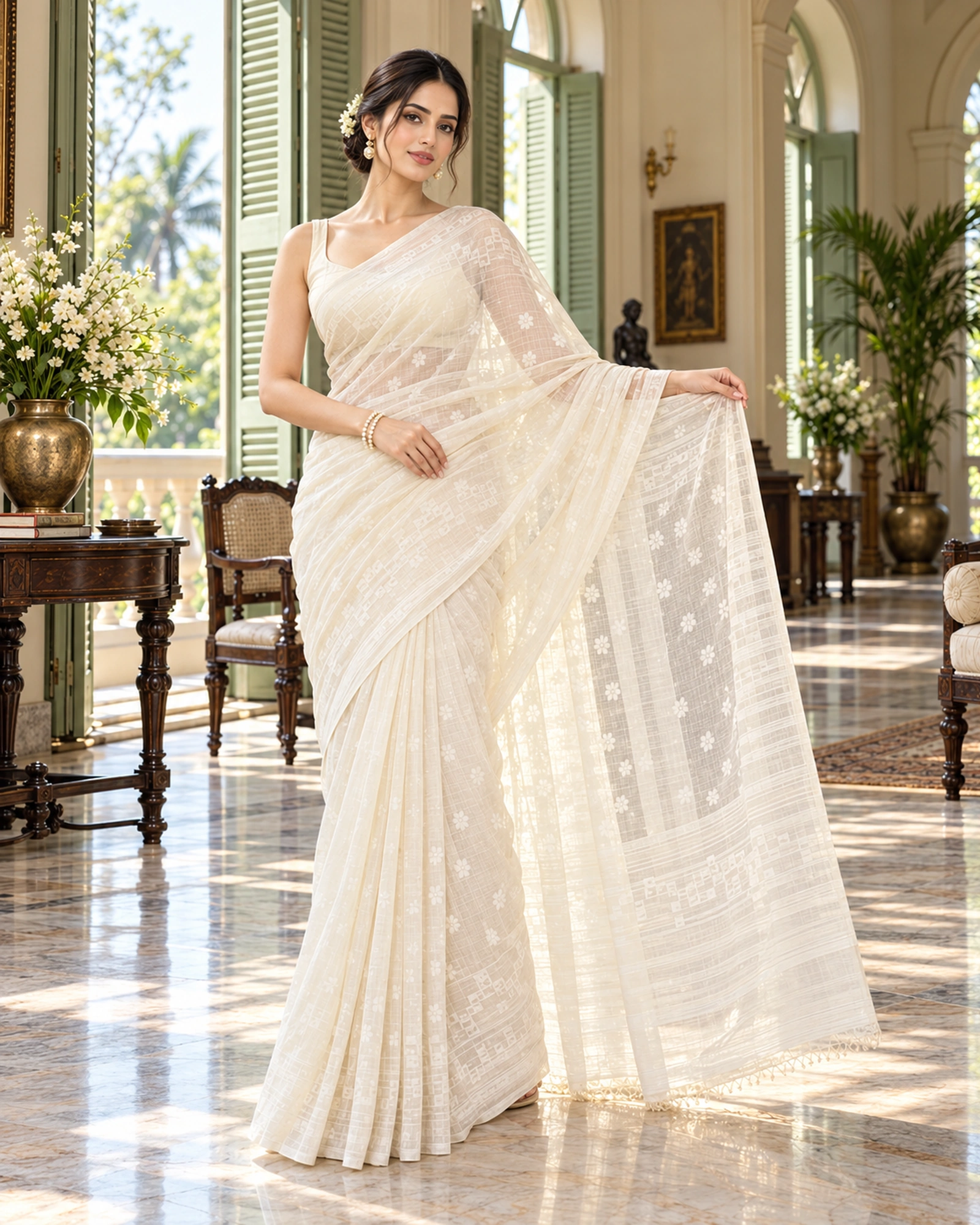
A model in a fine ivory Jamdani-style saree holding out its sheer pallu with woven floral motifs

Bengal (and Dhaka)

Fine Jamdani

Fine-count handwoven Jamdani

Why this one is exceptional

At its finest, Jamdani is a feat of control at the edge of invisibility. Pattern weft is worked locally into a gossamer cotton ground, motif by motif, so that flowers and lattices seem to rest on air while the ground stays even and open around them. In the finest handspun-muslin grades the spacing becomes the composition: the weaver decides as much with what is left empty as with what is filled. UNESCO’s 2013 inscription honours the living craft of Jamdani weaving in Bangladesh; in India, fine work continues in Bengal.

Where it rewards close looking
Hold the cloth so light passes through the ground: an exceptional piece keeps its evenness right up to the edge of each motif. Look at how motifs are spaced across the whole width, and ask how the pattern yarn was inserted and what any yarn count refers to.
An outstanding example
A very fine, even ground; crisp motifs that never pull the cloth; a composition in which spacing and density are clearly intended; and the maker’s statement of yarn and count.
Indicative budget
Approx. ₹25,000–₹40,000Grade represented: Fine-count handwoven cotton-muslin Jamdani, preferably with an artisan-specified high-count or handspun yarn, and exceptional woven figuresFiner commissions are quoted individually. A stated count is the maker’s description, not a laboratory measurement.
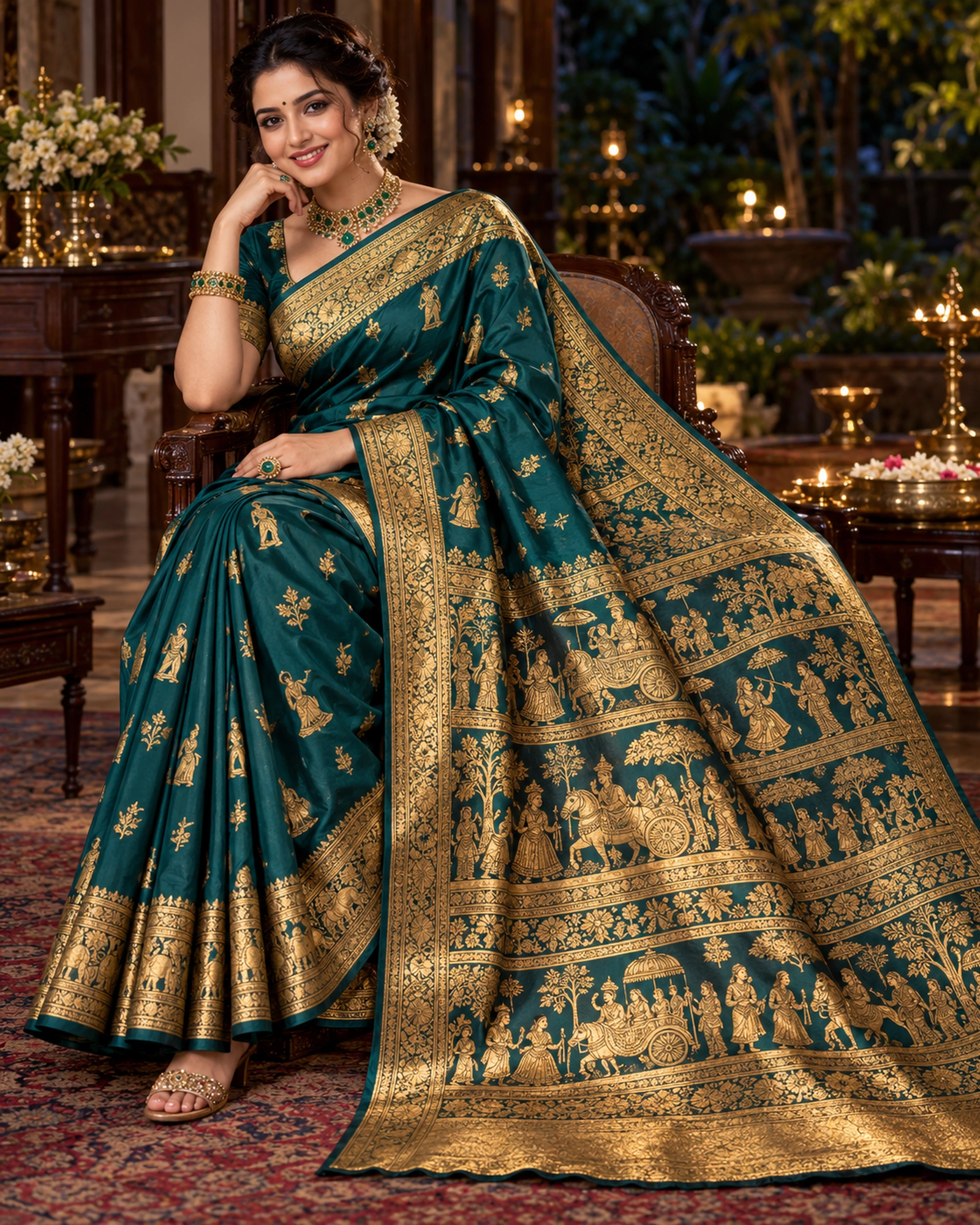
A model seated in a deep teal saree with a gold narrative pallu of figures in framed panels

Bishnupur, West Bengal

Baluchari & Swarnachari

Exceptional narrative Baluchari or Swarnachari pallu

Why this one is exceptional

Bishnupur’s narrative pallu is woven drawing: figures, processions and ornamental frames formed with pattern yarn on a silk ground, repeated and paced so that a scene reads across the end of the saree like a frieze. The masterwork is the one in which small figures stay expressive — a gesture, a turn of the head — within a carefully proportioned architecture of panels. Baluchari works its figures in coloured silk; Swarnachari adds gold- or silver-toned yarn, a different surface rather than a higher rank.

Where it rewards close looking
Follow a frame into its corner and look at a single figure at arm’s length: is it still legible? Ask what yarn makes the figures and how it is introduced; for Swarnachari, ask what the metallic-looking yarn actually contains.
An outstanding example
Expressive, clearly drawn figures; panels in good proportion to the body; a sound silk ground; and, for Swarnachari, a stated decorative-yarn specification.
Indicative budget
Baluchari approx. ₹25,000–₹45,000; exceptional Swarnachari assessed individuallyGrade represented: Exceptionally accomplished, detailed woven narrative figures across a complete pallu — not any ordinary narrative palluThe Baluchari range is a provisional curated budget, and some premium examples were unavailable when checked. Exceptional Swarnachari has no separately researched figure, so it is specified and priced individually. Price alone never decides whether a piece belongs here; the figure work does.
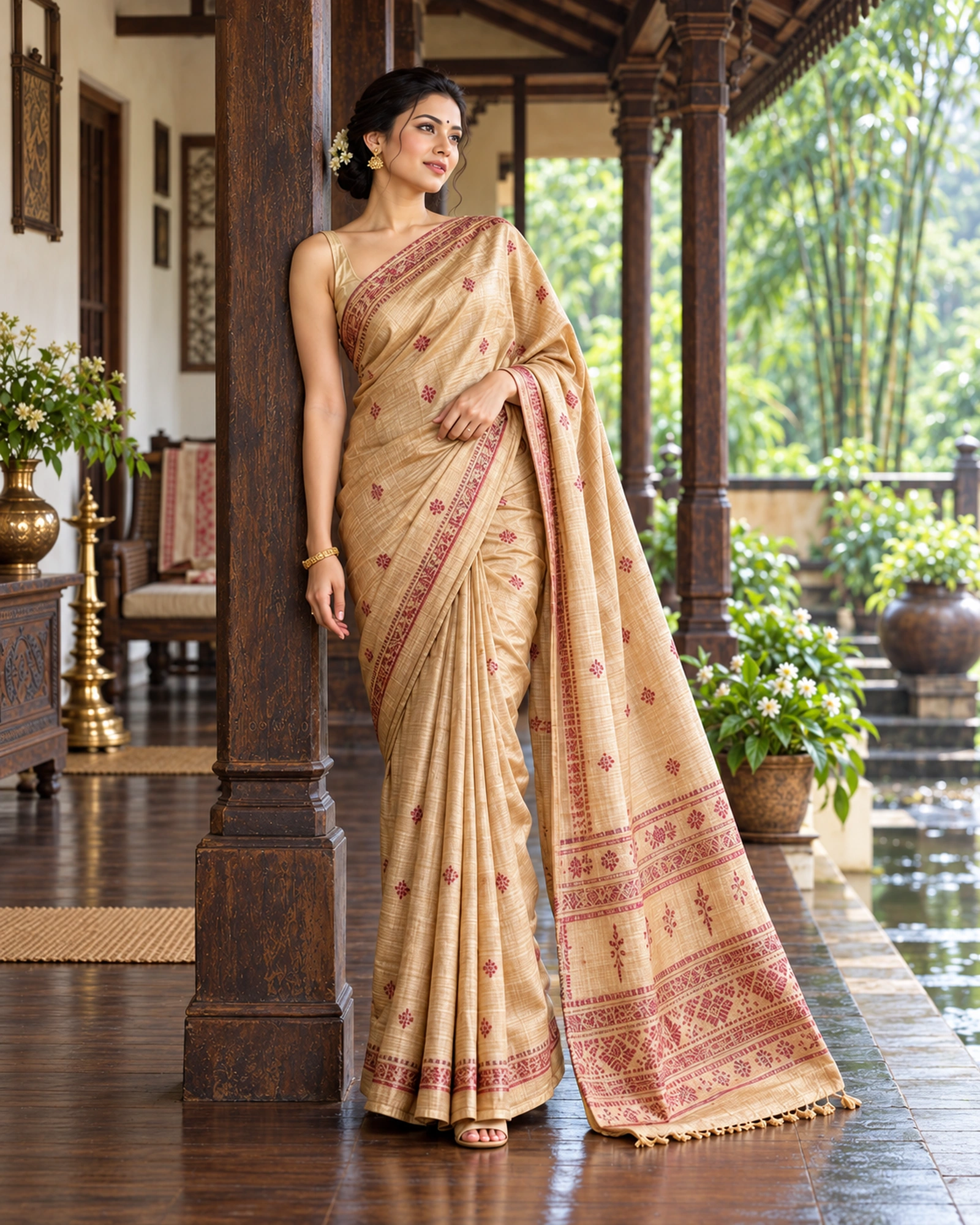
A model leaning against a wooden pillar in a golden Muga-style saree with red woven motifs

Assam

Assam Muga

Elaborate handwoven Muga-ground masterwork

Why this one is exceptional

Muga’s distinction begins in the fibre: a silk whose golden colour belongs to the material itself, raised through a rearing system closely bound to Assam’s landscape. A masterwork lets that material lead — a Muga ground woven with confidence, motifs used with restraint, the cloth’s own light doing the work that metallic ornament does elsewhere. The finest pieces are distinguished as much by what they leave unadorned as by what they add.

Where it rewards close looking
Look at the ground in daylight and at how sparingly the motifs are placed; then ask what fibres and silk species make the warp, weft and motifs. Golden colour alone cannot identify Muga, and a saree is a different garment from a mekhela chador.
An outstanding example
A Muga ground with any Eri or other motif yarn disclosed, restrained and well-drawn ornament, and documentation from a reliable maker.
Indicative budget
Approx. ₹90,000–₹1,60,000+Grade represented: A markedly elaborate handwoven Muga-ground masterwork with woven motifs; motif yarn and zari as declaredAsk what the motif yarn and any zari contain; golden colour never implies solid gold. The starting figure is an editorial budget, not a verified minimum.
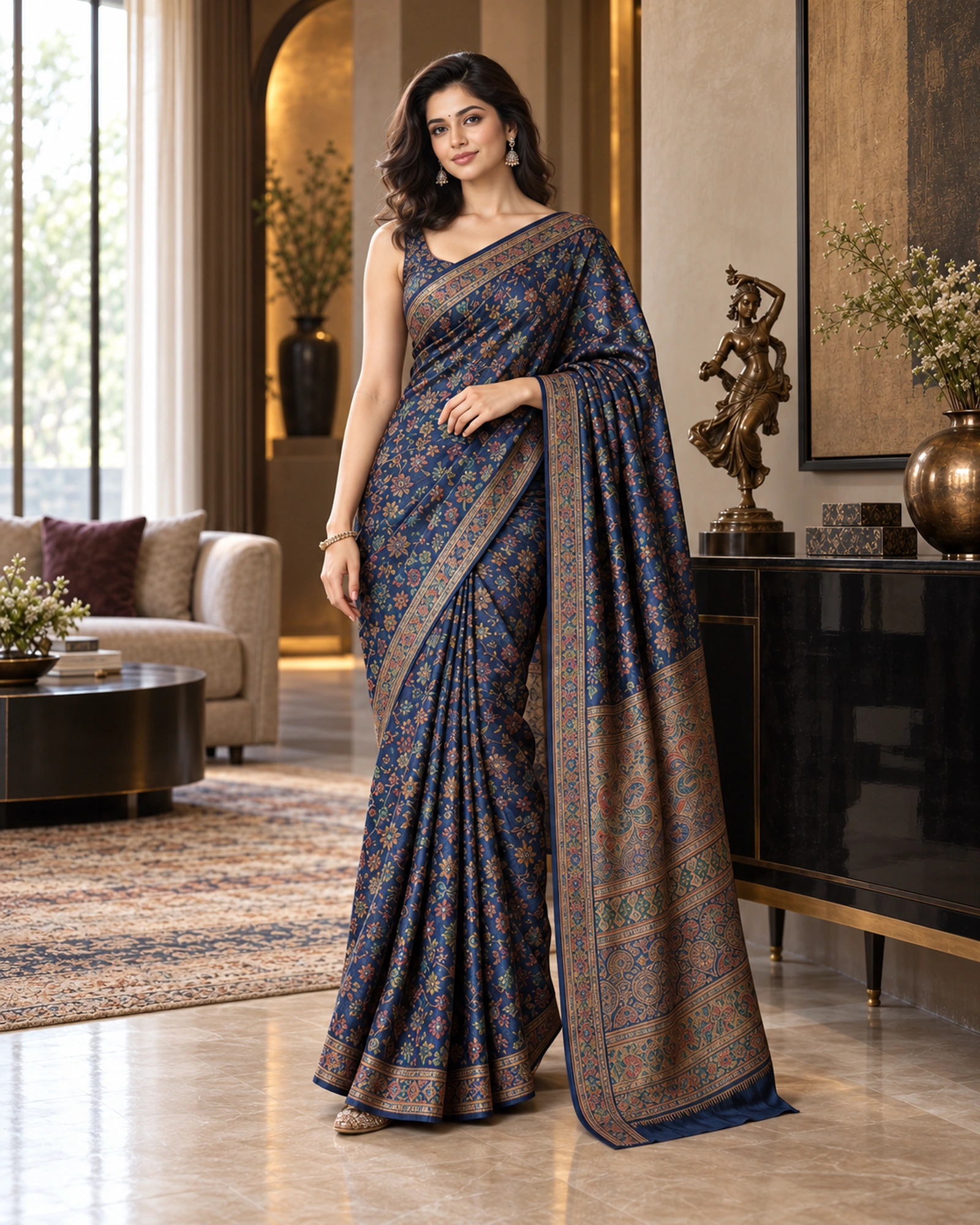
A model in a navy Tanchoi-style saree with dense, small all-over woven patterning

Varanasi, Uttar Pradesh

Banarasi Tanchoi

Fine pure-silk handloom Tanchoi with figured body

Why this one is exceptional

Tanchoi is Banaras at its most intimate: a satin-faced silk on which small, dense patterns are woven in coloured extra wefts, often with little or no zari. Its luxury lies in miniaturisation — birds, flowers and lattices reduced to a scale that rewards a close look — and in a surface so smooth that the pattern seems to lie within the cloth’s sheen. It is a different achievement from kadwa brocade: richness without weight.

Where it rewards close looking
Bring the cloth close and look at how small the repeats are and whether they stay crisp; notice the satin ground between them. The number of colours is not a measure of quality — harmony and drawing are.
An outstanding example
Very small, clearly resolved repeats; a smooth satin ground; colour used for harmony rather than quantity; and a liquid drape.
Indicative budget
Approx. ₹35,000–₹60,000Grade represented: Fine pure-silk handloom Tanchoi with a figured bodyExtra kadwa or meenakari work moves a piece towards the upper end. A Tanchoi border on a plain body is a different, less expensive garment.
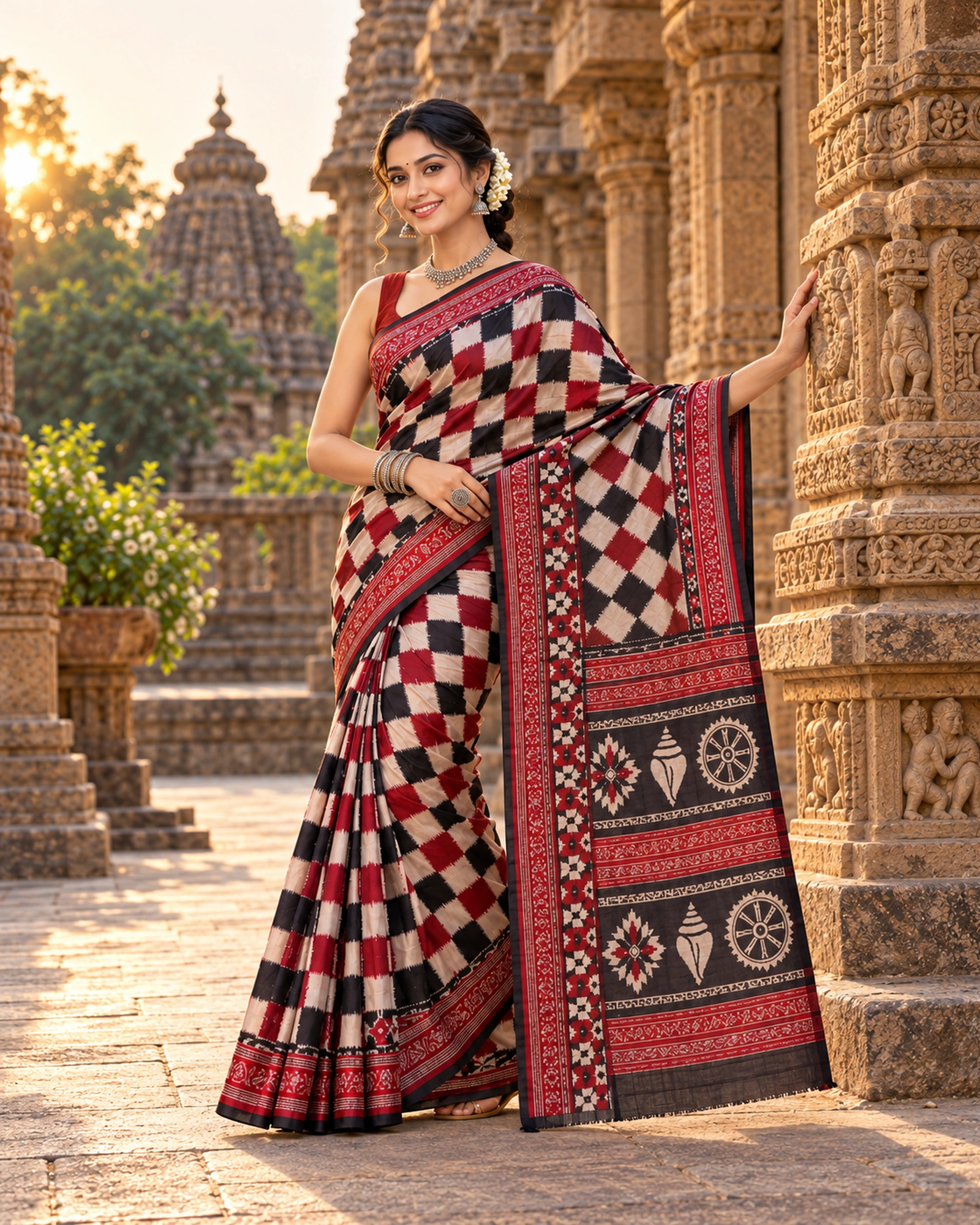
A model by a carved stone temple wall in a red, black and ivory checked double-ikat-style saree with a conch-and-wheel pallu

Western Odisha

Odisha Double Ikat

Double-ikat silk (Pasapalli or Sambalpuri bandha)

Why this one is exceptional

Western Odisha’s bandha weavers plan their designs into the yarn: bundles are bound and dyed so that conch shells, wheels, flowers and the chessboard squares of Pasapalli emerge as the cloth is woven. In double ikat both warp and weft carry the resist pattern, and the two must be brought into register as weaving proceeds. The masterwork is a silk piece in which that double planning is genuinely present and precisely resolved — the squares crisp, the motifs well proportioned, the border and pallu answering the body.

Where it rewards close looking
Ask which yarns were resist-patterned: double ikat should describe the yarn preparation, not two colours or a checked look. Follow a row of squares across a whole repeat and into the border.
An outstanding example
Precise, evenly scaled squares or well-proportioned bandha motifs, a smooth silk ground, a border and pallu in conversation with the body, and a maker who can state the ikat type.
Indicative budget
Approx. ₹25,000–₹35,000Grade represented: Demonstrable pure-silk handwoven double ikat from Western Odisha: both warp and weft resist-patternedA checked layout alone does not establish double ikat; ask the maker to confirm which yarns were patterned.
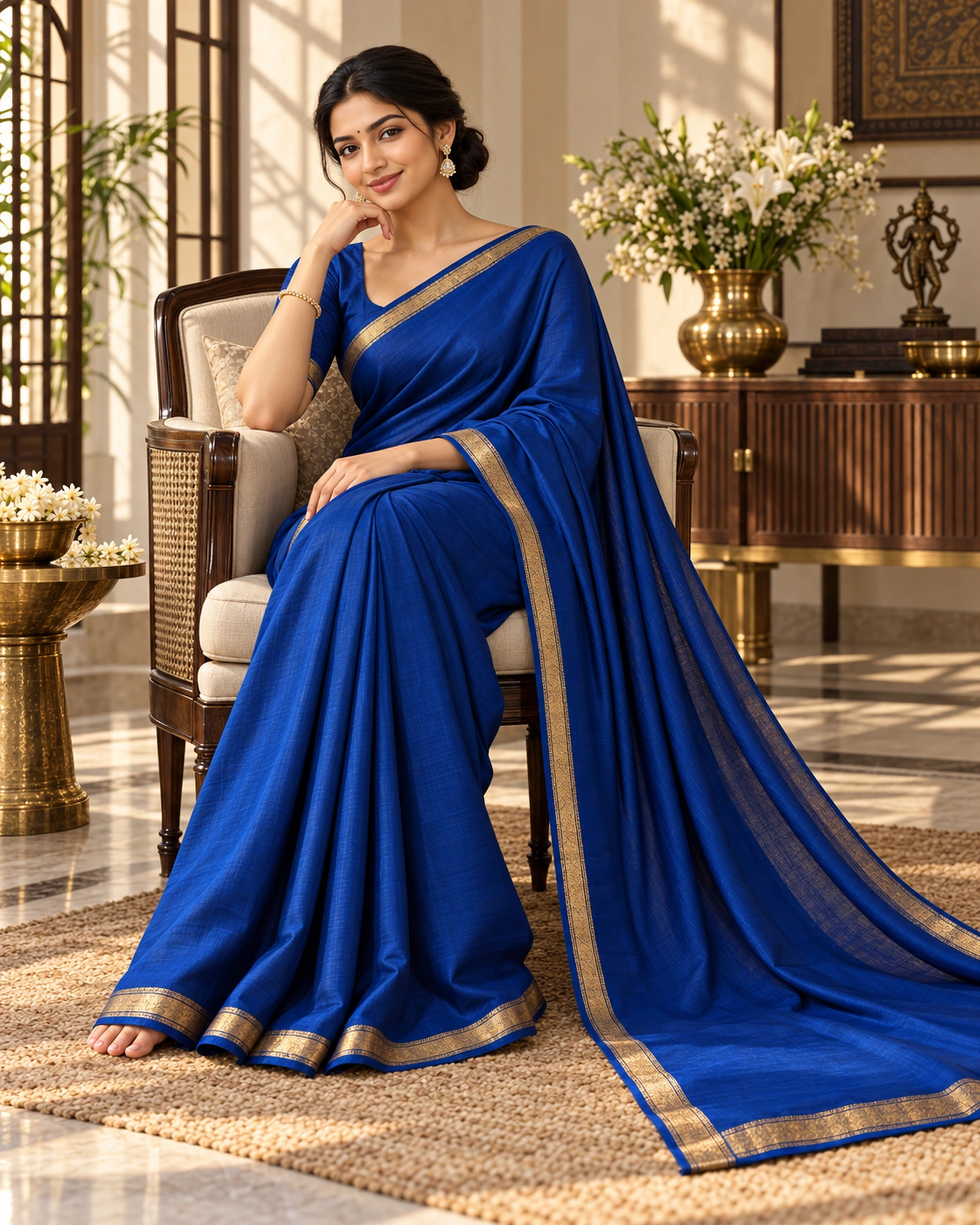
A model seated in a royal-blue crepe saree with a slim gold border

Mysuru, Karnataka

Mysore Silk (KSIC)

Exceptional official KSIC silk-crepe article

Why this one is exceptional

The understatement of the ten: a pure silk crepe from Karnataka Silk Industries Corporation, valued for its fluid fall, soft lustre and an exactness of finish that comes from a long-established manufacturing identity. Its distinction is restraint — a slim border, clear jewel colour and a cloth that moves beautifully — together with the unusual clarity of its provenance when bought from an official source.

Where it rewards close looking
Look at the evenness of the crepe and the neatness of the border; check the KSIC hologram and unique identity number against the invoice, and ask for this article’s zari specification rather than assuming pure gold.
An outstanding example
Even crepe texture, a refined border with its zari specification documented for the article, and official KSIC provenance.
Indicative budget
Approx. ₹50,000–₹1,60,000+Grade represented: An exceptional official KSIC silk-crepe article with distinctive woven, border or zari work, confirmed with the makerKSIC’s manufacturer-wide statement about pure gold zari is not an assay of a particular saree, and it does not make the saree handloom. Confirm the article and its availability.

Already own one?

Add it to your Hall of Fame

Your Hall of Fame recognises the specific variant and quality of each saree you treasure — so a Coveted Ten masterpiece counts for more than a regional label.

Open my Hall of Fame

Planning the next one?

Collector’s Signatures & Distinctive Traditions

The Collector’s Edit introduces twenty exceptional traditions, with a sensible buying target for a fine example of each.

The Collector’s Edit