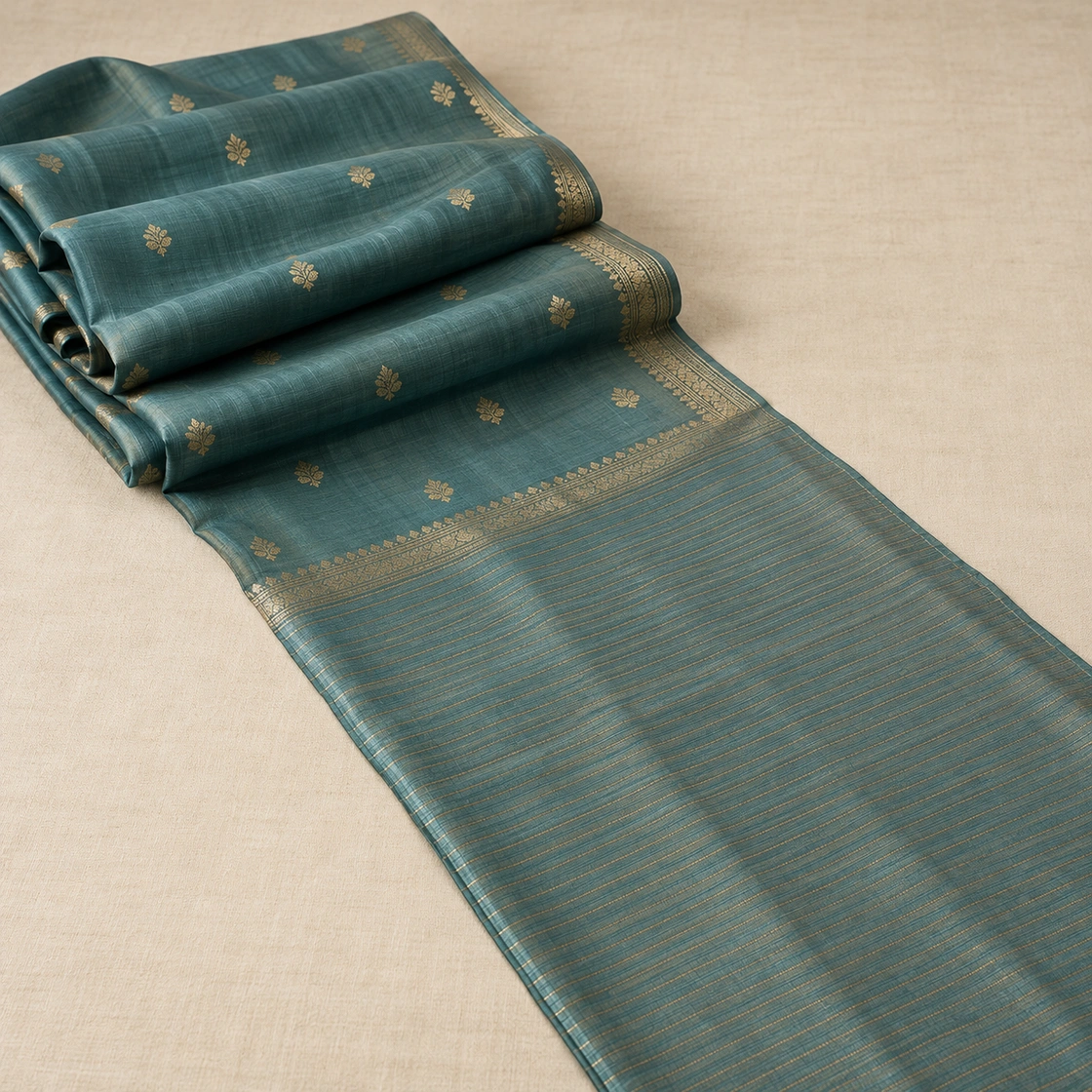
Blouse piece
An unstitched matching length may be included with a saree, but not always. Ask whether its length is included in the advertised metres.
Begin with the essentials: what makes a saree, how to wear one and the words worth knowing.
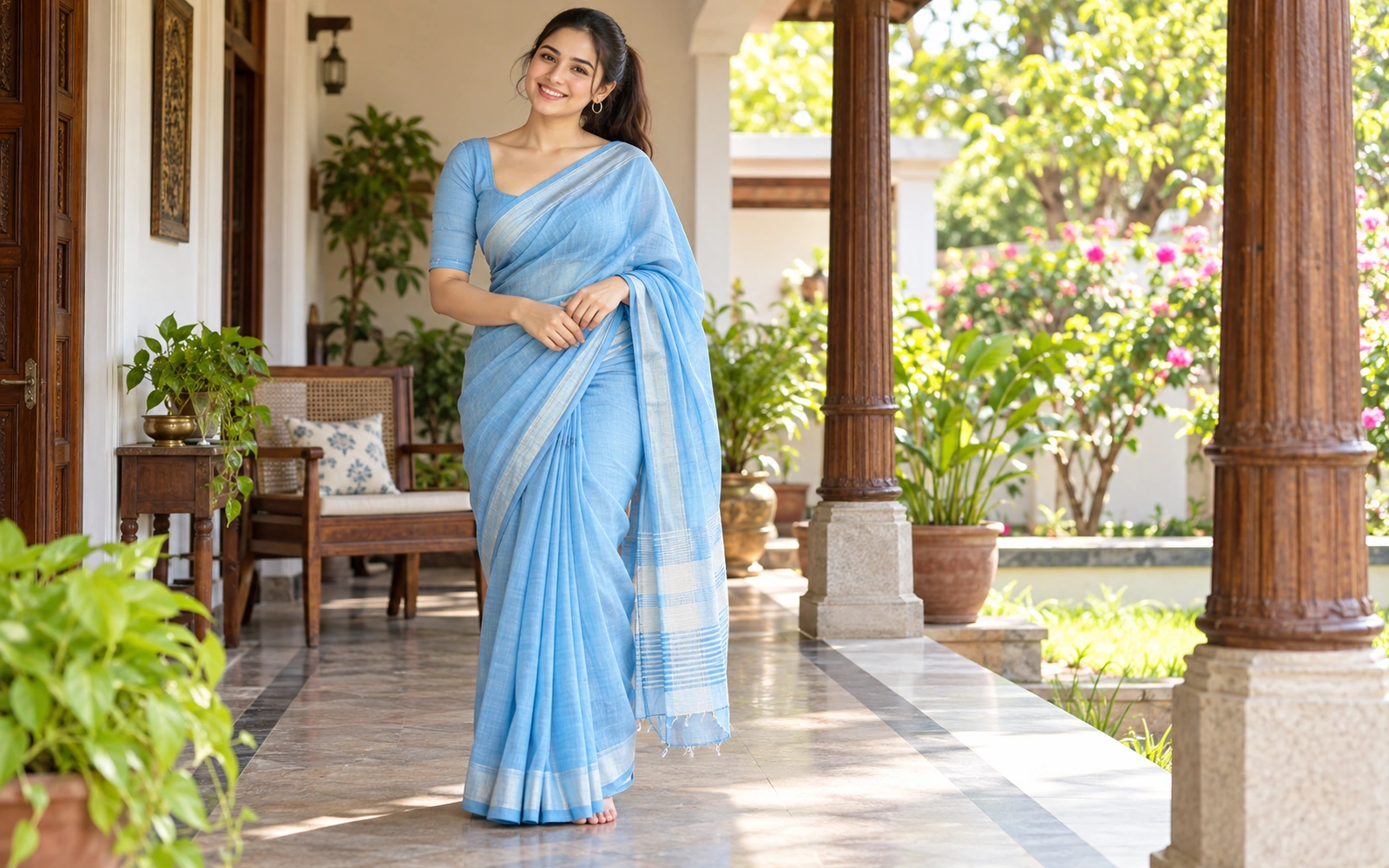
Consider the description: “This is a pure-silk Chanderi with little woven butis and a gold-coloured border.” The description contains four different kinds of information. The cloth is said to be made of silk; its look and making tradition is associated with Chanderi; its small repeating designs are called butis; and its border appears gold-coloured. The border may or may not contain actual gold or silver.
The four terms describe successive stages of making cloth and the identity of the finished saree:
| Word | Imagine | What it answers | Examples |
|---|---|---|---|
| Fibre | The raw material | “What is it made from?” | Silk, cotton, linen, polyester |
| Yarn | Thread made from fibres | “What kind of thread is it?” | Fine cotton yarn, twisted silk yarn, textured spun silk |
| Fabric | Cloth made from yarns | “How does the finished cloth look and behave?” | Organza, chiffon, georgette, satin, brocade |
| Saree tradition | A recognizable regional style | “What kind of saree is it?” | Chanderi, Kanjivaram, Paithani, Banarasi |
Fibre is the ingredient; yarn is the thread; fabric is the cloth. A saree is made from that cloth, but its regional name also describes customary colours, borders, motifs and designs. These are not four competing ways of naming the same thing.
Silk identifies the fibre; organza identifies the kind of cloth. Organza is lightweight, transparent and crisp, meaning it holds its shape more than a soft, flowing chiffon. There is also polyester organza. It can look similar from a distance, but it is not silk. Saying “organza” alone tells you nothing certain about the fibre.
Kanjivaram is a saree tradition from Kanchipuram, Tamil Nadu. Silk tells you the fibre. The traditional style often has a substantial silk body and strongly defined borders and pallu (the end worn over the shoulder). The name does not by itself tell you whether the particular saree has a small border, a broad one, contrasting colours or a modern design.
A yarn term describes the thread before it becomes cloth. For example, Katan traditionally refers to twisted silk filament yarn; shops also use “Katan silk” for cloth or sarees made from that yarn. It is not the name of a different silkworm.
A fabric term describes the cloth. Georgette and organza are examples. The same type of cloth can be made from different fibres, including natural silk and synthetics.
A trade term is simply a name used in shops, sometimes more loosely than a strict technical definition. When a shop says raw silk, for example, it might be describing a slightly uneven texture rather than a distinct silk variety. Art silk is another trade name: it usually means a silk-like manufactured material, not natural silk. Kora is often used for crisp, sheer silk or organza-type cloth in saree shops, but sellers do not always use it in exactly the same way.
A regional name describes a saree tradition rather than its basic ingredient. A Chanderi might be cotton, silk, or silk–cotton. A Banarasi can have different silk or other fabric bases. One word rarely tells you everything.
The word natural says where a fibre comes from—not automatically how costly, beautiful or comfortable the fabric will be.
An important correction to a common assumption: Natural silk is not automatically soft, nor is polyester always stiff. Silk organza can be crisp. Polyester georgette can flow beautifully. The fibre matters, but the type of fabric matters too.
The fabric hierarchy begins with the raw ingredient, then branches into cloth types:
FIBRES (what threads are made from)
├── Natural
│   ├── Silk: mulberry, Tussar, Muga, Eri
│   ├── Cotton
│   └── Linen (flax)
├── Regenerated from cellulose: viscose, modal, lyocell
└── Synthetic: polyester, nylon

FABRIC CONSTRUCTIONS (what the cloth is like)
├── Sheer and airy: organza, chiffon, some voile
├── Fluid/textured: georgette, various crepes
├── Smooth and shiny: satin
└── Patterned in the weave: brocade
These are two intersecting trees, not one chain of subtypes. Silk organza and polyester organza are both organza, but belong to different fibre branches. Some commercial names—Katan, Kora, raw silk, tissue—need extra explanation because sellers use them across yarn, finish and fabric categories.
The saree-tradition hierarchy is primarily geographical. Here is a short map of well-known examples; the full entries come later:
INDIAN SAREE TRADITIONS
├── North: Banarasi, Chikankari, Kashmiri embroidered styles
├── West: Paithani, Patola, Bandhani, Gharchola, Panetar, Leheriya
├── Central: Chanderi, Maheshwari
├── East: Baluchari, Jamdani, Sambalpuri, Bomkai, Tangail...
├── South: Kanjivaram, Gadwal, Pochampally, Ilkal, Uppada...
└── Northeast: Muga and Eri silk saree traditions
Region is only one way of organising types. Bandhani names a dyeing technique that also became a widely recognised saree category; Pochampally Ikat combines a place with a pattern-making method. The guide will not pretend all the names fit the same kind of box.
Body: The main area of the saree, covering most of the length. A plain body can have a very elaborate border, and vice versa.
Border: The decorative strip running along the long edges. It may be narrow, broad, plain, patterned, the same colour as the body, or a contrasting colour.
Pallu (also called aanchal): The end usually arranged over the shoulder. Many regional sarees put their most elaborate designs here.
Motif: One shape—say, a little flower, peacock, mango or diamond.
Pattern: The way shapes repeat or combine—a row of flowers, an all-over network, stripes, or checks.
Zari: Decorative thread with a metallic or metallic-looking surface, commonly seen in borders and pallus. Its actual composition can vary.
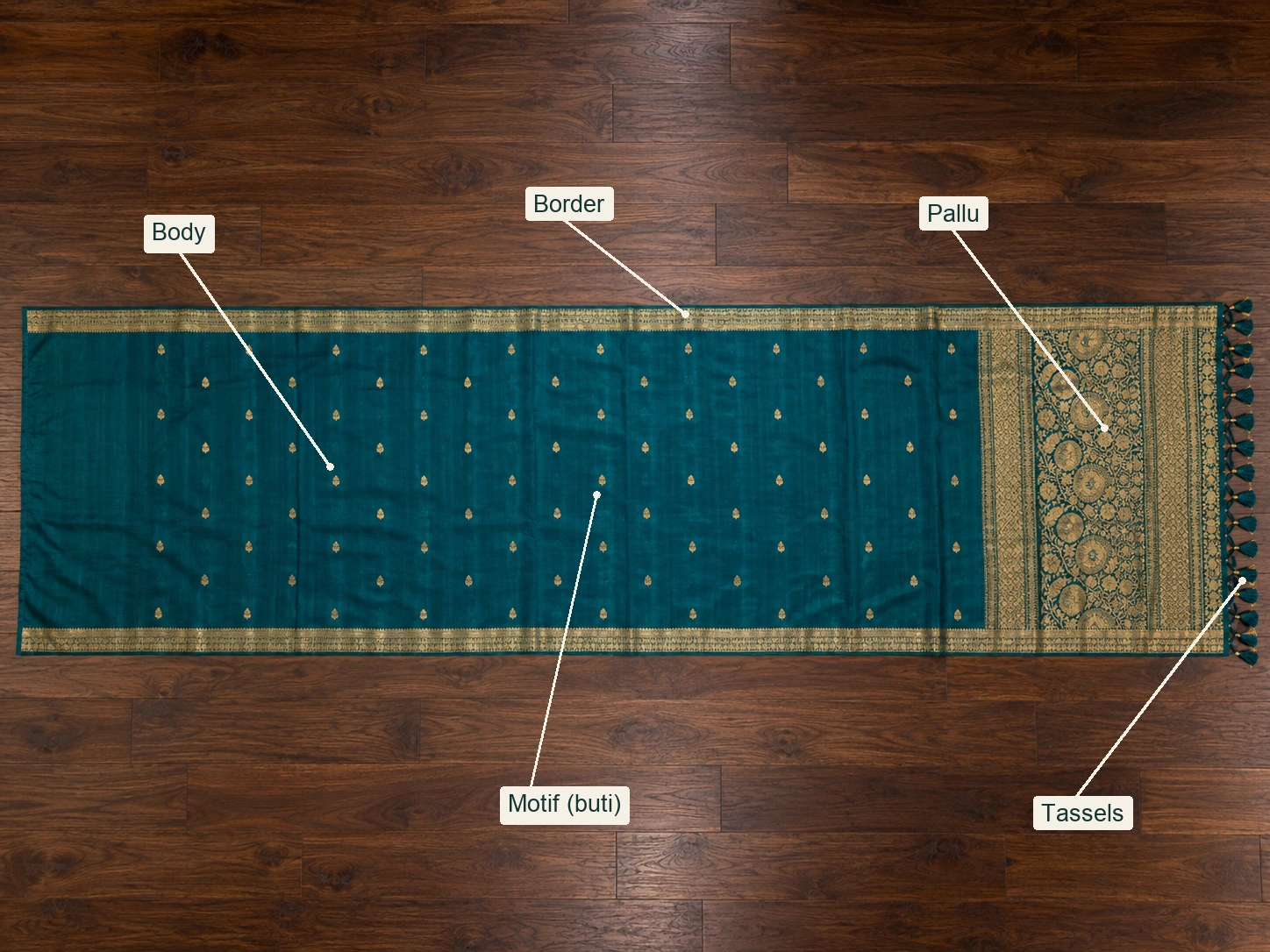
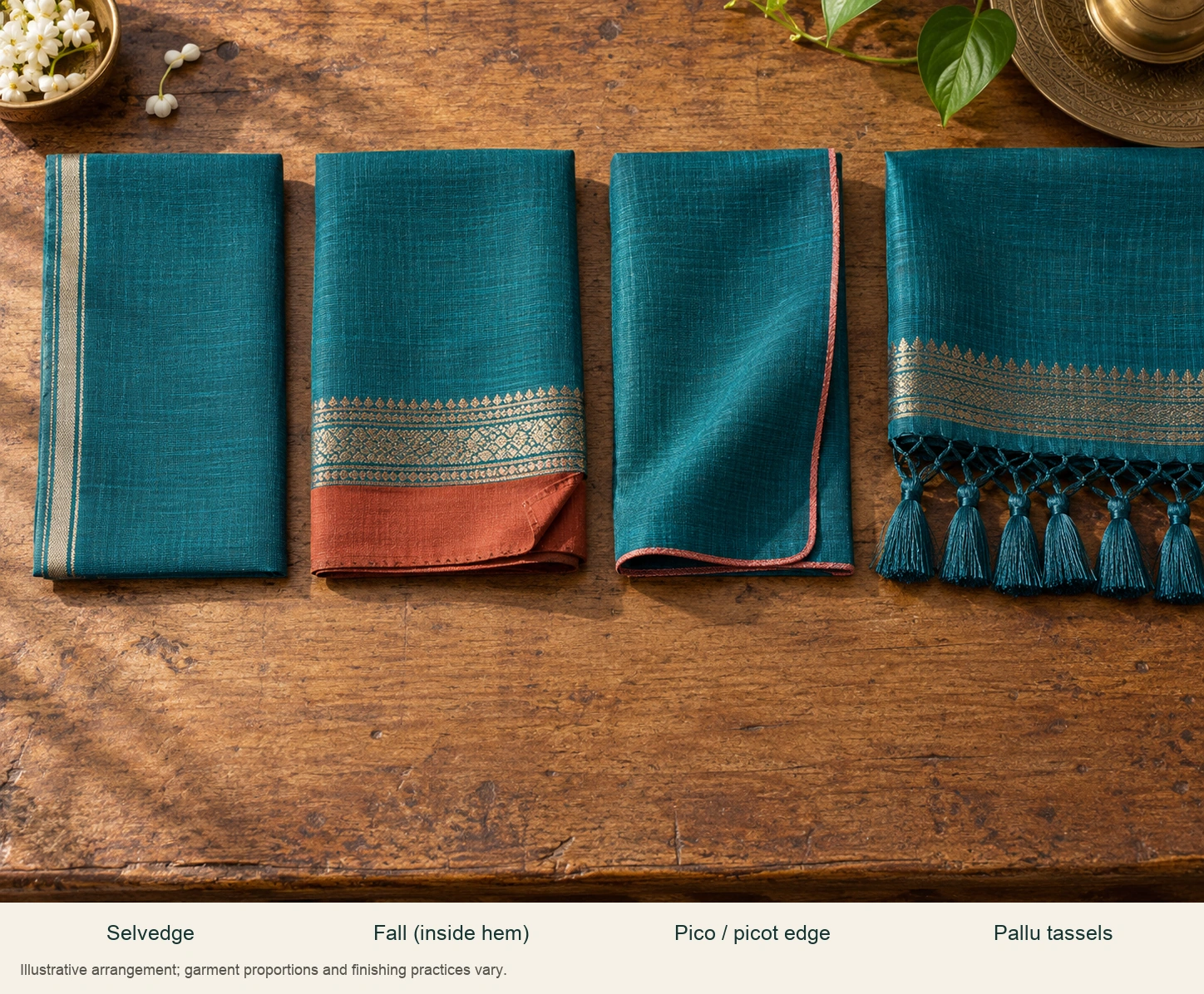
The selvedge is the finished woven edge that limits fraying. Tassels or fringe may finish the end. A matching blouse piece may be woven or packaged with the saree, but is not always included.
A fall is an added reinforcing strip stitched along part of the lower edge; pico is a finishing stitch. The petticoat or other waist support is a separate garment worn with many drapes. None of these is a fibre or weave type.
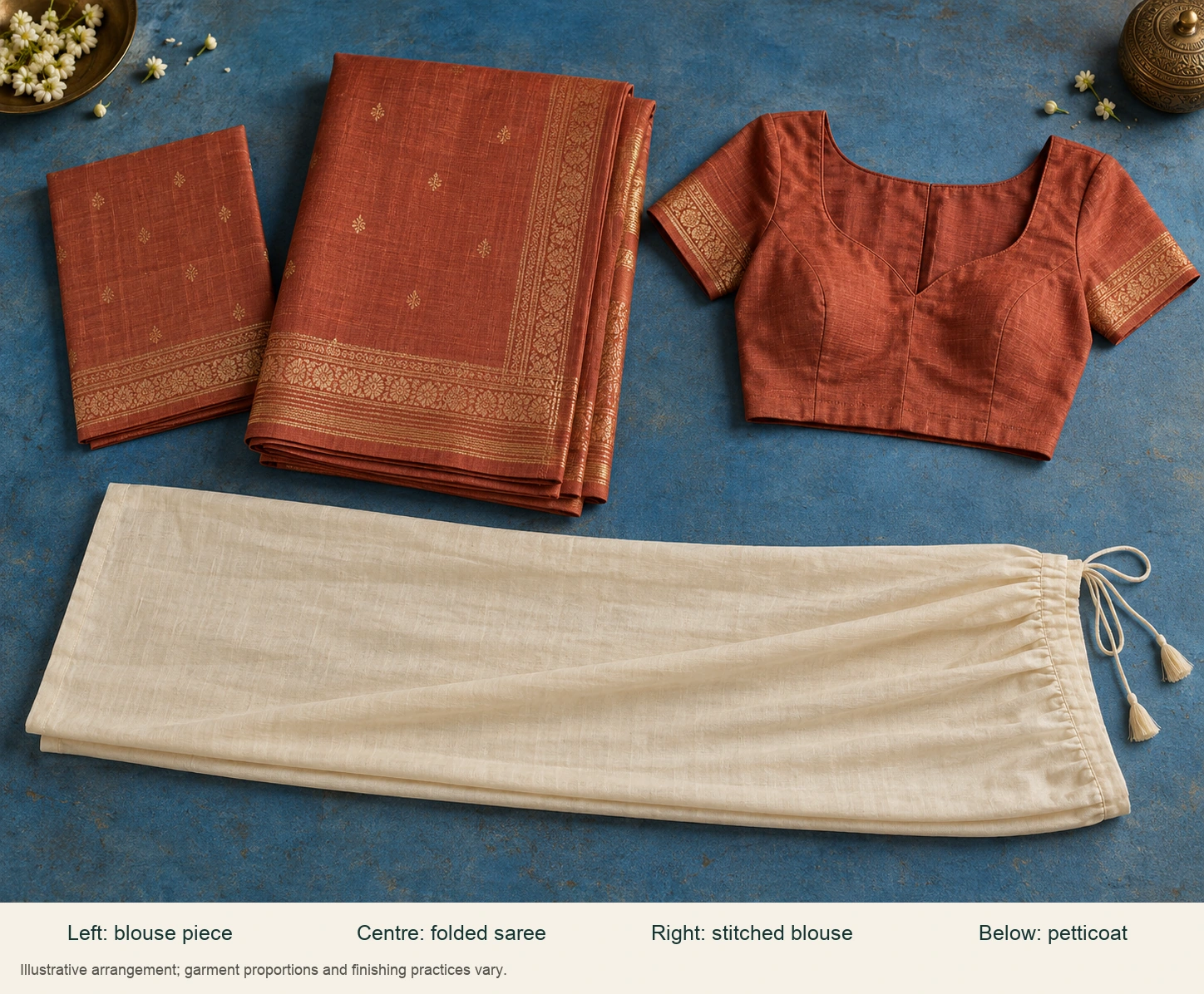
Many modern drapes use roughly 5.5 metres of saree cloth; a package advertised as about 6.3 metres may include the additional blouse length. A traditional Nauvari is commonly described as nine yards (about 8.2 metres). Check the measured drape length, width and included blouse material for each piece.
A saree may be the leading lady, but a good blouse, the right underskirt and proper finishing keep the whole performance together. Here are the practical pieces worth knowing before your tailor or shopkeeper asks.
An unstitched matching length may be included with a saree, but not always. Ask whether its length is included in the advertised metres.
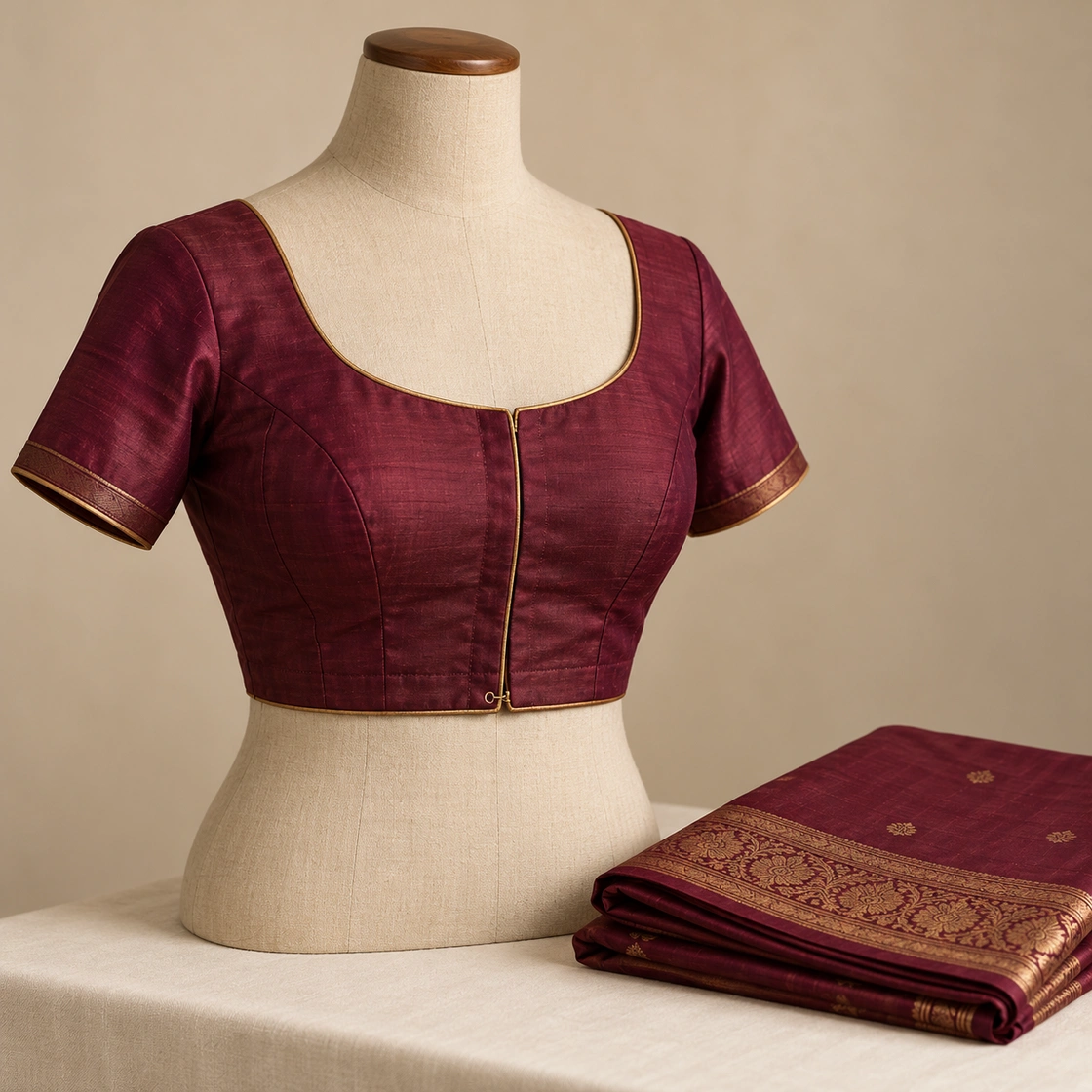
The tailored upper garment. Check sleeve, neckline, fit and closure; the saree itself does not determine blouse size.
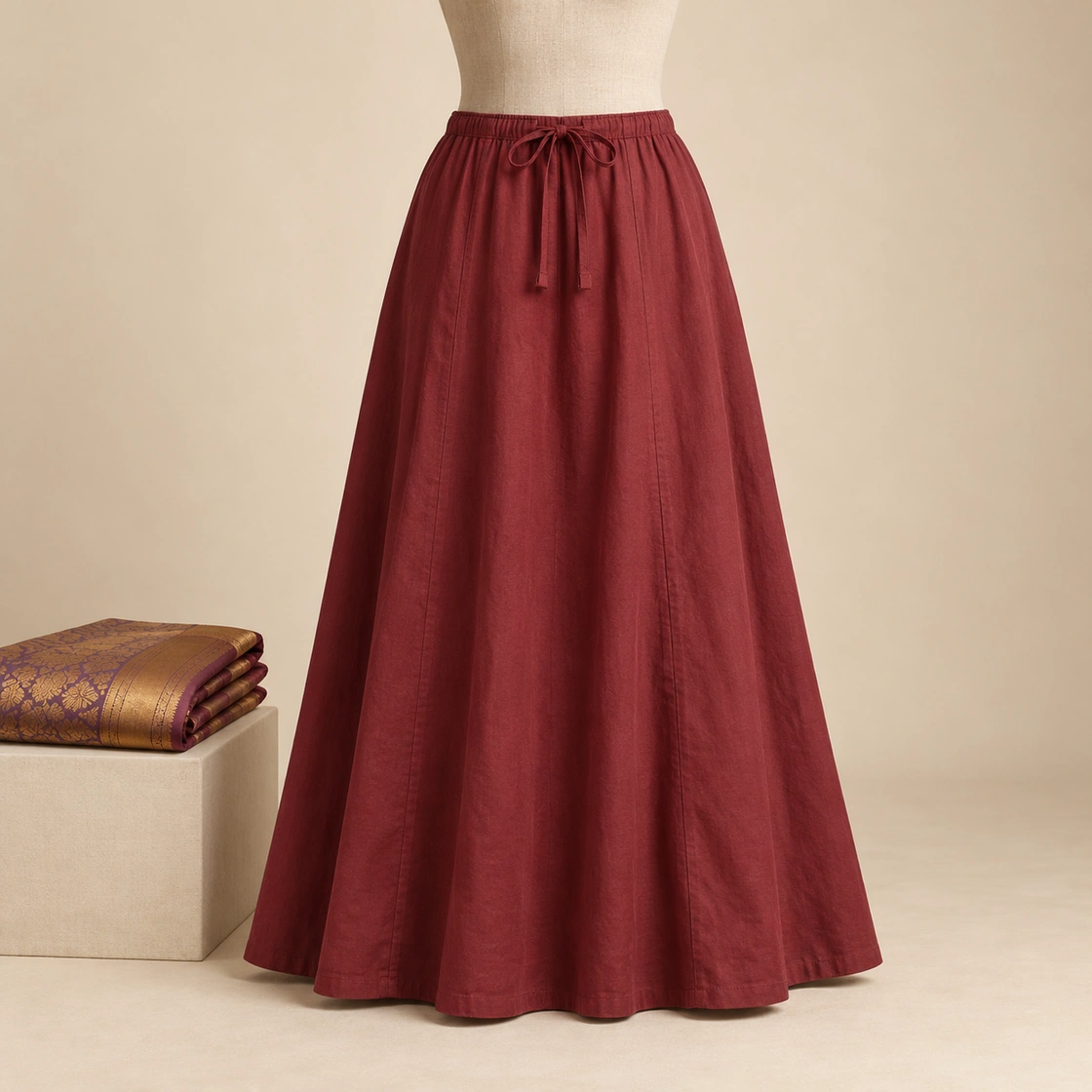
A separate underskirt that helps secure many conventional drapes. Cotton drawstrings are one common option.
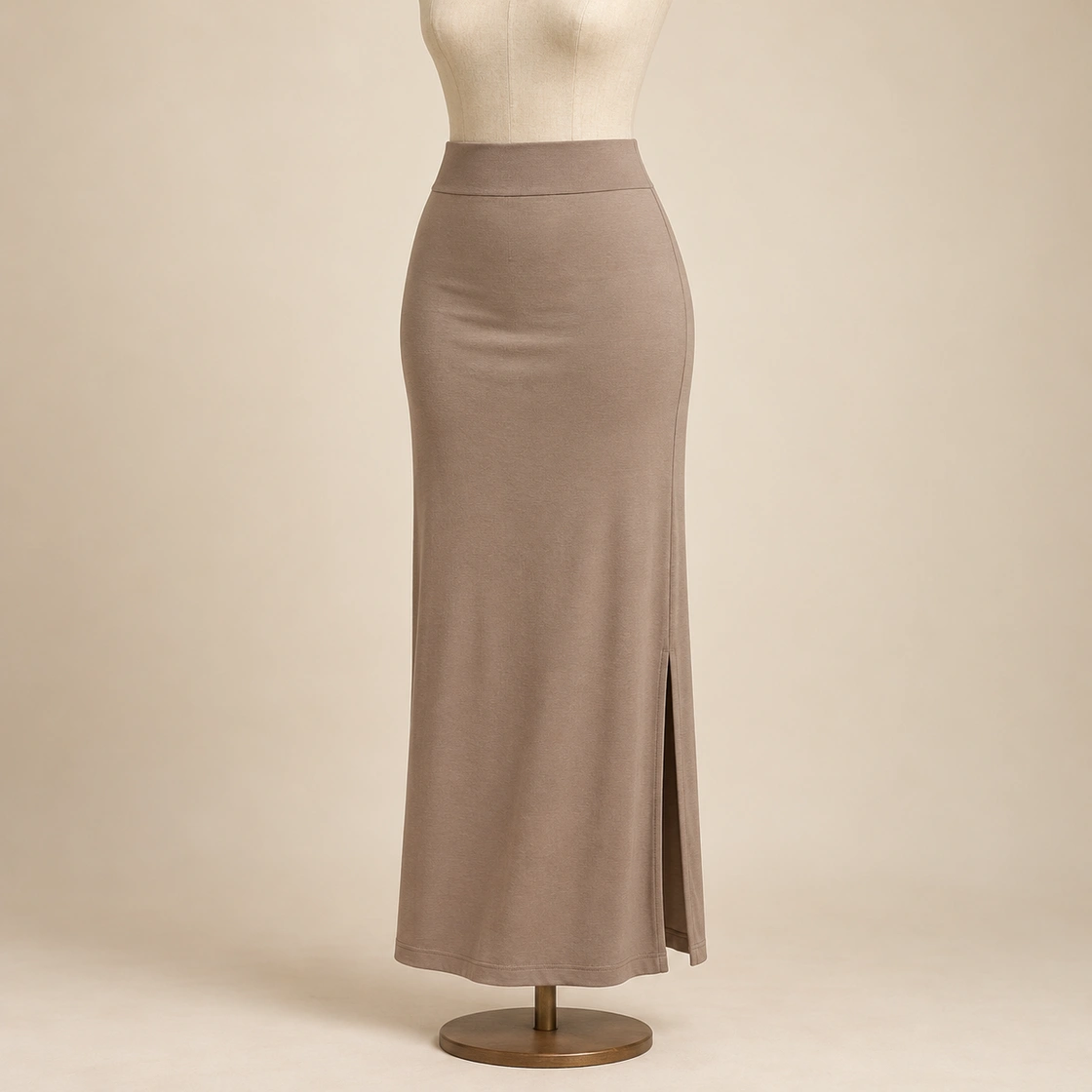
A body-skimming alternative to a traditional petticoat for some drapes. Fit and freedom to walk matter more than marketing promises.
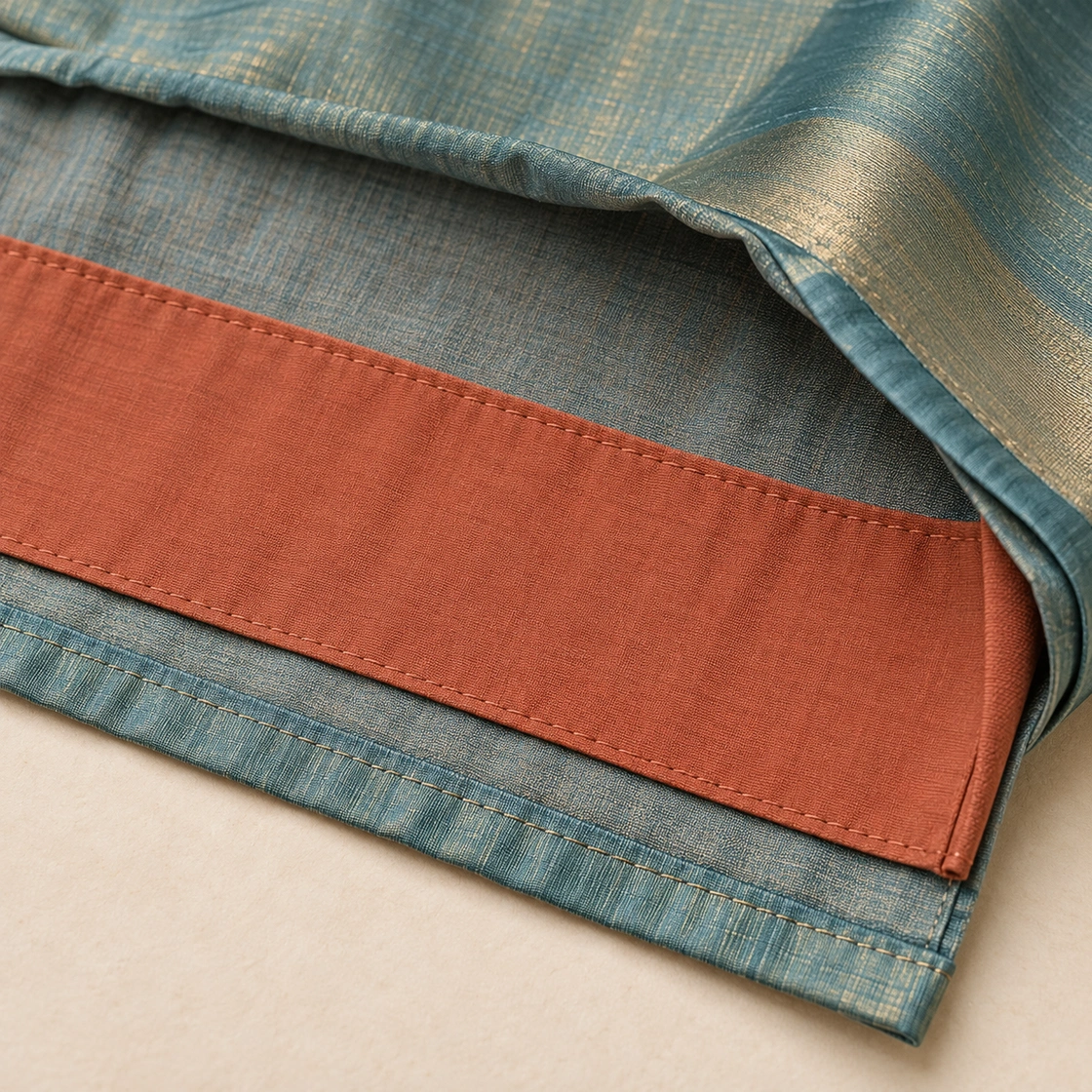
A protective strip stitched on the inner lower edge, commonly added to give the hem a little body and protect wear.
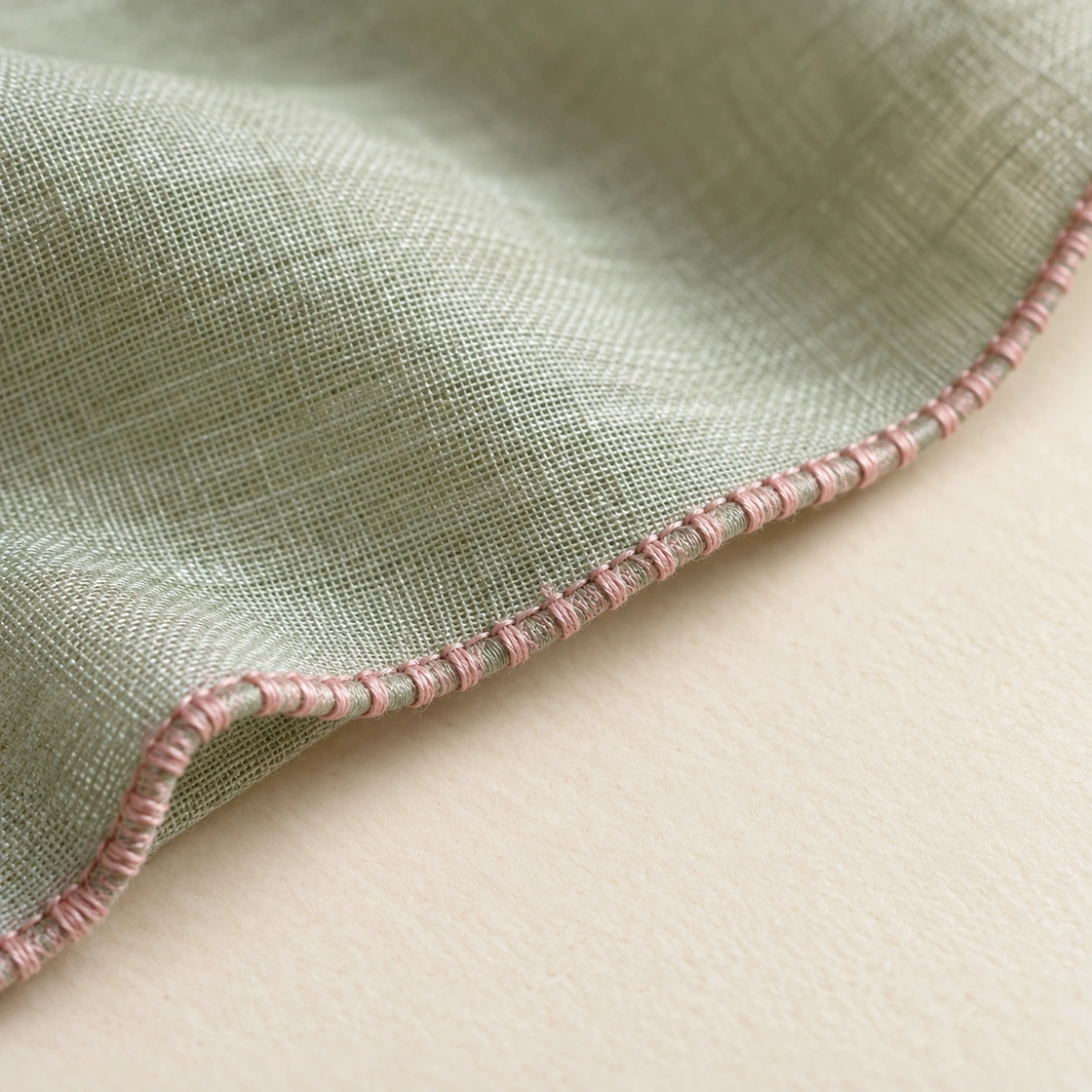
A narrow finished edge that helps control fraying. It is different from the separate, wider fall strip.
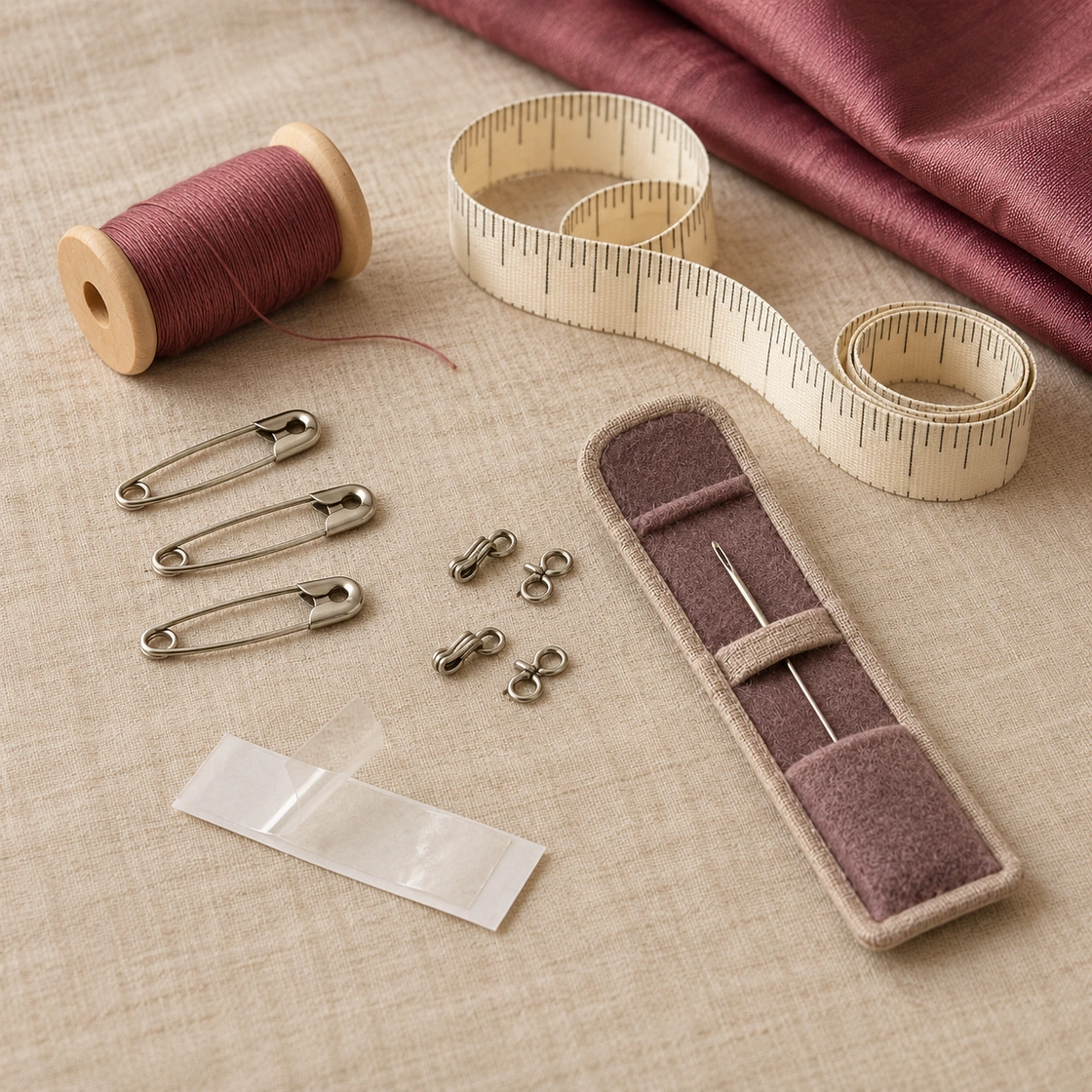
Pins, spare hooks, matching thread and a few discreet helpers save a surprising amount of last-minute trouble.
These are representative illustrations. Not every saree needs the same undergarment, fall, pico or accessories; details vary with drape and fabric. Check the Buyer’s Field Guide before purchasing →