Practical price assessment, invoice checks and three worked hypothetical shopping scenarios—without pretending an asking price proves authenticity.
A name is not a price“Banarasi” or “Kanjivaram” tells you the tradition. Fibre, loom, zari and workmanship set the price.
Compare like with likeTwo sarees are comparable only when their specifications match — not their labels.
An estimate is not a valuationThe ranges here are indicative market guidance. Only a qualified appraiser who has examined a piece can value it.
THE SAREE ATLAS · ILLUSTRATED REFERENCE
How to judge price and value
Assessing price and value
There is no single correct price for a saree simply because the tag says Banarasi, Kanjivaram or Paithani. A regional name identifies a tradition or visual style; the actual price depends on the materials and the particular work. The practical task is to establish which version of that saree is being offered, then compare prices for genuinely similar pieces.
A framework for comparison, with no points or fixed weights.
01
Material
Actual fibre and proportion, yarn quality, weight and fineness.
02
Pattern method
Woven, embroidered or printed: how was the design made?
03
Power source
Handloom or powered weaving, supported by evidence.
04
Zari
Stated metallic-yarn composition and relevant testing.
05
Complexity & finish
Skill, execution, motif work, alignment and condition.
06
Like-for-like comparison
Compare similar specifications; consider retailer costs and exclusivity.
1. Establish the material. Is it pure natural silk, cotton, a silk–cotton blend, viscose or polyester? Ask for the actual composition, not 'soft silk', 'semi-silk' or 'premium silk'. Natural silk can vary widely in quality and weight; real silk is not a fixed price category.
2. Establish how the pattern was made. A flower may be printed onto the cloth, embroidered after weaving or woven as part of the fabric. Each can look attractive, but the time and equipment involved differ. A genuine supplementary-weft Jamdani or laborious double-Ikat Patola is not directly comparable with a print that copies the same motif.
3. Establish handloom versus powered production. Handwoven work can command more because of skill and labour. Powered cloth can be excellent and should not be dismissed, but it should not be priced or described as handmade without evidence. Jacquard pattern control alone does not determine whether a loom is hand-powered.
4. Understand the zari. A 'gold zari' border may mean a gold-coloured metallic thread, a coated base-metal thread, or a more precious silver-containing thread with gold plating. Actual precious-metal content adds substantial cost. Ask for the composition and whether it has been tested. Tested zari does not automatically mean solid precious-metal zari.
5. Assess complexity and finish. Observe how much of the saree is decorated, whether intricate designs are cleanly executed, whether the border and pallu sit straight, and whether there are unwanted pulls, stains, weak edges or misalignments. A light, understated saree can require as much skill as a heavily decorated one, depending on its construction.
6. Compare like with like. A ₹25,000 handloom silk saree with imitation zari should not be measured against a ₹75,000 piece with silver-based zari as though the only difference were the brand. Equally, a high showroom price may reflect overhead, exclusivity or branding rather than a proportionately more complicated weave.
Where the money goes. Fine zari, dense hand-worked motifs and a supple silk can multiply a weaver’s time — and the price — several times over.
A price is a claim, too. Ask what it is paying for.
A price is only as meaningful as the description behind it. Before paying for a significant saree, ask for an invoice that names the tradition, the declared fibre, how it was made and what the zari is — in writing. See a field-by-field specimen and model wording below ↓
Practical price bands: what is reasonable to expect?↗
How to read the prices. Every figure on the Atlas is an approximate, indicative budget for the grade named beside it — the fibre, how it is woven, the motif technique and the zari — drawn from Indian online retail in October 2026. It is not a quotation, a valuation or a ceiling, and a “+” means finer work is priced individually. The Regional Saree Atlas describes an accessible authentic grade, the Collector’s Edit a chosen, more distinctive grade and the Coveted Ten one exceptional variety, so the ranges teach a progression and can overlap. A cheaper listing may be a different fibre or a blend, a printed rather than woven design, power-loom work, a simpler design, different zari or simply unspecified. That does not make it fake or inferior, but it is not the same grade. The table below gives the Regional guide for each tradition; the Collector’s Edit and the Coveted Ten price their own grades.
Indicative Indian online retail prices, checked October 2026, for the textile grade stated. These are representative shopping ranges, not market-wide minimum and maximum prices. Fibre, weaving or embroidery, motif density and zari specification affect the price, and exceptional pieces are quoted separately. Each linked tradition shows its own grade and price references in the Regional Atlas.
Fibre first: cotton at entry, silk–cotton and silk higher; about ₹11,000–₹20,000 for pure silk. Dense double ikat and Telia work need their own comparison.
Motif method, design density and zari composition. Kadwa (about ₹28,000–₹50,000 in the Collector’s Edit) and Shikargah (about ₹30,000–₹85,000; real-silver-zari pieces from about ₹1,65,000) are separate grades.
Border yarn first: silk thread or zari, and whether tested, half-fine or pure. Contrast korvai with declared pure zari is a separate grade (about ₹30,000–₹80,000+).
Both yarn directions are patterned before weaving; workshop and origin confirmation matter. Selectively elaborate pieces cost more, and complex masterworks are quoted individually.
Motif yarn and zari disclosed separately; elaborate work costs more. A printed saree marketed as “Muga” is a different, unpriced category — why.
Designer label or couture, regardless of fabric
No useful fixed ceiling
Design exclusivity, embroidery, branding, service and scarcity.
The Collector’s Edit gives narrower, named collecting budgets for twenty curated selections; they sit inside or beside these guides because each describes a particular grade. A price alone never proves authenticity, and a lower-priced authentic cotton or lighter silk saree may be an excellent purchase.
Example: why two apparently similar pieces cost ₹12,000 and ₹45,000↗
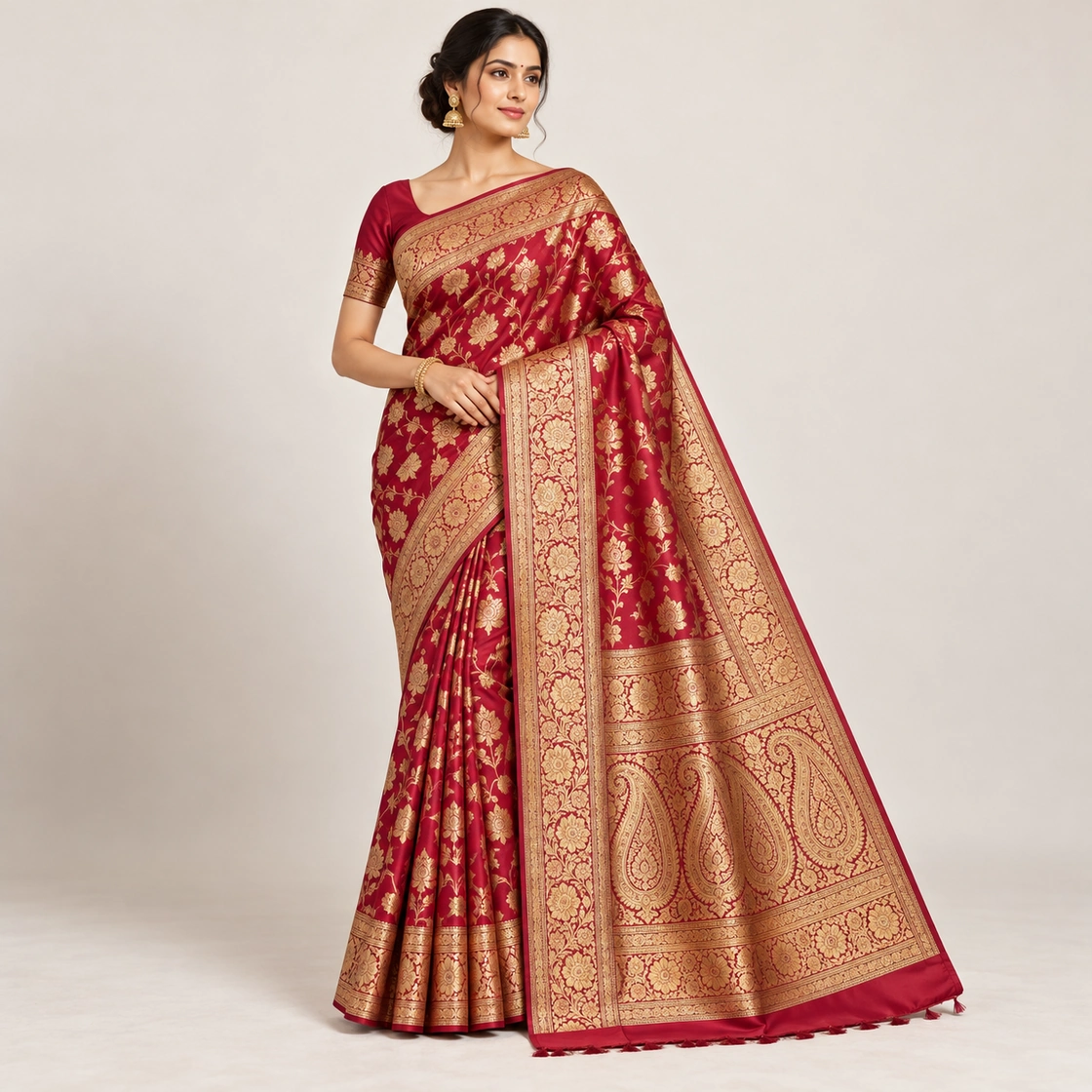
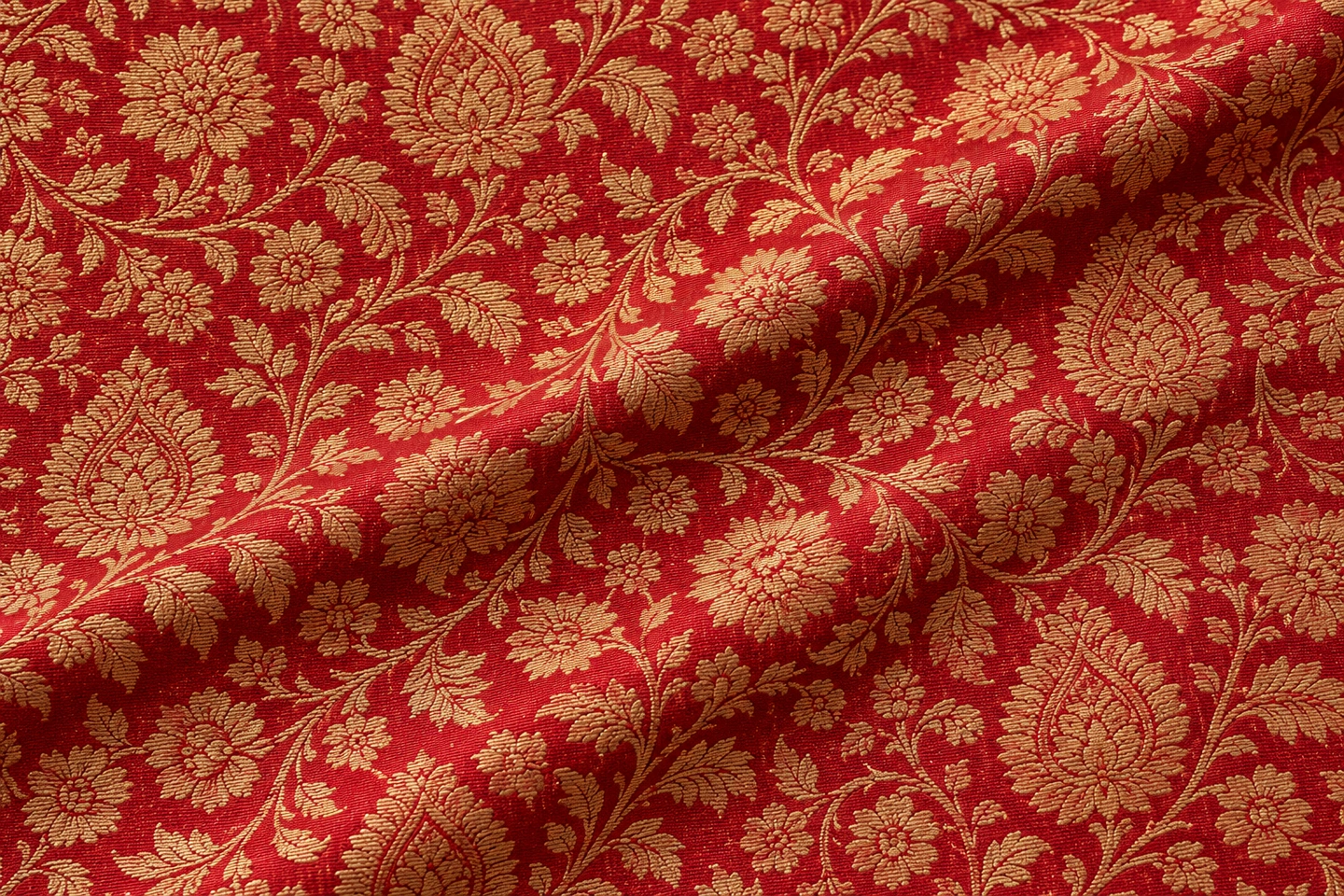
Imagine two red sarees with gold-coloured flowers, both labelled 'Banarasi'. The ₹12,000 piece might have genuine silk but a relatively simple repeated motif and imitation metallic thread, while the ₹45,000 piece might use more complex individually worked motifs, finer silk and a significantly denser design. Or the cheaper one might be a beautifully executed powerloom fabric while the other is handwoven. There is no way to conclude which case applies from the photograph or sticker alone: the product specifications determine whether the comparison makes sense.
ILLUSTRATED STUDY
₹12,000 / ₹45,000: ask what differs
Both specification cards are hypothetical. The prices do not belong to the pictured items.
Hypothetical A · ₹12,000
Illustration only: Banarasi-style sareeNo price or specification is attributed to this image.Open full-resolution image
Handloom versus powerloom must still be established.
Compare
Ask about yarn quality, finish and the seller’s exact description.
Hypothetical B · ₹45,000
Illustration only: ornate brocadeNo price or specification is attributed to this image.Open full-resolution image
Possible specification
Finer silk and more complex motif work, perhaps greater design density.
Unresolved claim
Individual motif work and handloom method need evidence.
Compare
Check whether the material, zari or making method actually differs.
Worth checking: These prices and specifications are hypothetical examples, not valuations of the pictured sarees.
Printed motifs versus single- and double-Ikat production
The same problem occurs with 'Patola'. A ₹6,000 printed silk-like saree, a ₹35,000 single-ikat silk saree and a ₹1.3 lakh documented double-ikat Patan Patola belong to radically different product categories. Calling all three Patola without qualification conceals the information that most explains the price.
The comparison concerns process and workmanship, not simply how much the resulting motif resembles a traditional design.
ILLUSTRATED STUDY
Where the pattern enters the process
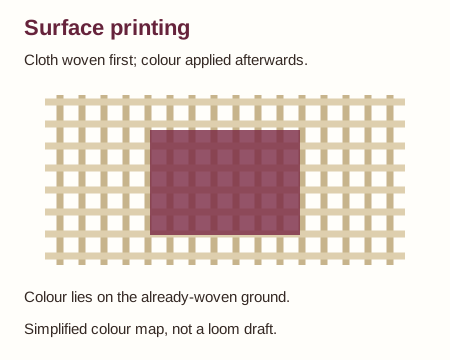
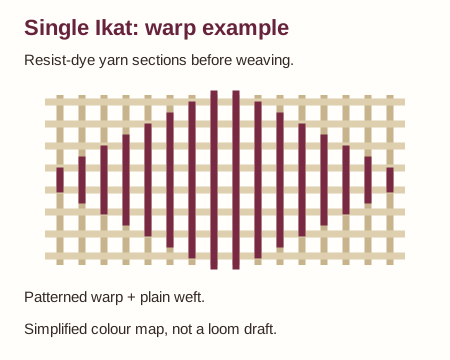
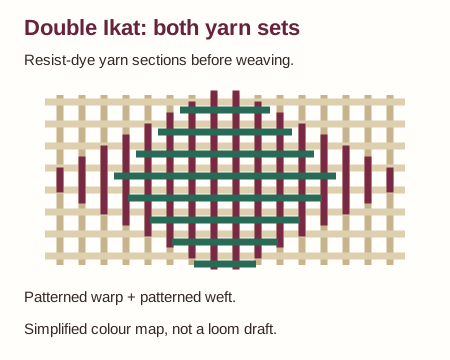
Printing, single Ikat and double Ikat involve different production sequences.
Weave ground cloth → apply surface colour.On small screens, scroll the diagram sideways to inspect the labels.
Resist-dye warp OR weft → weave with the other yarn set.On small screens, scroll the diagram sideways to inspect the labels.
Resist-dye warp AND weft → align both during weaving.On small screens, scroll the diagram sideways to inspect the labels.
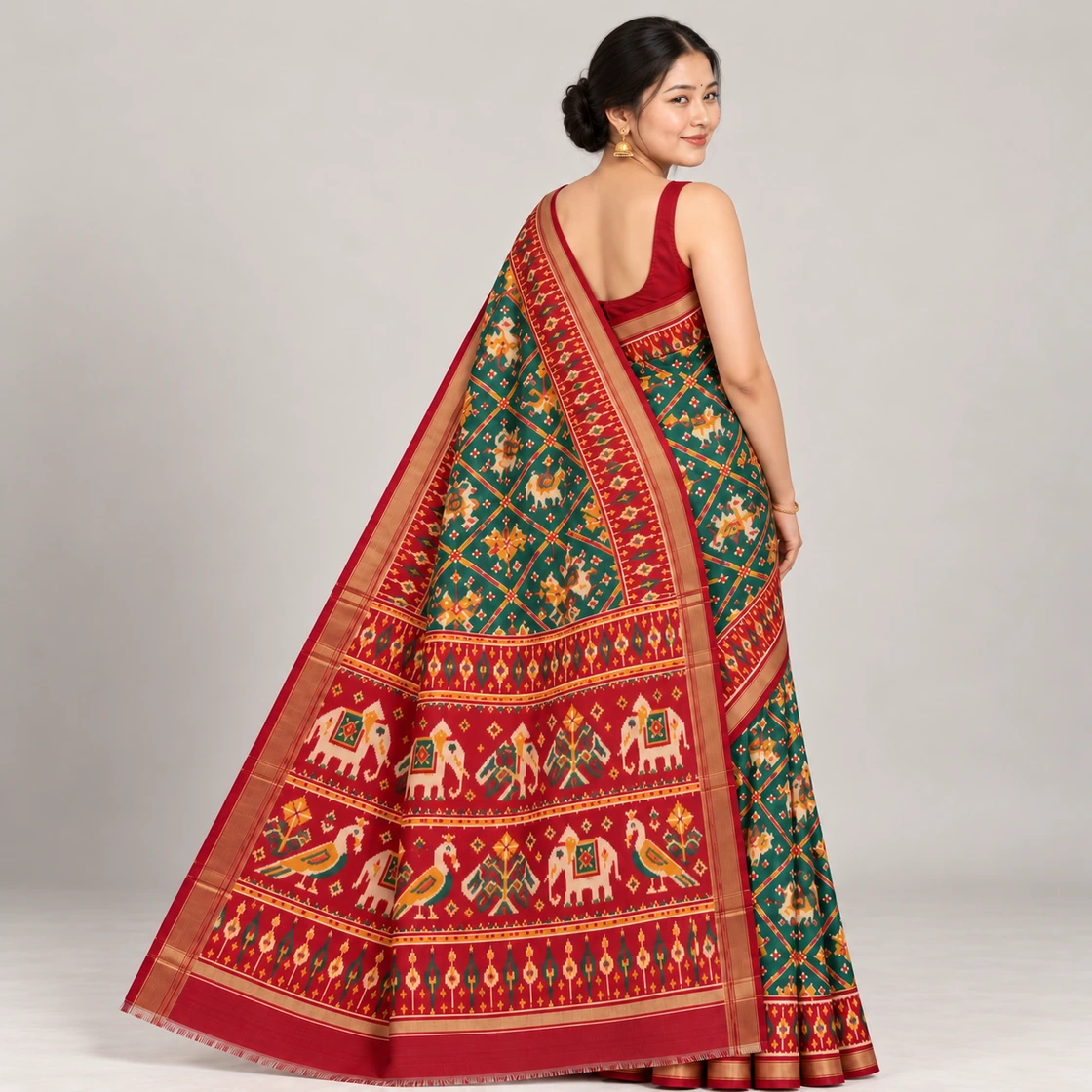
Regional design-language referenceIllustration only; process is not verified by the image.Open full-resolution image
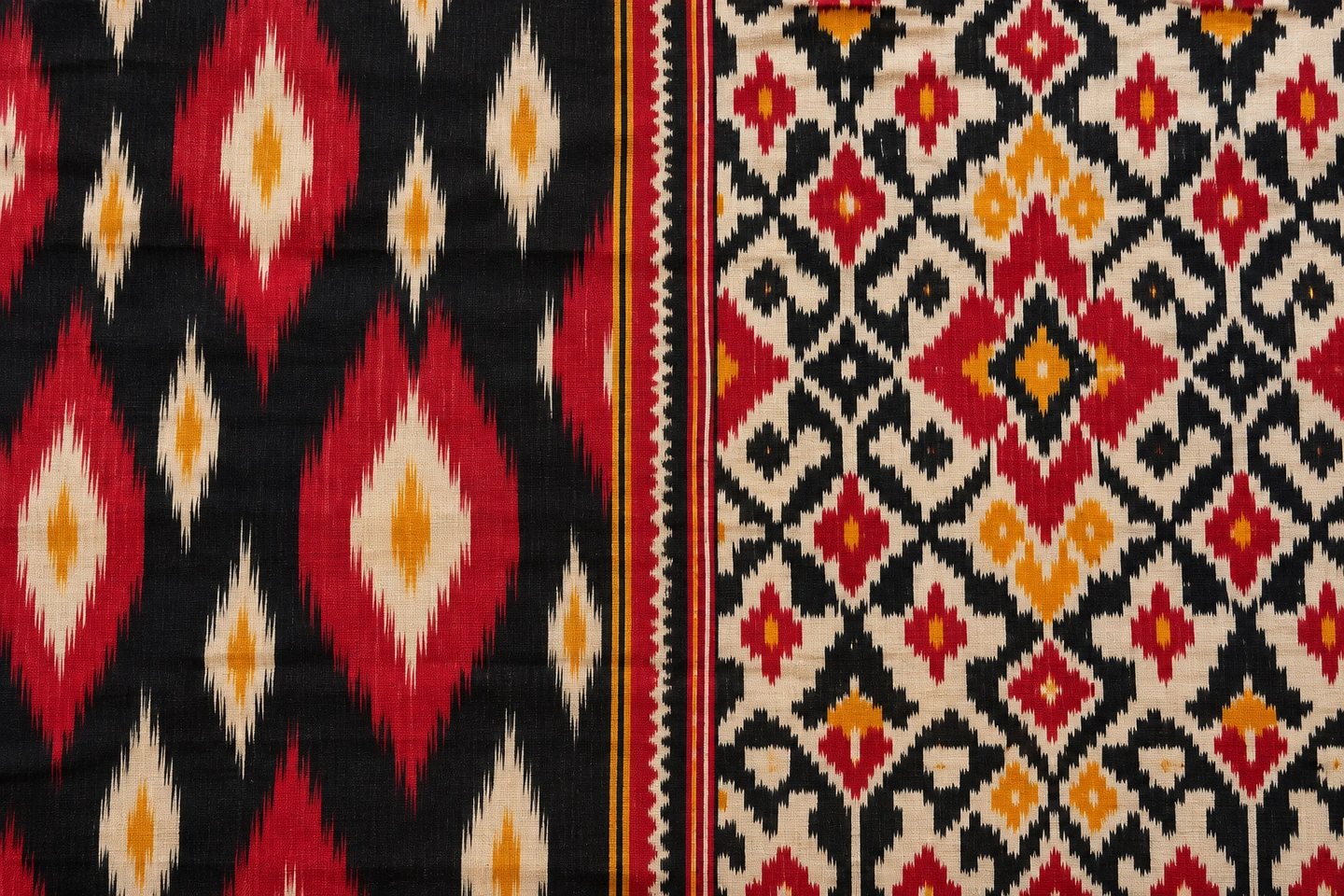
Geometric pattern referenceColour boundaries alone are not a definitive process test.Open full-resolution image
Price should be questioned when the fibre is undisclosed, expensive handwork is claimed but cannot be explained, the invoice gives only a vague trade name, heavy 'real gold zari' claims are unsupported, or the seller refuses to differentiate a regional original from a stylistic adaptation. Equally, visible faults in dyeing, border alignment, pallu finishing or the fall of the fabric deserve an explanation. A premium label does not excuse manufacturing defects.
Sarees are usually purchased for wearing and appreciation, not investment returns. Traditional craftsmanship, condition, scarcity and documented provenance can affect collector interest, but there is no liquid, standardized resale market that guarantees rising values. The best purchase combines dependable material information, workmanship appropriate to the price, appearance the wearer enjoys and realistic care requirements.
APPLY THE PRICE FRAMEWORK
Three realistic buying scenarios
All prices and vendor statements below are fictional examples. They demonstrate how to ask better questions, not current quotes or market valuations.
Case A · The ₹25,000 Banarasi budget
Two red sarees, two very different claims
You have a ₹25,000 budget. One seller quotes ₹18,000 for a Banarasi-style saree with a brocade-like finish; another quotes ₹25,000 for a saree represented as handwoven natural silk with woven motifs.
Verify: Fibre statement, whether motifs are woven or printed, handloom provenance, zari composition, and exactly what each invoice will record.
Buying lesson: A higher quote is not proof of better production, and a lower quote is not proof of imitation. Compare stated specifications, then choose the look and workmanship you value.
Case B · The first festive saree
₹6,000 fluid drape or ₹12,000 crisp silk?
One saree is described as easy-care polyester georgette; another as natural silk organza. Both are attractive, but one falls close to the body while the other may create more structured volume.
Verify: Actual composition, transparency, blouse and underskirt needs, care requirements, and whether you can comfortably pleat each piece.
Buying lesson: The “better” buy depends on the wearer, the event and the intended use—not solely on natural-versus-synthetic status.
Case C · The “real gold” claim
A ₹35,000 Kanjivaram-style saree
The salesperson says a heavy, gold-looking border justifies the asking price because it contains precious-metal zari.
Verify: Whether the saree itself is documented as silk and handwoven; exactly what the zari thread contains; any testing evidence; and the seller's written return terms.
Buying lesson: Silk Mark is not certification of zari metal content. If the premium depends on the metal claim, request evidence specific to that claim.
Before paying: Open the entire saree, compare like specifications, ask for written claims, check condition and care, and confirm the invoice and return policy. An attractive photograph never settles fibre, provenance or zari composition.
Change the specification, budget or intended use. Return to the first check.
Clarify or pause
Ask for the missing information. If it remains unsatisfactory, leave the purchase open or decline.
Consider the purchase
Proceed only if you are comfortable with the product, evidence, total and terms.
When the showroom floor is full of possibilities, use this short sequence before getting lost in the adjectives:
Write the claim in plain language. “Natural silk; handwoven; supplementary-weft floral motifs; metallic-looking zari” is more useful than “royal heritage premium.”
Identify the one or two claims that most affect the asking price. They may be labour-intensive weaving, documented fibre, precious-metal content or an unusually elaborate design.
Ask what evidence supports those claims. A label, maker information and an itemized description are different forms of evidence; none guarantees every possible quality.
Compare two genuinely comparable items. Compare material, ornament, production method and finish rather than just colour or regional name.
Imagine actually owning it. Drape, care costs, return policy and how much you like the saree are legitimate factors in value.
What a useful invoice looks like
For a significant purchase, an invoice that merely says “one silk saree” leaves too many questions unanswered. Prefer a description that identifies the exact article, declared fibre composition, design or weaving method as represented by the seller, any claimed certification reference, and the price paid. If zari composition is untested, writing “composition not verified” is more meaningful than an unsupported assurance.
Illustrative wording, not a real purchase: “Banarasi-style silk saree; body declared 100% mulberry silk; woven floral supplementary-weft motifs; zari composition untested; production method represented as handloom; product identifier ABC-001.” This is an example of how to write claims down, not proof that a pictured saree possesses these properties.
ILLUSTRATED STUDY
A bill should describe the product
A fictional layout showing useful fields, without a real merchant identity.
FICTIONAL TEACHING SPECIMEN · NOT A RECEIPT
Information to request on a bill
Seller identity
[Legal seller name, address and contact]
Document details
[Invoice number and date]
Product description
[Saree style / product ID and quantity]
Declared fibre
[Composition and blend proportions]
Making claims
[Weaving method; decorative method; origin if supported]
Zari statement
[Stated composition, or clearly “not tested”]
Supporting records
[Relevant label, registration or test reference]
Price & tax
[Item price, discount, applicable tax details and total]
Terms
[Care instructions, returns and alterations in writing]
Worth checking: This is a specimen invoice. Ask the seller to describe the actual saree and provide applicable tax and product details.
Add origin, maker and certification where documented. Avoid buying on the strength of adjectives such as royal, heritage, premium, authentic or pure zari look alone.
Silk Mark addresses genuine 100% natural silk, not handloom origin or zari purity. Handloom Mark addresses handwoven production, not silk content. India Handloom Brand adds a different scheme for registered quality-parameter compliance. A GI name concerns the protected geographical indication, but its use in a retail description should not be mistaken for evidence that the specific product has been verified. Silk Mark: Ministry of Textiles release (PIB) · Government handloom scheme documentation.
Retail price examples elsewhere in this chapter describe indicative scenarios or dated seller references. They are not market appraisals; independent specification comparison remains essential.
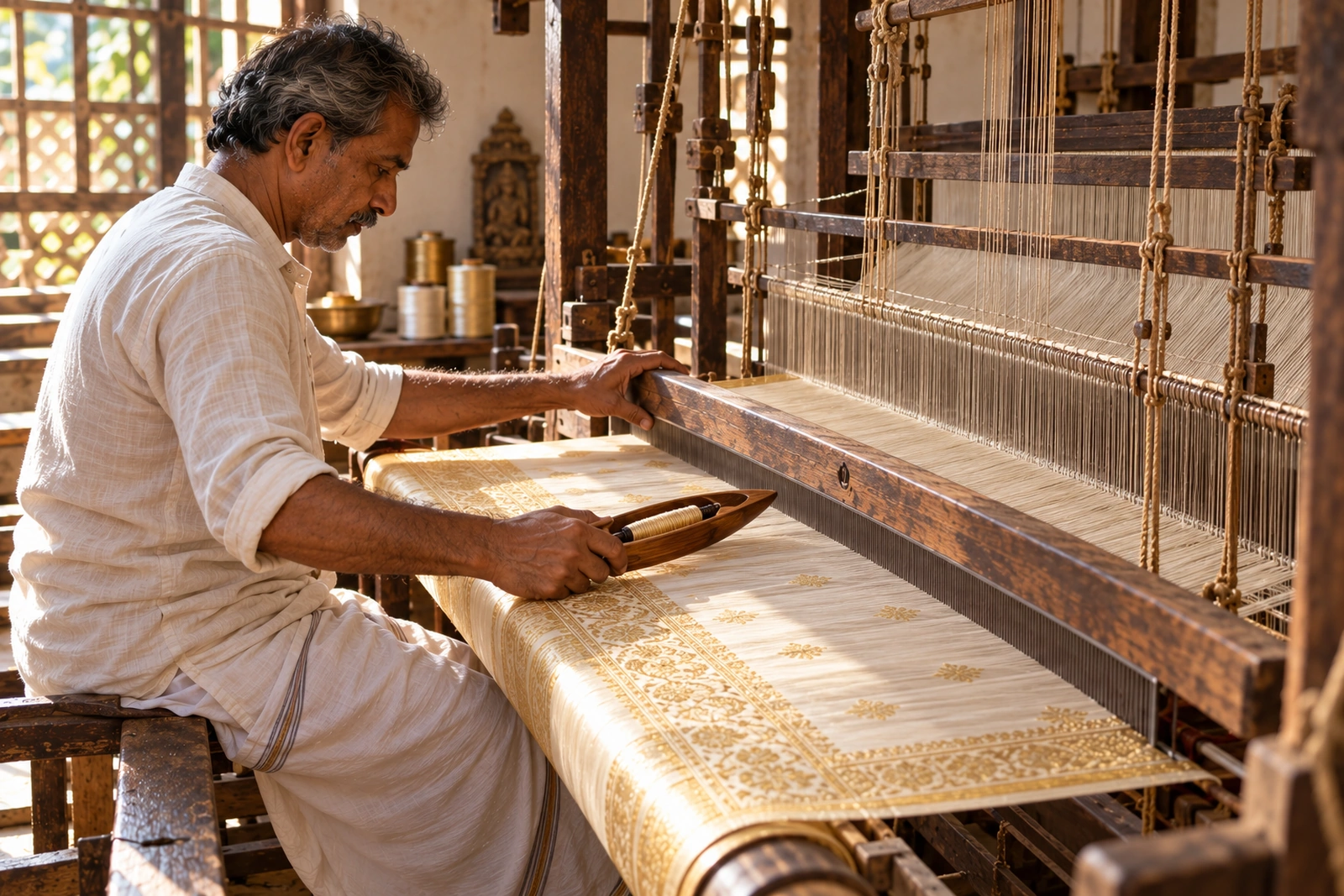
Time is the hidden ingredient. A handloom saree can take days or months; a powerloom one, hours. The difference belongs in the description, not just the price.
RARE DOES NOT ALWAYS MEAN COSTLY
Beyond Price: Rarity & Collectability
Two sarees can cost the same and embody very different kinds of value. Material, workmanship, rarity, provenance and cultural significance are overlapping considerations—not a universal prestige ladder.
Material
Ask what fibres, yarns, decorative threads and finishes are actually present. Fibre prestige is not a ranking of beauty.
An authentic 100% natural silk saree is materially different from a silk–cotton blend, viscose or polyester saree. Within natural silk, mulberry, Tussar, Muga and Eri are different materials, not successive luxury grades . Fine mulberry filament silk may be sought for its smooth lustre; Muga is prized for its gold-toned natural fibre and regional heritage; Tussar for its texture; Eri for its soft, often matte quality. Their desirability depends on what the saree is intended to be.
Workmanship
Compare the process of pattern-making, the quality of weaving, joins, ornament and finishing. Print, embroidery and woven motifs are not interchangeable production claims.
At one end are straightforward woven or printed sarees that can be produced relatively efficiently. At the other are individually worked Jamdani motifs, intricate supplementary-weft brocades, elaborate tapestry-style pallus and double-Ikat pieces whose patterns require very precise preparation. Each technique has its own learning curve. A densely decorated design need not be superior to a simple one, but genuinely labour-intensive work usually deserves to be compared with work of similar complexity.
Rarity and provenance
Scarcity may arise from technically demanding work, a documented maker, limited production or an exceptional surviving piece. “Collector-grade” needs evidence.
Some verifiably traditional products are scarce because few artisans can make them, their materials are expensive or production takes unusually long. Patan double-Ikat Patola and especially intricate heirloom-quality Paithani or fine brocades can sit high in this category. However, rarity should be documented , not merely claimed by a boutique as 'exclusive'. A repeating card pattern can be used for many sarees; a fashionable print can be marketed as limited without being technically difficult.
Cultural meaning
A textile may hold exceptional ceremonial, family or community importance regardless of its resale value.
Kanjivaram silk, Banarasi brocade, Paithani and other ceremonial sarees carry particular prestige within regions and families. This is a cultural hierarchy, not a laboratory ranking. A Bengal Jamdani, Kerala Kasavu or Assamese silk may be more meaningful for a specific ceremony than a more expensive saree from elsewhere. Contemporary fashion also deliberately reverses conventional expectations: a very fine plain cotton can signal refinement in settings that once emphasized heavy silk and zari.
Collectability is a reason to ask better questions, not an excuse to stop asking them. For material definitions see Fabrics & Silks; for verifying claims see Materials & Verification.
Pricing note: indicative Indian online retail prices, checked October 2026, for the grade stated. Premium grades and individual products can differ materially; seller descriptions are claims, not independent authentication.