Saree Care
A practical guide to cleaning, drying, storing and preserving treasured sarees. Always begin with the actual fabric and its care instructions.
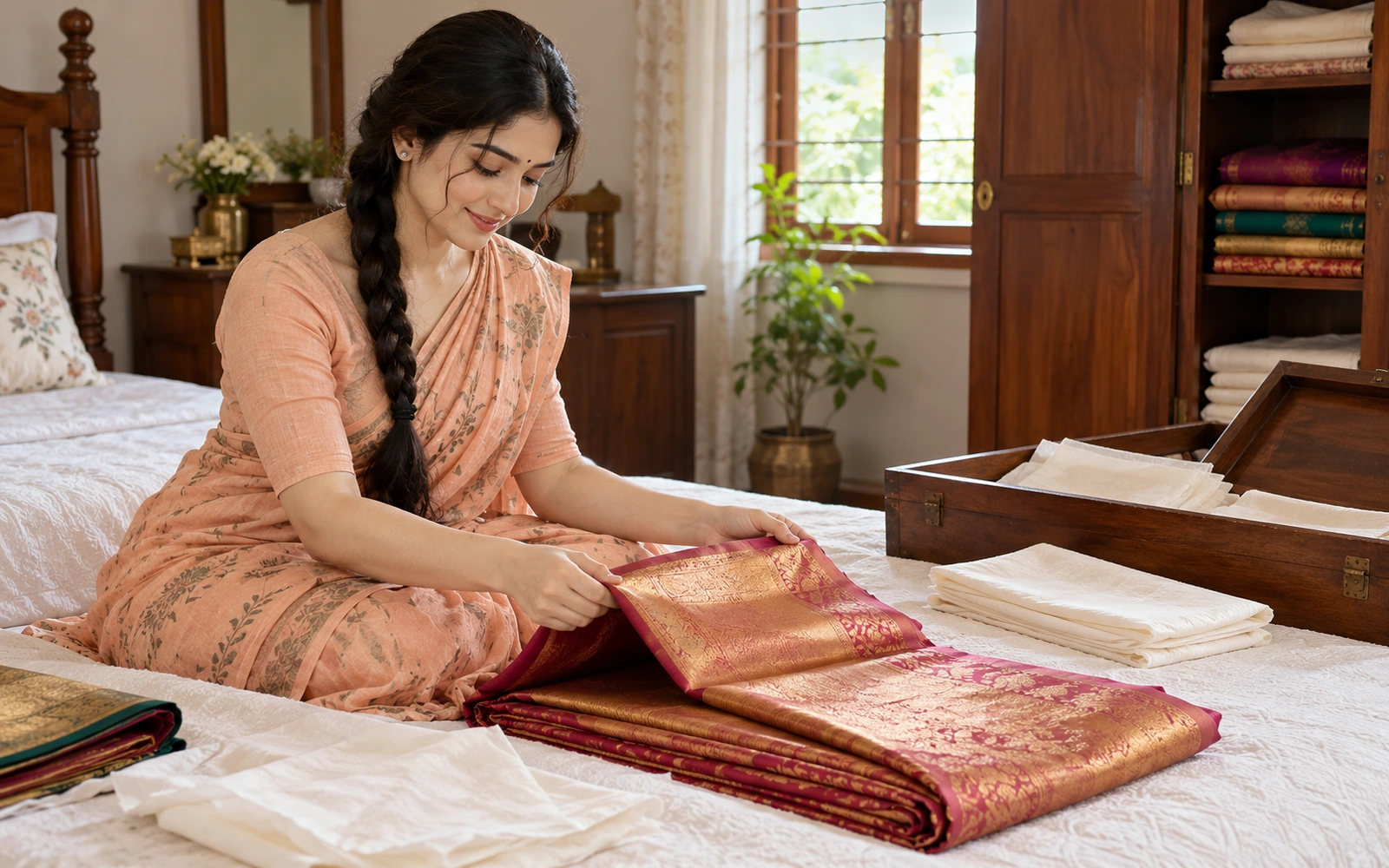
Care that suits the actual saree
A practical reference for storage, cleaning, pressing and travel, in six short topics. Read straight through or jump to the one you need; follow the garment’s care label and be particularly careful with fragile silk, zari and heirloom work.
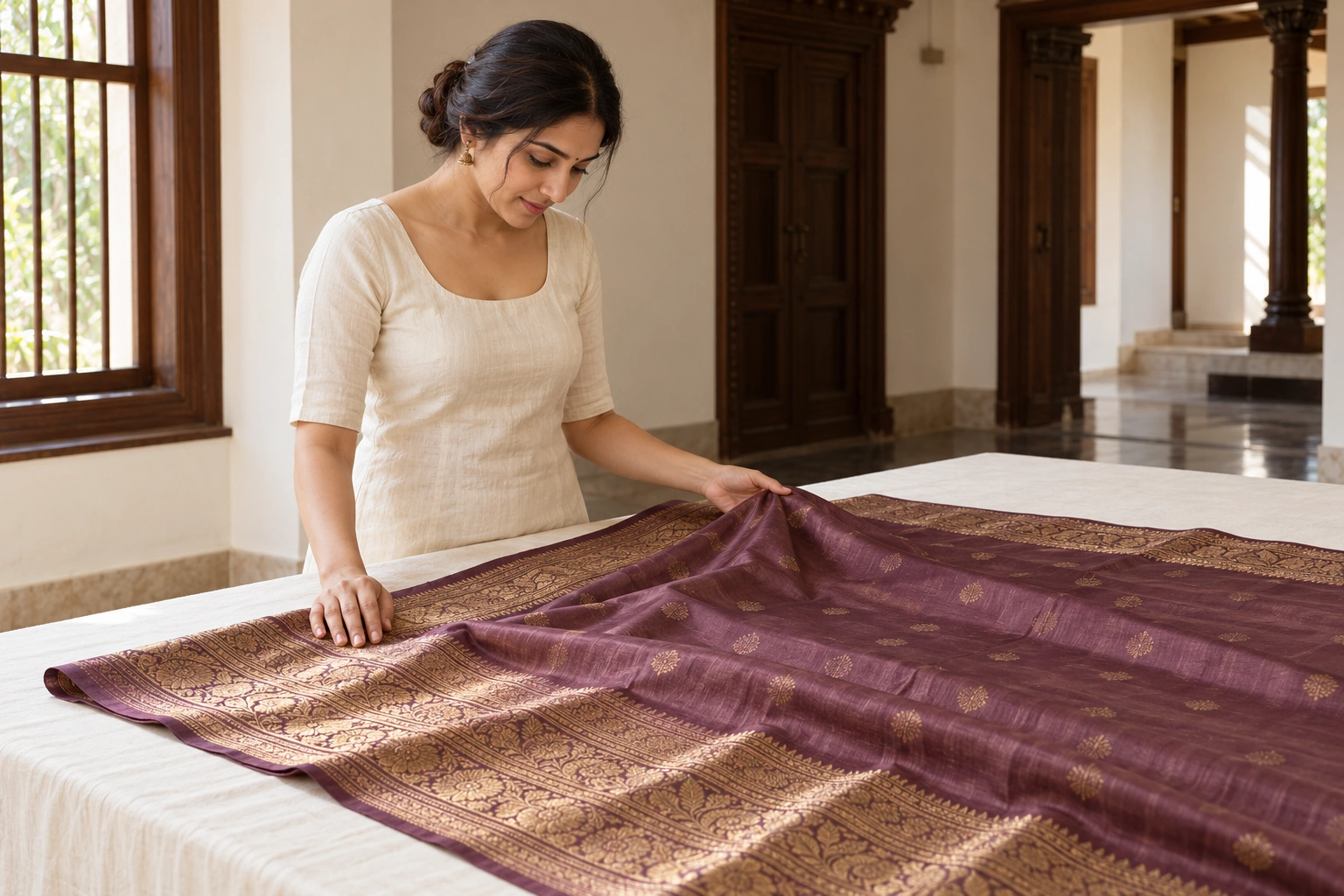
Fibre, silk and zari
Know the actual fibre and construction before handling.
- Start with this garment, not its regional name
Do: Keep the item’s label, fibre and decoration details with its purchase record. Use its care instructions for routine care; if absent, conflicting or inconsistent with visible fragility, obtain advice before cleaning.
Avoid: Do not choose a wash or dry-clean method from “silk”, “cotton” or a regional name alone.
- Support silk and protect it from light
Do: Handle on a clean supported surface, lift with support across the cloth and keep prolonged light exposure low. If accidental wetting occurs, support the wet textile and seek item-specific drying advice.
Avoid: Do not lift a wet silk saree by one edge, wring it or stretch a heavy pallu from a fine body.
- Do not assume every silk needs the same cleaning
Do: For a sound modern silk piece use the maker’s garment-specific method or a cleaner experienced with its dyes and ornament. For an heirloom, obtain a conservator’s assessment first.
Avoid: Do not adopt universal first-dry-clean, every-wash-improves, detergent, soak-time or ironing-temperature rules.
- Cotton is not automatically washable
Do: A sound modern cotton saree may be washed only when the actual label permits that method. Follow its temperature, agitation and drying instructions; account for contrast borders and added decoration.
Avoid: Do not assume white/undyed-looking cloth, a cotton body or handloom status permits boiling, bleaching or vigorous washing.
- Allow for cotton finish and shrinkage
Do: Ask about sizing, shrinkage and finishing before washing or tailoring. Keep stored cotton dry and inspect sized cloth for pest activity.
Avoid: Do not promise a fixed shrinkage percentage or routinely add starch for long-term preservation.
- Assess the whole mixed construction
Do: List body, border, pallu, sewing thread, fall, embroidery and attachments. Ask the maker or cleaner for a method compatible with all of them, not just the majority fibre.
Avoid: Do not use a cotton washing rule for a silk-bordered or metallic-thread piece.
- Treat regenerated and synthetic fibres separately
Do: Confirm fibre names and read the actual care instruction. “Art silk”, georgette and chiffon are not sufficient fibre specifications; handle wet rayon particularly cautiously.
Avoid: Do not treat a silk-look fibre or polyester blend as equivalent to natural silk or cotton.
- Protect metallic ornament from abrasion
Do: Support heavy borders and pallu and keep them from rubbing adjacent cloth. Use clean soft interleaving for folds where practical.
Avoid: Do not scrape, polish or rub zari to test it or restore shine.
- Keep cleaning experiments away from zari
Do: Give the cleaner the stated metallic-thread composition and ask about compatibility with its core, plating, dyes and base cloth. Retain patina if removal risks the textile.
Avoid: Do not apply jewellery polish, acids, salt mixtures, bleach or household stain removers to metallic-thread textiles.
Cupboard, humidity and folds
Store dry and supported, without sharp long-term pressure.
- Measure storage conditions through humid seasons
Do: Check inside the actual cupboard for persistent damp, condensation, leaks or mustiness. A humidity meter can inform decisions. Inspect more often in humid or monsoon conditions rather than relying on room comfort.
Avoid: Do not assume an air-conditioned room or a breathable wrap guarantees a dry cupboard.
- Control moisture before adding packaging
Do: Repair leaks, choose a dry location and improve room moisture control as needed. CCI’s textile note says mould is unlikely below 60% RH with good circulation; this is risk reduction, not a guarantee or a universal set point.
Avoid: Do not treat a numerical humidity reading as permission to store a damp or soiled garment.
- Choose a protected shelf
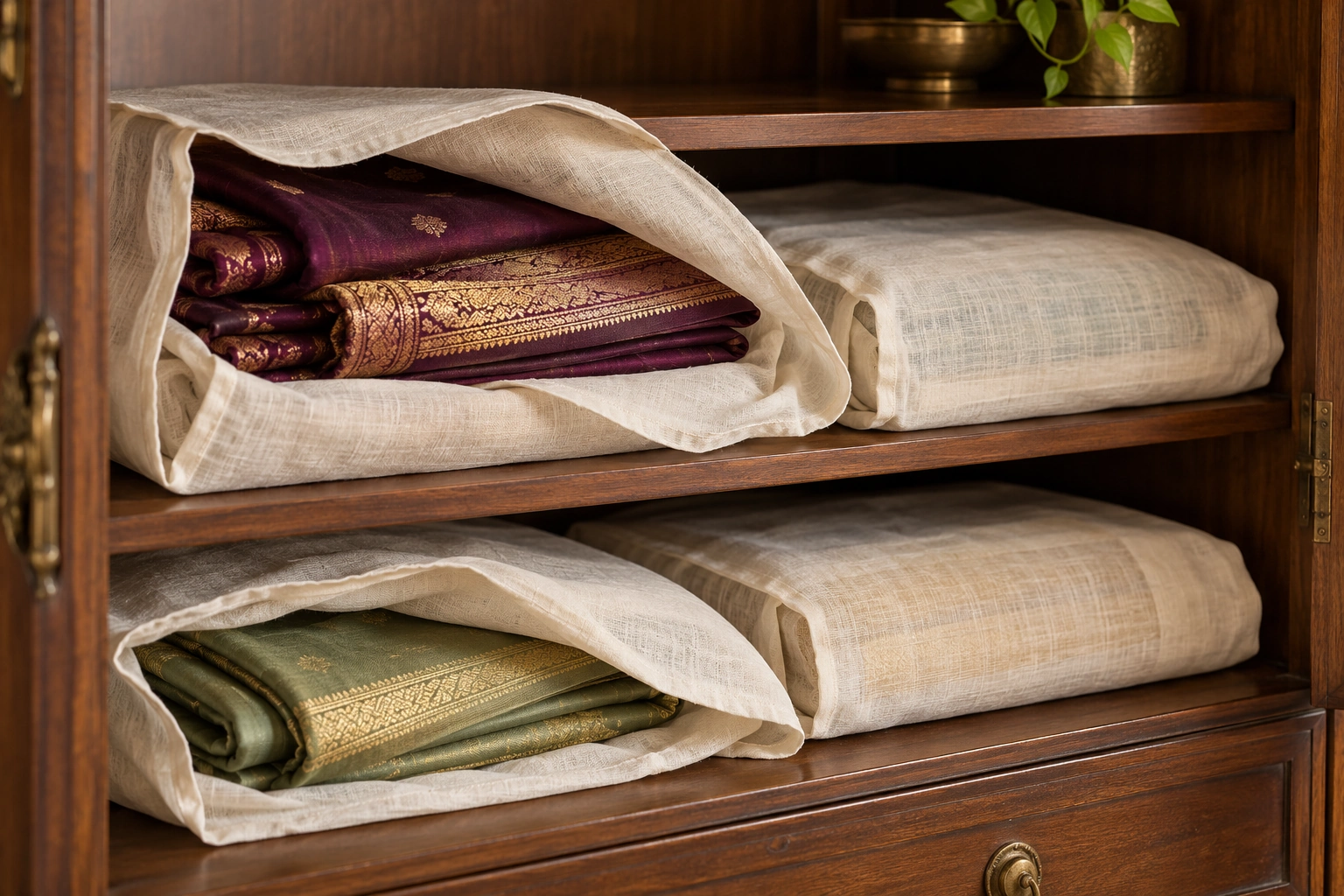
Do: Keep wrapped sarees clear of floors, damp exterior walls, leaks, strong light and heat. Leave sufficient room to retrieve each supported piece without dragging or compressing it.
Avoid: Do not push fabric against a damp wall or pack it tightly into an overfilled shelf.
- Choose clean wrapping that suits the textile
Do: Use clean prewashed unbleached cotton muslin or suitable unbuffered acid-free tissue, and a dry protective container. Check wrapping for soil, damp or deterioration during inspections.
Avoid: Avoid prolonged contact with acidic/coloured paper and rough or reactive surfaces.
- Distinguish bad sleeves from suitable boxes
Do: Do not use an ordinary dry-cleaner sleeve for years. Proper clean PP/PE storage boxes may be suitable if the textile is dry, supported and monitored; enclosure design must suit local humidity.
Avoid: Do not seal damp cloth or assume all plastics are either safe or unsafe.
- Minimise and cushion folds
Do: Prefer as few broad folds as practical. Put soft support at a fold instead of making a hard crease, especially beside heavy decoration.
Avoid: Do not force a crisp crease through brittle silk or heavy zari.
- Refold according to condition
Do: At a condition inspection, gently shift fold positions if the cloth is sound. Inspect during seasonal storage changes; frequency should reflect climate, use and fragility.
Avoid: Do not impose a universal monthly, quarterly or six-month refolding rule; repeated handling can also cause damage.
- Give weak or heavy work full support
Do: Ask about flat supported storage for fragile or heavily decorated pieces. If space requires layering sound items, avoid concentrated weight and protect decoration.
Avoid: Do not hang heavy ornament from weak cloth or leave heavy sarees crushing fragile ones.
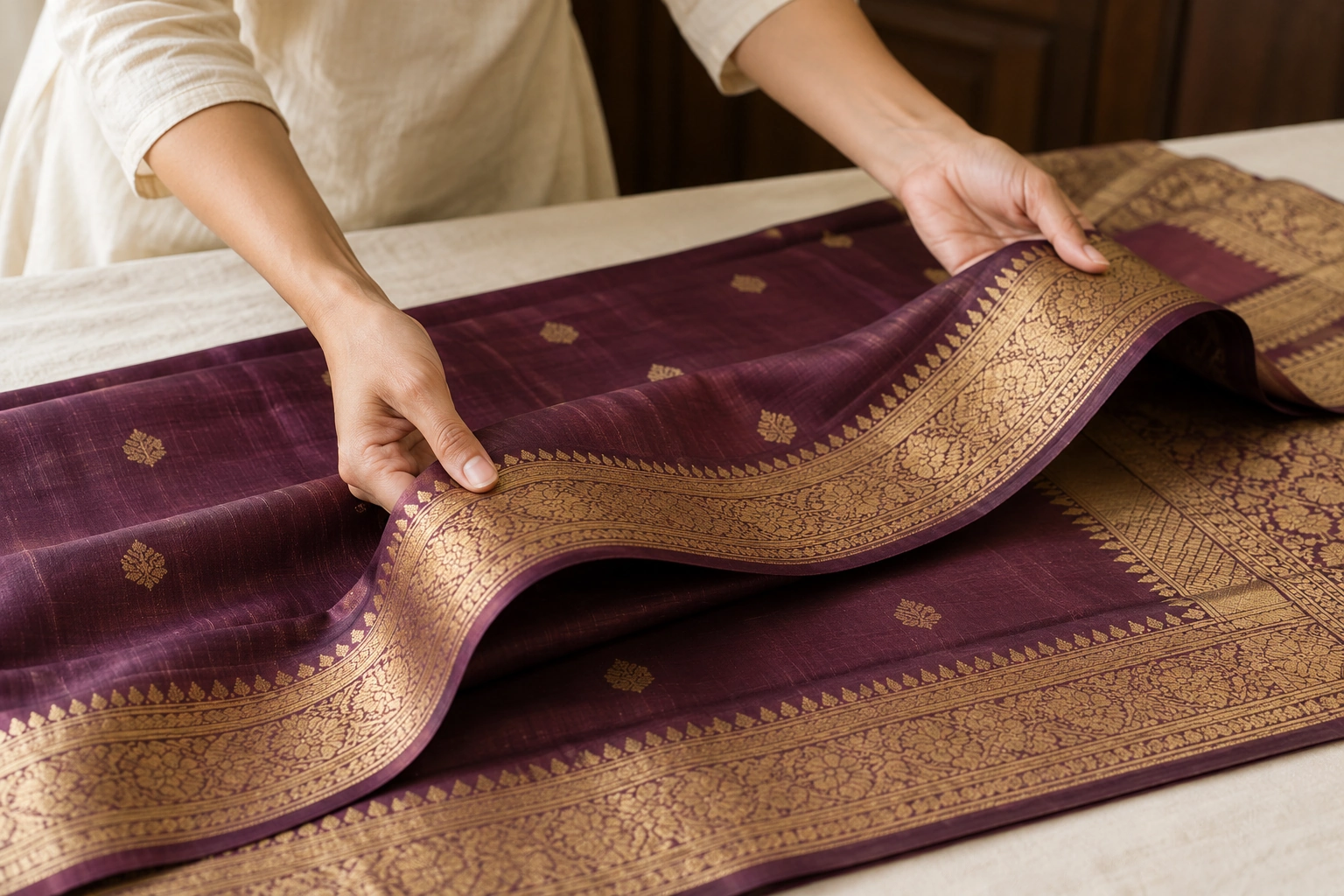
After wearing, cleaning and pressing
Handle marks and finishing according to the garment.
- Inspect and dry before putting away
Do: Check for perspiration, food marks, dampness and loose ornament after use. Let ordinary sound cloth become fully dry in a clean shaded setting before wrapping; record stains for the cleaner.
Avoid: Do not store damp cloth, apply perfume to it or scrub an unfamiliar stain.
- A colour test is not clearance to wash
Do: A competent cleaner or conservator should assess all coloured components and the proposed process when required. A small test may miss later bleeding or structural damage.
Avoid: Do not rub or wet-test fragile areas at home or infer washability from a single dry rub.
- Choose a specialist for sound complex garments
Do: Before handing over a complex modern saree, discuss the actual fibres, decoration, stains and proposed cleaning/finishing. Ask the cleaner to identify limitations and existing damage.
Avoid: Do not assume “dry clean” means no mechanical action, heat or risk.
- Prioritise preservation over complete stain removal
Do: Consult a textile conservator before trying to make an old saree spotless. Some discolouration may be safer to retain than to remove.
Avoid: Do not insist on whitening, invisible stain removal, strong spot treatment or fresh-looking antique zari.
- Use only a suitable garment-specific finishing method
Do: Follow a sound modern saree’s actual ironing instruction and account for its decorative yarns. Ask a specialist if steam, pressure or heat compatibility is unclear.
Avoid: Do not iron historic brittle cloth or press directly over fragile embellishment to remove a fold.
Packing for travel
Keep sarees supported, dry and separate from spills.
- Pack dry, supported and with room
Do: For travel, use clean wrapping, broad supported folds and a container that limits movement and crushing. Keep ornaments separated from surfaces they can snag.
Avoid: Do not vacuum-compress delicate work or cram it under heavy luggage.
- Keep wet items and spills separate
Do: Keep sarees away from damp clothing and leaking toiletries. If a water-resistant outer barrier is needed in transit, enclose only dry cloth and inspect and unpack promptly at destination.
Avoid: Do not make transit plastic a long-term sleeve or trap dampness inside it.
- Use a conservator for fragile loans or heirloom transport
Do: Obtain a condition record and a supported packing method before moving a fragile inherited textile. Transport on its support where practical.
Avoid: Do not refold a weak heirloom repeatedly to make it fit a small case.

Pests and dampness
Watch for early damage without household chemical experiments.
- Keep the storage area clean and inspect hidden folds
Do: Keep food and debris away, clean the cupboard and examine folds, undersides and nearby surfaces for larvae, webbing, cast skins, holes or droppings. Check incoming textiles before shelving with others.
Avoid: Do not assume darkness, cotton fibre or a sachet prevents infestation.
- Separate suspected insect damage
Do: Keep the affected dry piece apart from the collection; a clean labelled PE enclosure may help contain insects while a conservator or appropriate pest specialist advises. Inspect nearby textiles and the storage space.
Avoid: Do not spray the saree, heat it in sunlight or improvise freezing/fumigation.
- Do not substitute scented remedies for prevention
Do: Rely on inspection, cleanliness, exclusion and suitable storage. Keep added scents, oils, powders and loose plant material away from textile contact.
Avoid: Do not recommend mothballs, camphor, neem oil, essential oils or home chemical mixtures as a default treatment.
- Isolate suspected mould and get advice
Do: Keep a suspect piece apart and limit handling. Do not shake it or direct a fan at it. Obtain advice about safe isolation and drying promptly, especially if damp; do not leave a damp textile sealed and unattended.
Avoid: Do not brush mould into the room, sniff it closely or use bleach, vinegar, alcohol or other home mixtures.
- Correct the storage cause before returning the piece
Do: Have the textile assessed and address damp or building problems before reusing the cupboard. Inspect neighbouring textiles and replace damp or soiled wrapping.
Avoid: Do not return a treated piece to the same unresolved damp conditions.
When to ask a specialist
Recognise vulnerable heirlooms and complications.
- Recognise when ordinary cleaning is the wrong next step
Do: Use a textile conservator for splits, powdering, brittle silk, old repairs, unstable embroidery, corroding metal or suspected mould. A specialist cleaner is appropriate only when a garment is sound enough for its proposed process.
Avoid: Do not sew, tape, glue or iron a fragile split closed before assessment.
- Make the handover informative
Do: Give the specialist the label, known fibres/decoration, purchase record, past treatments and date/nature of staining. Photograph existing damage and agree the objective and limitations before treatment.
Avoid: Do not hide earlier home treatments or accept a promise that every old stain can be removed.
Adapted from conservation guidance including Canadian Conservation Institute. General guidance, not a cleaning prescription for every saree.