The Saree Atlas
Search
THE ILLUSTRATED REFERENCE

Regional Saree Atlas

Explore saree traditions through an interactive India map, beautiful textiles and practical details.

How to read the prices. Every figure on the Atlas is an approximate, indicative budget for the grade named beside it — the fibre, how it is woven, the motif technique and the zari — drawn from Indian online retail in October 2026. It is not a quotation, a valuation or a ceiling, and a “+” means finer work is priced individually. The Regional Saree Atlas describes an accessible authentic grade, the Collector’s Edit a chosen, more distinctive grade and the Coveted Ten one exceptional variety, so the ranges teach a progression and can overlap. A cheaper listing may be a different fibre or a blend, a printed rather than woven design, power-loom work, a simpler design, different zari or simply unspecified. That does not make it fake or inferior, but it is not the same grade. Each entry’s price strip names the grade it represents; more elaborate grades are noted beneath it. More on price and value →

A GEOGRAPHICAL INDEX

Explore sarees across India

Explore India’s textile traditions by weaving centre. Select a marker to open its Atlas entry.

NorthWestCentralEastSouthNortheast
Textile traditions geographical indexInteractive SVG showing the weaving-centre locations of the saree traditions documented in the Atlas. The official Survey of India outline is shown with a marker for each documented weaving centre. A separate accessible list provides equivalent navigation.

SELECT A TRADITION

Choose a marker or use the alphabetical list to explore a tradition and its weaving centre.

Browse every documented tradition by name

    Source: Survey of India, Government of India. External boundaries as published by Survey of India. Official international-boundary outline, generalized 1:16m; locations indicate approximate principal weaving centres, not areas of GI protection. Official boundary source: Survey of India ↗

    Your saree wishlist

    What would you love to own?

    Tap the ♡ beside any profile below. Your choices stay on this device; rank them, note the variant you want and download a beautiful PDF from My Saree Wishlist.

    No wishes saved yet.

    THE SAREE ATLAS · ILLUSTRATED REFERENCE
    Regional saree traditions

    The major types of Indian sarees

    Indian sarees frequently reveal their regional identity through a combination of features: the cloth's thickness or transparency, the design of its borders, the treatment of the pallu, and its characteristic motifs. None of these features is exclusive to one region. A peacock, for example, appears in both Paithani and Kanjivaram designs, but it is usually arranged and combined with other elements differently.

    The following identification keys describe the most recognizable traditional examples. Contemporary interpretations deliberately mix borders, colours, motifs and even techniques. Visual recognition is therefore a useful first step; a firm statement of geographical origin or production method requires documentation.

    North India↗

    Banarasi — Uttar Pradesh (Varanasi)

    Banarasi — Uttar Pradesh (Varanasi)↗

    बनारसी साड़ी

    Region / centreVaranasi
    FibreSilk (also blends and other fibres)
    TechniqueSupplementary-weft brocade; several weaving constructions
    GI relationshipRegistered GI (2009)Banaras Brocades and Sarees
    Indicative budget (Oct 2026)Approx. ₹15,000–₹60,000Grade represented: Handwoven pure-Katan-silk Banarasi with ordinary cutwork, woven butis or jaal; motif method declared and zari composition varyingElaborate kadwa Shikargah is a separate grade (about ₹30,000–₹85,000), and real-silver-zari Shikargah starts around ₹1,65,000. This band does not cap either.

    When people imagine a richly decorated Banarasi saree, they often picture silk covered with woven gold-coloured flowers and a substantial pallu. That is a familiar version, but Banarasi is much broader. Some have widely spaced little butis on a nearly plain body. Others have large floral jaals, dense Jangla designs, bold colours or very light, sheer Kora/organza grounds.

    A typical look: Silk or another fabric with woven motifs, floral vines, paisleys or richly decorated borders and pallus. Popular variations: Katan-based sarees, sheer Kora/organza styles, tissue, georgette, Tanchoi and other design categories. How it differs from a print: Many characteristic brocade motifs are actually woven into the fabric; a Banarasi-inspired printed saree may imitate the appearance without using the same technique.

    Think flowers and decorative silk, from extremely subtle to highly elaborate. The name does not guarantee pure silk or handloom production.
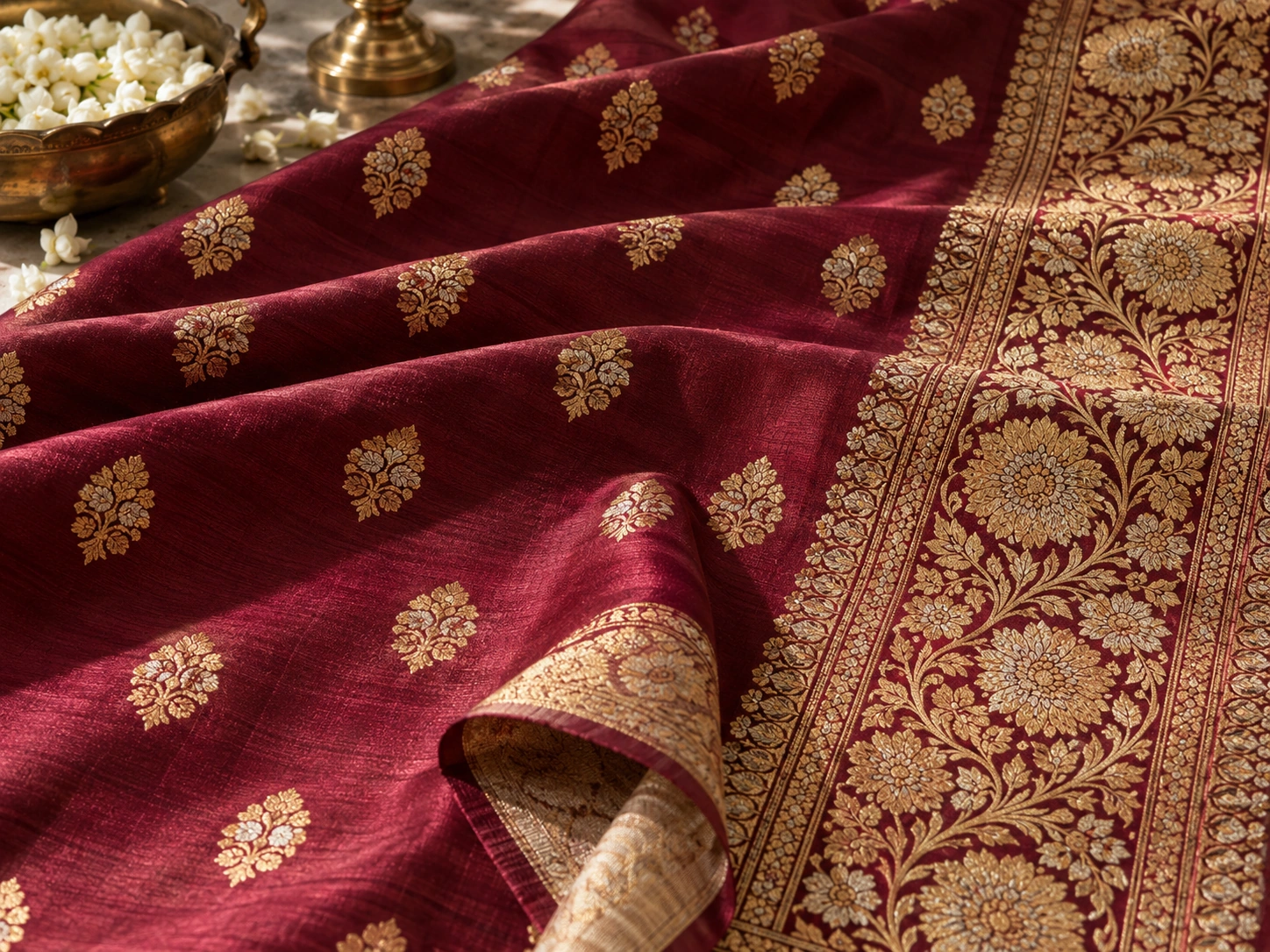
    Gold-coloured floral motifs on a burgundy body meet a denser scrolling border.
    Examine body and border separately Gold-coloured floral butis on a burgundy body, and a denser scrolling border.

    In depth

    10 sections · one open at a time

    Begin with the cloth, then read the ornament

    Banarasi is a regional weaving family with an unusually large wardrobe. A densely figured brocade, a light silk carrying scattered butis and a transparent ground with restrained ornament can all belong in the conversation. The name alone does not settle fibre, weight, zari composition or loom operation. Start with those four questions and a showroom full of apparently similar gold flowers becomes much easier to understand.

    The most useful way to look at a Banarasi saree is in two layers: the cloth that makes the ground, and the yarns that make the pattern. Ask what each layer contributes. A fine ground might be valued for its drape; a design for its drawing and placement; a border for the way it frames the body. These qualities can reinforce one another, but none substitutes for the others. An ambitious pattern on damaged cloth is still damaged cloth.

    A weaving centre with a history, not one invention date

    Varanasi's textile identity includes many makers and occupations: yarn preparation, dyeing, design drafting, pattern preparation, weaving and finishing. Field documentation shows that the saree is the result of a production network, rather than one person improvising every stage at a loom. It also documents handloom and powerloom activity in the same wider cluster.

    Historical summaries often compress this development into a neat sentence about royal patronage and a precise date. A responsible account can acknowledge the strong courtly and floral visual vocabulary without inventing an exact moment at which the modern Banarasi saree was born.

    For an heirloom or antique, regional history and the history of the actual object are different enquiries. A family account can be valuable provenance, but date, maker, alterations and material need their own evidence. A newly woven historical pattern is contemporary work, even if the design is old.

    How a pattern becomes woven cloth

    The warp is the lengthwise yarn system held under tension; the weft crosses it. Pattern control selects which warp threads rise so that the crossing yarns produce the intended structure. The design may first be translated into a graph and a sequence of pattern cards. A Jacquard attachment performs selection; it does not, by its name, tell you whether the loom is driven by a weaver or a motor.

    Think of three separate descriptions: ground, pattern system and loom operation. “Silk satin ground, supplementary-weft floral design, handloom” is informative because it answers a different question at each step. “Jacquard silk” leaves two of those questions open. The broad word brocade is useful for a richly figured effect, but it is not a complete construction specification.

    The India Handloom Brand brocade sheet describes a satin-ground silk example, with Katan yarn and patterned ornament. It does not mean that every Banarasi has a satin ground or that every Banarasi must be heavy: the regional family includes several kinds of cloth.

    Kadwa, continuous patterning and cutwork

    In kadwa (also written kadhua or karhuwa), motifs are worked with separate lengths of pattern yarn rather than carrying one unused pattern yarn between all motifs. In the continuous supplementary-weft method described for cutwork, the design yarn travels between motifs; unused floats are clipped after weaving. Spellings vary; a useful description explains the yarn path as well as the name.

    The distinction matters because the maker has to organise the design differently. It also explains why trimmed ends on a cutwork reverse are not automatically damage. But the reverse is not a self-interpreting certificate. A customer might see short ends without understanding which yarn was cut, whether the finishing is sound or whether the whole saree uses one method.

    “Fekwa” needs similar care. The trade name does not promise that every continuously carried pattern yarn has been finished in exactly the same manner. Ask what it means on this saree, where the yarn travels and what finishing was done. Never pull at a motif to see whether it comes free: that damages the cloth and gives an uncertain answer to the wrong question.

    One saree can use more than one patterning method

    Kadwa and fekwa need not be labels for two mutually exclusive wardrobes. A documented 1973 Banaras jangla in the Calico Museum uses individually worked silver pattern yarn and continuously worked gold pattern yarn within its border; its body is described separately. The Textiles Committee's study names these kardhwan and fekwa. It is a useful example of why the most revealing question is “which part of this saree is made that way?”.

    Cutwork adds a finishing question. In the Banarasi method described by India Handloom Brand, unused supplementary-weft floats are clipped after weaving. Fekwa describes the carried pattern yarn in the comparison; cutwork tells you what happens to unused lengths. Shops may use the names together, but the yarn path and its finishing remain worth describing separately.

    For comparison, open a body motif and a border motif rather than inspecting one and assuming it represents the whole saree. A piece combining methods can be a considered design choice. Ask the seller where the separately worked motifs occur and which carried yarns were trimmed; then assess the drawing and condition of those actual areas.

    Sources: Textiles Committee and Human Welfare Association, *Dream of Weaving*, object description, printed p. 110 · IHB Banarasi cutwork sheet

    Materials: silk can also be georgette

    Katan, organza, georgette and tissue are not four competing biological fibres. Katan is a yarn description in this context; organza and georgette describe cloth families; tissue refers to a metallic-looking construction or effect whose actual specification still needs explaining. A silk georgette can be pure silk. A shop's word “pure” needs a noun after it.

    Keep the ground-fibre statement separate from the pattern yarn. “Pure silk Banarasi” should not be used to imply precious-metal zari. Equally, imitation metallic yarn does not make a silk ground synthetic. The Atlas's price guide deliberately compares a declared handwoven Katan-silk grade while acknowledging varying zari fineness, which is more useful than placing every Banarasi under one enormous range.

    For two sarees, write the specifications side by side before comparing prices: ground fibre and cloth, pattern method, loom claim, zari specification, design coverage and maker or origin evidence. A lower price might reflect a different construction, a lighter design or a different retail proposition. Price alone cannot decide which explanation applies.

    Read the design at three distances

    From across the room, notice the balance of body, border and pallu. At arm's length, see how repeats are spaced and how vines or framed motifs turn a corner. Close up, look at whether small elements remain readable and whether pattern yarns lie securely without disrupting the ground. These are ways of discussing workmanship and composition; they do not prove where the saree was woven.

    Butidar describes scattered small motifs; a connected all-over jangla changes the visual rhythm; a shikargah hunting theme changes what is depicted. A motif label should not be asked to identify a fibre or loom.

    A dense design can conceal problems as easily as it displays labour. Unfold a relatively plain area too: it gives the eye a place to judge the cloth without the distraction of shine. Conversely, a restrained body can leave the quality of the border drawing unusually exposed. More coverage and better design are separate judgements.

    Banarasi, Jamdani and Tanchoi: compare the right axes

    Banarasi is a regional identity; Jamdani is a technique and an associated family of traditions. They are not logical opposites. Both can involve supplementary pattern wefts. Compare the actual ground, how each motif is inserted, the design's visual density and documented production identity, rather than saying one is woven while the other is not.

    Tanchoi deserves its own description within the Banarasi conversation. It does not require a metallic surface or a minimum number of colours before it is recognised. A buyer who likes a quieter patterned silk should be able to value it without treating the absence of gold as missing workmanship.

    Likewise, Paithani's pictorial pallu and Baluchari's narrative panels can share a figurative appeal without sharing the same construction. Start by asking how the image is made; only then compare imagery and regional identity.

    What excellent workmanship contributes

    An experienced observer values clear drawing, considered spacing, secure ornament, a stable ground, well-finished edges and the coordination of border and pallu. Technical difficulty matters when it serves the design. Counting colours, weighing the cloth or rewarding visible irregularity cannot replace that assessment.

    Consider two sarees with the same declared fibre and zari. One has widely spaced motifs and a balanced border; another has complex connected patterning over much more of its surface. The second gives a reason to investigate additional labour. It does not prove that its drawing, durability or suitability for the wearer is better. “More difficult” is part of the value conversation, not its conclusion.

    Documentation is another kind of value. A named workshop, a precise process description and a traceable purchase history make future study and repair easier. They do not turn every material statement into a laboratory result: an invoice records what was represented at sale, not an independent assay.

    Living with the saree

    For a richly ornamented piece, look at exposed decorative yarn at folds, the pallu and areas likely to rub against jewellery. Ask which part of the construction determines the maker's cleaning advice. A delicate ground with substantial ornament needs a decision based on both, rather than a generic “silk” instruction. Saree Care covers storage and handling in full.

    Further reading: India Handloom Brand: Banaras Brocade Saree · India Handloom Brand: Banarasi Cutwork Silk Saree · India Handloom Brand: Tanchoi Saree · IDC IIT Bombay / Dsource: Weaving Craft of Varanasi · NID / Dsource: Banarasi Saree making process

    Before you buyInspect and ask: the Banarasi guide in the Showroom Companion
    Registry record ↗

    Chikankari saree — Uttar Pradesh (Lucknow)

    Chikankari saree — Uttar Pradesh (Lucknow)↗

    लखनवी चिकनकारी साड़ी

    Region / centreLucknow
    FibreCotton, georgette, silk and other bases
    TechniqueFine embroidery on woven/finished cloth
    GI relationshipRelated GI(s) registeredLucknow Chikan Craft
    Indicative budget (Oct 2026)Approx. ₹3,500–₹30,000Grade represented: Genuine hand-embroidered Lucknow chikankari saree, often on georgette; the base fibre must be namedFine jaali or murri work and added cutdana can cost well above ₹30,000; very fine pieces are quoted individually.

    A Chikankari saree is associated with fine embroidery, not one specific saree fabric. Traditionally white stitches on pale fabric are iconic, but coloured thread and dyed fabric are now common too. The decoration is often floral, leafy and delicate rather than heavily metallic.

    A typical look: Tiny stitched flowers, vines and patterns that reveal their beauty up close. Common bases: Cotton, georgette and other light fabrics. How it differs from Banarasi brocade: Chikankari patterns are embroidered onto cloth, whereas the characteristic Banarasi brocade look is woven into it.

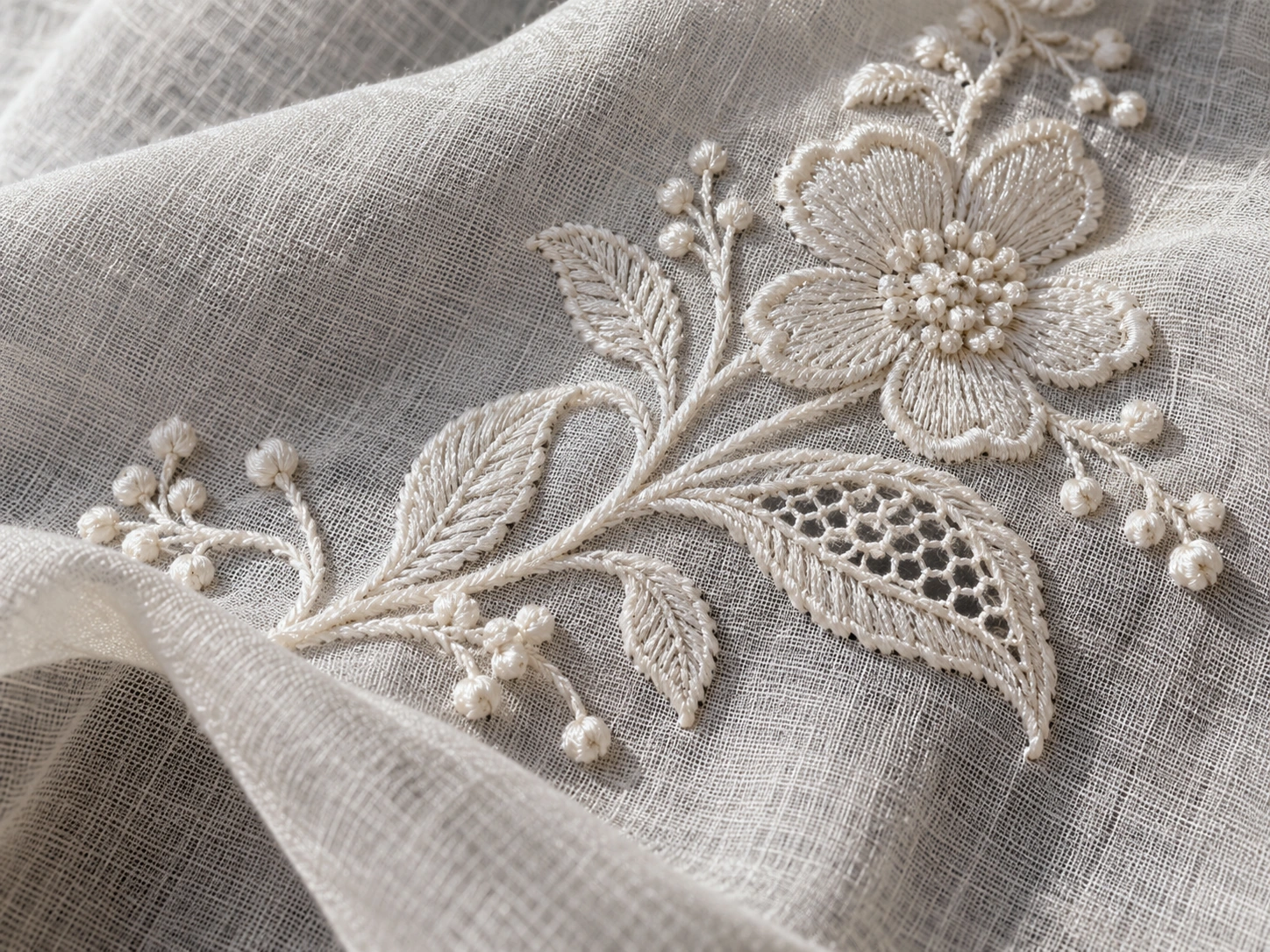
    White embroidery combines flat outlines, raised knots and openwork-like areas.
    Embroidery texture White-on-white embroidery combining flat outlines, raised knots and openwork-like areas.

    In depth

    7 sections · one open at a time

    Two textiles to understand at once

    A Chikankari saree asks the reader to understand both the base cloth and the embroidery added to it. The base determines much of the garment's drape and transparency; the stitches create another surface of outlines, shadows, raised details and openwork. Generic praise of delicacy is less useful than knowing what each kind of stitch actually does.

    Lucknow and the limits of an origin story

    Lucknow is the regional centre in the official craft account. Popular histories often supply a single royal inventor or a tidy story of introduction; the documentation is stronger on present practice and production than on proving such an invention. A repeated legend is not a dated fact.

    The regional craft identity also does not make the base handloom. A maker may hand-embroider cloth woven by another method or obtained from another centre. If hand embroidery is what you value, ask about it directly, and ask separately about the loom.

    From a marked design to finished embroidery

    The official account describes chapayi, tanka and dhulayi: marking or printing the design, embroidery, then washing and finishing. Printing a working guide before stitching does not make the finished ornament a printed imitation. The important question is what forms the visible finished design.

    Field documentation also describes different stitch specialists contributing to a piece. That is a better account of authorship than imagining one embroiderer performs every stage, and a precise producer description can value that cooperative skill without inventing a universal number of days or workers.

    Manufacturing washing and finishing are not instructions for home care. A process used to remove working marks or prepare merchandise should not be copied as advice for an owner's finished saree. The base fibre, thread, dye and any additional decoration all matter to later treatment.

    Read effects rather than memorise a stitch census

    Tepchi gives a running-stitch effect; bakhiya is associated with shadow work; murri and phanda create raised details; jali creates openwork through controlled manipulation of ground threads. These distinctions are useful because each changes how the pattern and base interact. Lists differ in how they count and group named stitches, so an exact total is not a definition of the craft or a quality score.

    Bakhiya's shaded appearance makes the base important: you are seeing a relationship between stitch placement and the cloth's transparency. Jali asks a different question, about the integrity and control of the opened ground. Raised detail is not an imitation simply because another Chikankari example is flatter.

    The correct stitch name is a starting point for asking the maker what was done. A glance at the reverse cannot prove that a stitch was worked by hand.

    Base fabric and embroidery thread are separate specifications

    Field documentation records a variety of bases and embroidery fibres. Georgette and chiffon do not themselves name a fibre: a silk or polyester ground can belong to the same broad cloth family. The embroidery thread may also differ from the ground.

    “Pure georgette” is incomplete as a silk claim. Ask what is pure, what the ground contains and what the thread contains. Keep any added metallic decoration separate too; its presence does not tell you how the main embroidery was made or whether it contains precious metal.

    Fine workmanship is the relationship to the ground

    Look at the work with the cloth relaxed. Does stitching pucker the ground? Is the outline resolved? Are open areas deliberate and stable rather than torn? Does dense embroidery make the fabric behave as the wearer expects? These questions are more useful than rewarding the greatest stitch density everywhere.

    A large all-over design can involve substantial work, but a restrained composition with well-controlled effects may be the more accomplished choice for a particular base. Consistency is not proof of machine manufacture, nor unevenness proof of handwork. The observed result and the claimed process need separate assessment.

    Buying and caring for it

    Ask whether all the visible ornament is hand embroidery or whether different sections use different processes. That is a clarification about the actual product, not an accusation. The useful question is not “does it look handmade?” but “what exactly is represented as hand embroidered, who did it and what record supports that?”. A bill is the place to record the answer.

    Before choosing any cleaning, check the base beneath dense work and any openwork, and ask whether working marks, finishing residues or alterations remain. The Chikankari name alone does not prescribe bleach, steam, hand washing or dry cleaning; Saree Care explains how to decide.

    Further reading: DC (Handicrafts): Lucknow Chikan Craft · NID / Dsource: Chikankari stitches · IDC IIT Bombay / Dsource: Chikankari taanka

    Before you buyInspect and ask: the Lucknow Chikankari guide in the Showroom Companion
    Registry record ↗

    Kashmiri embroidered sarees — Jammu & Kashmir

    Kashmiri embroidered sarees — Jammu & Kashmir↗

    कश्मीरी कढ़ाईदार साड़ी

    Region / centreSrinagar and Kashmir Valley
    FibreSilk, wool blends and other base cloths
    TechniqueSozni, aari and tilla embroidery traditions
    GI relationshipRelated GI(s) registeredKashmir Sozani Craft
    Indicative budget (Oct 2026)Approx. ₹10,000–₹30,000Grade represented: Hand-embroidered Kashmiri saree on a seller-declared pure-silk base; modest to moderately worked piecesSpecify the base silk. Extensive fine sozni is a separate grade, often above ₹80,000.

    Kashmiri embroidered sarees take their character from the embroidery traditions of the Kashmir Valley, including fine Sozni needlework and other aari or tilla approaches. Paisleys, chinar leaves, flowers and winding vines can be stitched onto different base cloths, rather than belonging to one uniform weave or fibre.

    A typical look: delicately embroidered botanical or paisley motifs, sometimes concentrated on the border and pallu. Check that decorative motifs are actually stitched, not merely printed. Kashmir Sozani Craft is a related registered GI, but does not certify every saree marketed as Kashmiri embroidery.

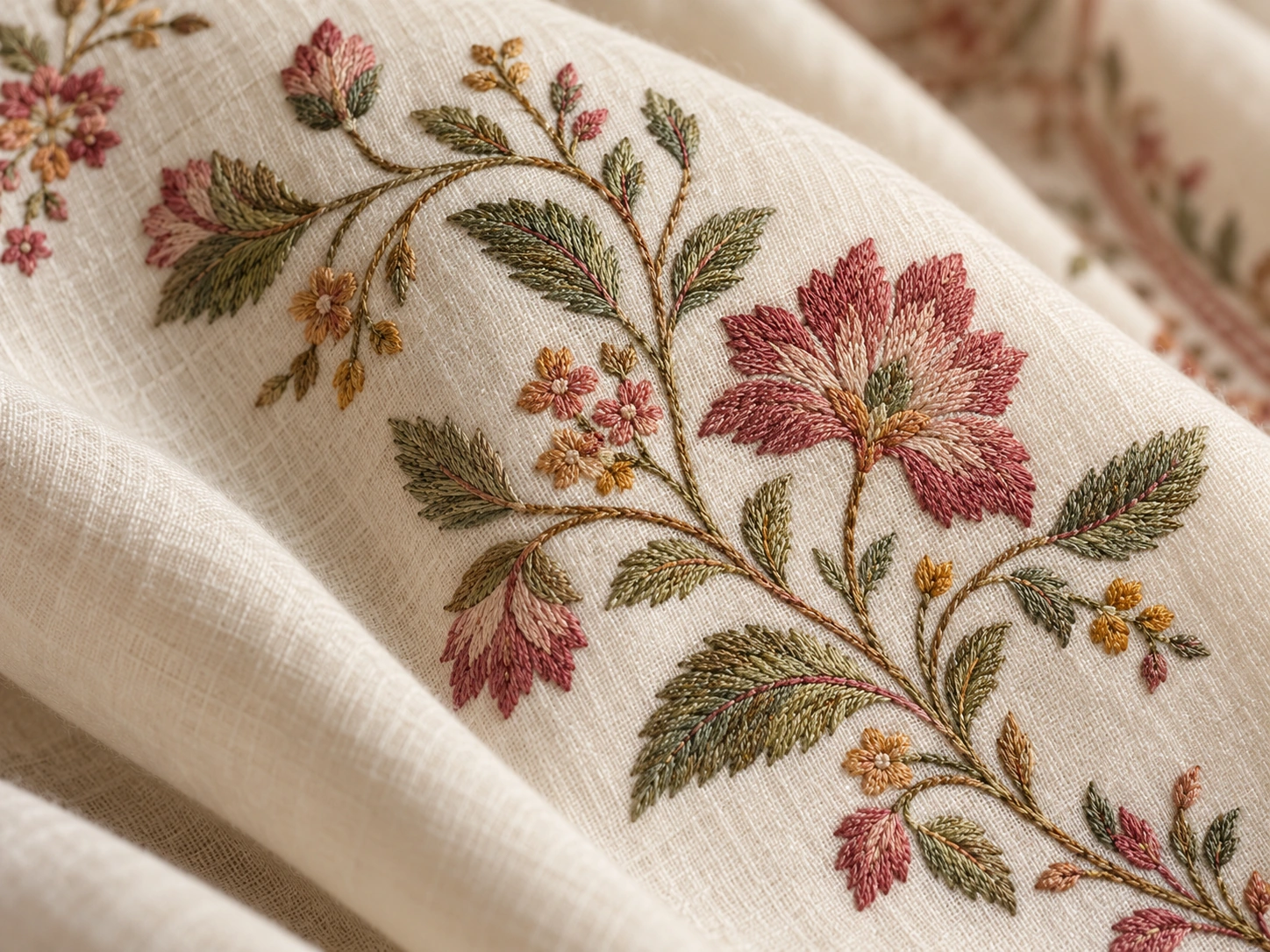
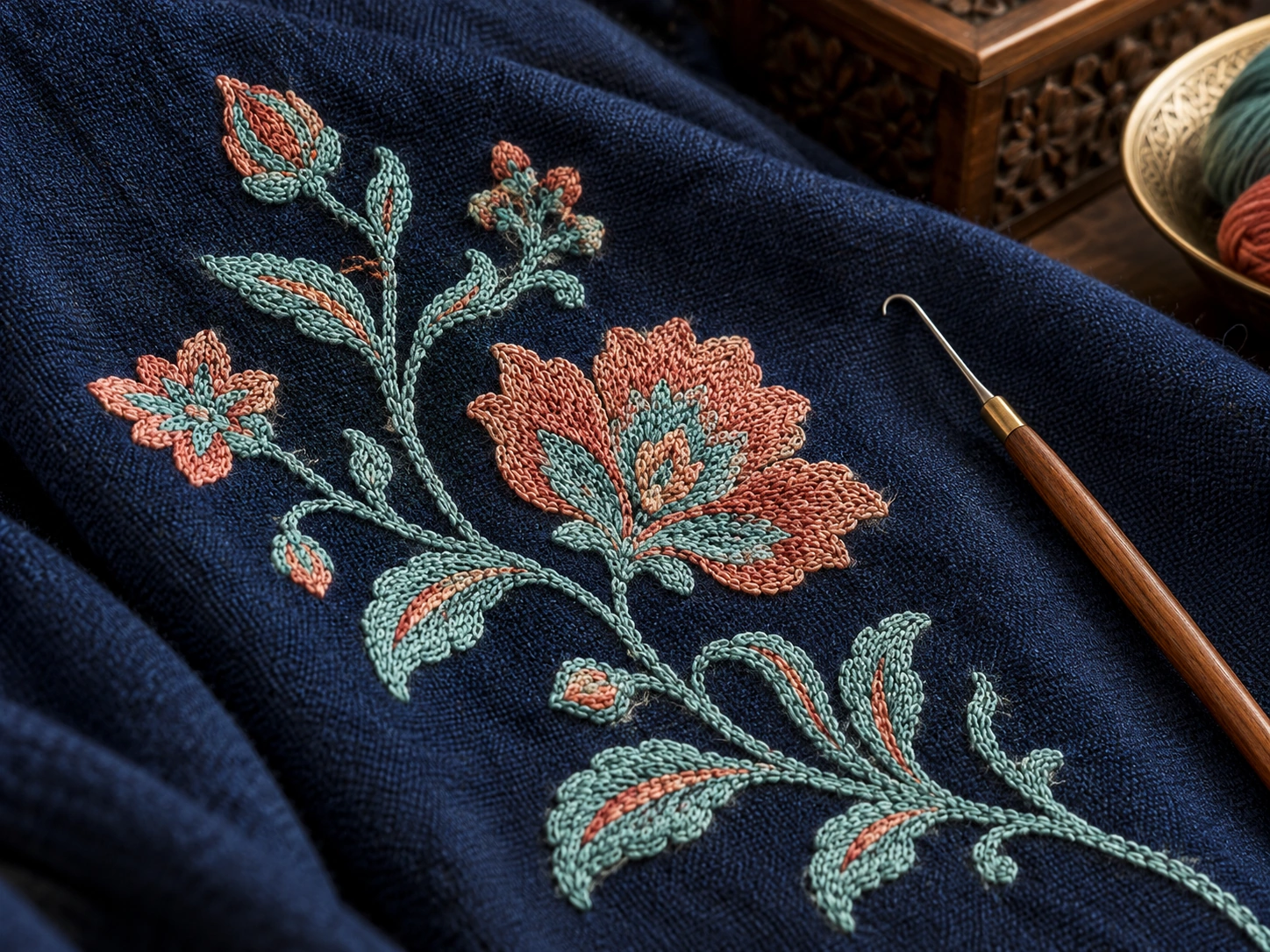
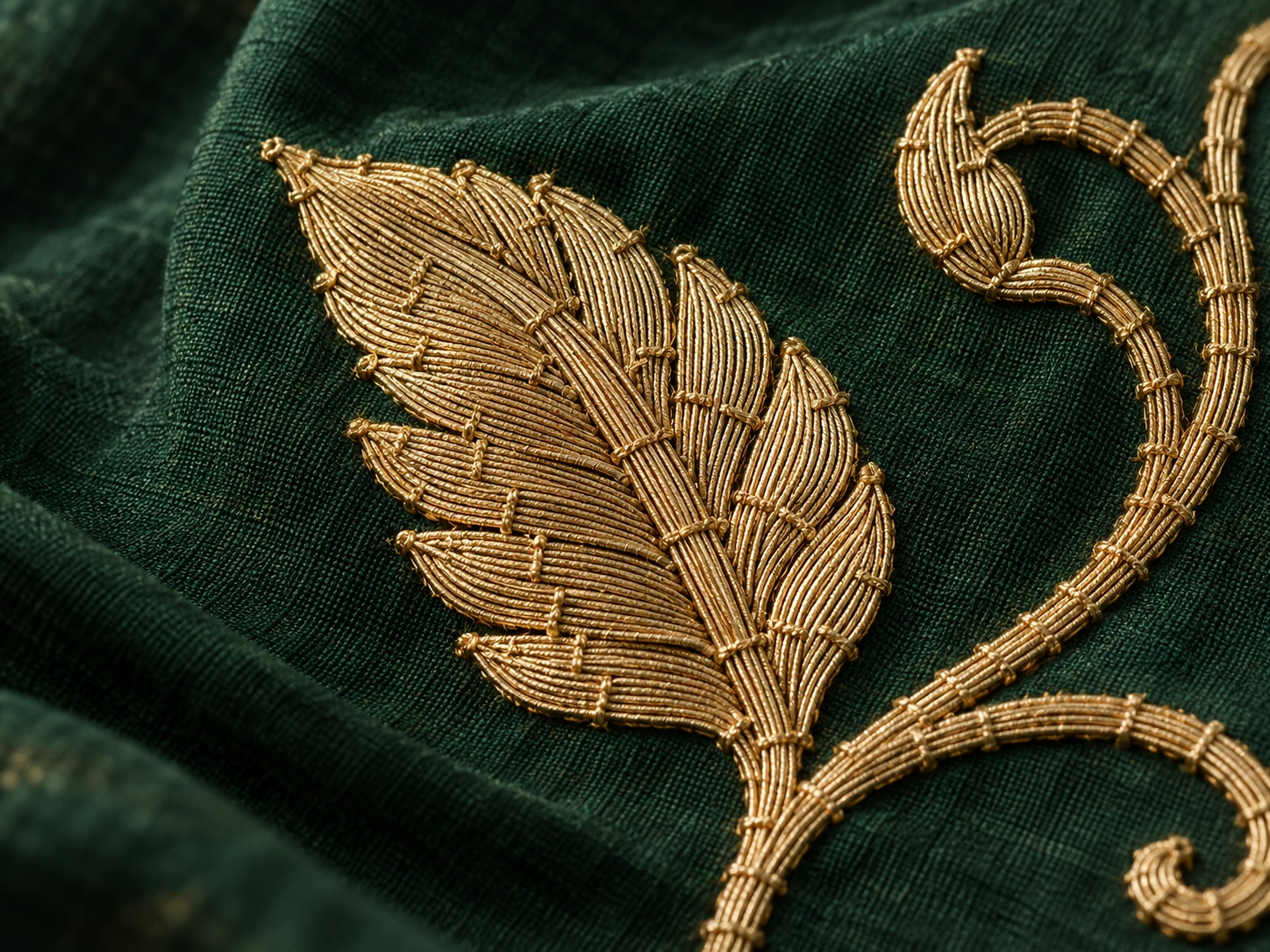
    Fine coloured needle embroidery forms small botanical motifs on an ivory ground.Linked chain stitches trace a floral spray on dark blue cloth.Small binding stitches secure metallic-looking floral ornament to a dark ground.
    Three Kashmiri needle traditions Left to right: sozni, fine coloured needlework; aari, linked chain stitch; tilla, metallic-looking thread couched down with small binding stitches.

    In depth

    1 section

    Three kinds of work, several kinds of cloth

    The interesting difference between sozni, aari and tilla is what the embroiderer asks the thread to do. Sozni is fine needle embroidery. Aari uses a hook to build linked chain stitches. Tilla brings metallic thread into the design, securing it to the cloth with a separate binding thread. A flower can appear in all three; its outline does not tell the whole making story. The distinction is between tools, stitches and materials, rather than three names for a Kashmiri floral print.

    Sozni also has a vocabulary of placement. The government profile describes jamawaar as dense all-over embroidery, jaaldar as a more open distribution, butidaar as scattered motifs and palladar as work concentrated at the ends or borders. These words help explain why two sarees with the same stitch family can feel so different: one makes embroidery the entire landscape; another lets the base cloth breathe. Ask a seller to show what their particular label describes.

    There is design work before the stitching. A naqash prepares the drawing, which can be transferred through carved blocks before the embroiderer begins. A printed working guide and a finished printed decoration are different things. The official handicrafts compendium also records dorukha: sozni worked to give a considered effect on both faces, sometimes with different dominant colours. That is a particular accomplishment to discuss, rather than a rule that every embroidered saree must look identical on its reverse.

    A saree is also a different canvas from a shawl. The official profile includes silk sarees alongside pashmina shawls and viscose garments. “Kashmiri embroidery” therefore describes the work without settling the fibre beneath it. When comparing pieces, unfold the body as well as the richly worked end. Notice how much cloth remains unworked, how the stitched areas bend and whether the ground stays relaxed around dense motifs. For tilla, look particularly at the small securing stitches and exposed metallic areas. For sozni or aari, ask which sections use which technique.

    Sources: CBSE craft teaching account · DC (Handicrafts): Kashmir Sozani Craft · DC (Handicrafts): Ari Work · DC (Handicrafts): Tilla Work · GI handicrafts compendium, Kashmir Sozani Craft, printed p. 70

    Before you buyInspect and ask: the Kashmiri Embroidered guide in the Showroom Companion
    Registry record ↗

    West India↗

    Paithani — Maharashtra

    Paithani — Maharashtra↗

    पैठणी

    Region / centrePaithan and Yeola, Maharashtra
    FibreSilk (also contemporary variants)
    TechniqueFigurative woven pallu/border using tapestry-like techniques
    GI relationshipRegistered GI (2010)Paithani Saree & Fabrics
    Indicative budget (Oct 2026)Approx. ₹20,000–₹80,000Grade represented: Handwoven pure-silk Paithani; standard muniya/butta through richer pictorial pallu; zari grade disclosedPure precious-metal zari and unusually dense or commissioned pallu work are quoted separately; richly accomplished tapestry pallus begin around ₹40,000.

    A Paithani immediately draws attention to its pallu and border, often richly coloured and decorated with recognisable motifs such as peacocks, parrots, lotus flowers and geometric forms. Traditional silk Paithanis can combine a relatively quiet body with an exceptionally striking pallu, though designs vary widely.

    A typical look: Lustrous silk, strong colour combinations, and ornament with intricate bird or floral motifs. Some varieties have characteristic geometric border patterns. How it differs from a Kanjivaram: Both may be substantial festive silks, but Paithani is especially associated with its particular tapestry-like pallu motifs, while Kanjivaram is well known for commanding silk body-border relationships and its South Indian design vocabulary.

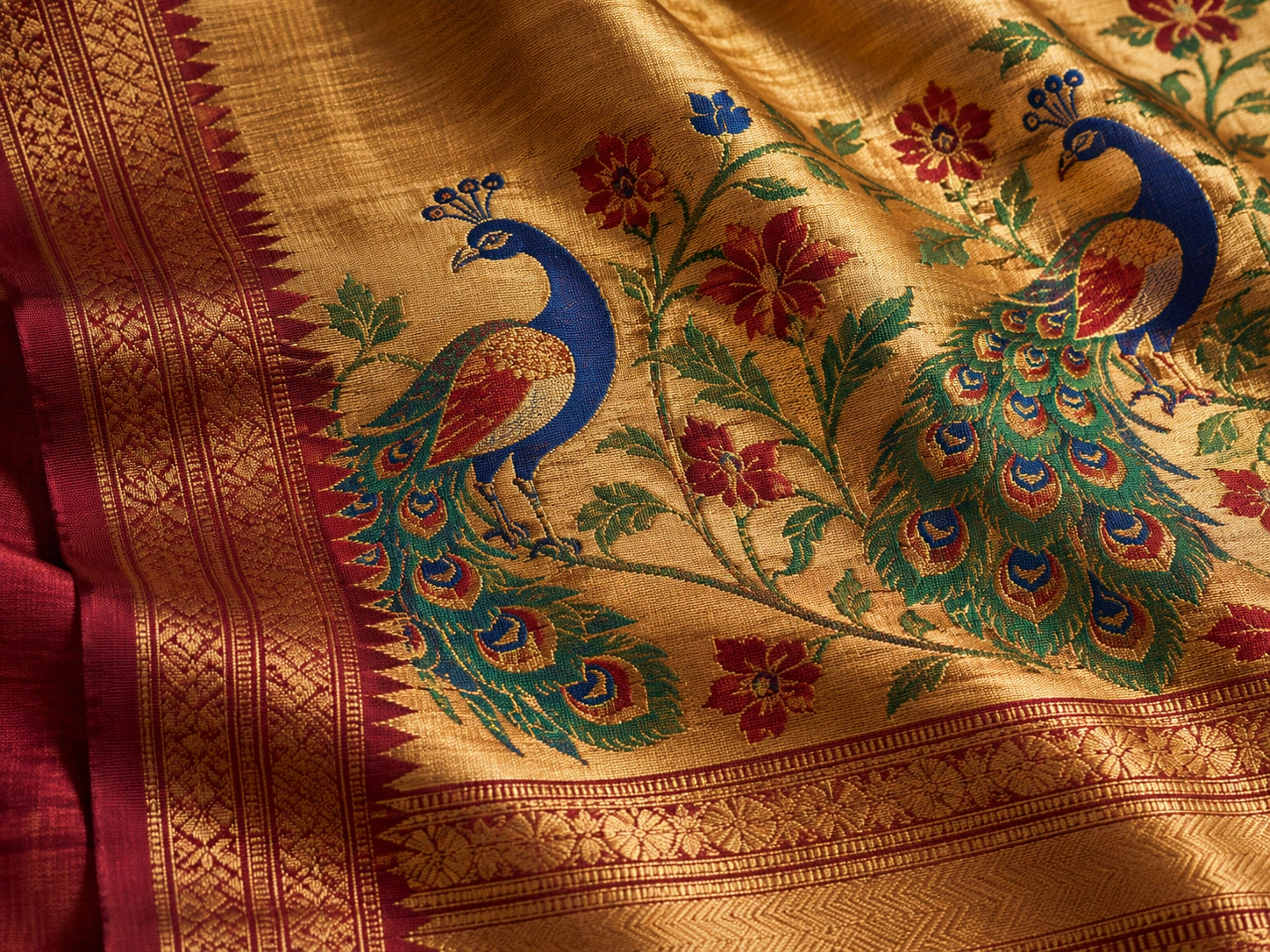
    Coloured peacock forms sit within a gold-coloured ornamental pallu.
    Pallu ornament Coloured peacocks set within a gold-coloured ornamental pallu.

    In depth

    8 sections · one open at a time

    The picture is made at the loom

    Paithani rewards looking beyond the peacock. Its pictorial pallu matters not simply because of what it depicts, but because of how the coloured areas are built in weaving. The relationship between the silk field and the tapestry-like work gives the pallu its particular character.

    Paithan, Yeola and a careful historical account

    The name connects the textile with Paithan in Maharashtra, and Yeola is an important centre too; neither is the exclusive modern place of production. The official Paithani registration record includes producer addresses in Yeola.

    Official and educational summaries repeat an antiquity of more than two thousand years. That is not, by itself, a documented chain connecting every feature of the modern saree to an ancient surviving object. An ancient textile centre, historical patronage and the precise construction of a contemporary Paithani are related subjects that need different evidence.

    Returning wefts: tapestry in practice

    In the documented tapestry work, short lengths of coloured weft travel within a design area and return, rather than one decorative yarn crossing unused behind the whole width. Adjacent colour areas are coordinated where they meet. The image is formed as the cloth is woven; it is not a picture embroidered onto a finished saree.

    A similar bird can be drawn through different constructions, and one simplified pallu explanation does not cover every part of a Paithani. Producer documentation separately shows body weaving, butti work, borders and pallu preparation. The responsible question is “how is this part made?”, not “does this whole cloth pass a reversible test?”.

    Silk, metallic yarn and colour

    The classic current material is silk with decorative zari, but the metallic yarn's actual composition needs separate disclosure. The India Handloom Brand sheet itself records the use of imitation metallic yarn to make pieces more affordable. An imitation-zari specification does not make a declared silk ground synthetic, and a silk ground does not establish gold content.

    Different colours in the two yarn directions can produce a changing, shot effect as the cloth moves. That teaches colour interaction, not origin: a shot effect is not exclusive to Paithani.

    When comparing stock, distinguish three descriptions: a Paithani with a documented traditional pallu construction; a contemporary regional product with a differently specified construction; and a Paithani-inspired motif on cloth made elsewhere. The label and the evidence should tell you which you are being offered. “Semi” is not a shared definition of material or loom.

    Motifs: look at composition as well as names

    Bangadi mor, muniya and asawali give an engaging entrance. Then follow a whole composition. How does a vine turn? How are birds spaced? Does a small repeat stay coherent at the edge? Is a dense pallu balanced by a quieter field?

    A named motif describes what is depicted. It does not disclose whether the pattern uses tapestry-like work, another woven method, embroidery or printing, and a larger peacock is not automatically better drawing. A restrained design is a perfectly good thing to prefer.

    Paithani and Baluchari

    Both can attract a person who likes pictures in cloth. Paithani's appeal often centres on coloured birds, plants and ornament in the pallu; Baluchari's familiar narrative layout presents repeated figures or scenes in framed panels. These are visual orientations, not exclusive rules.

    The stronger comparison asks how the image is constructed. A figurative pallu need not be Paithani, and a narrative scene does not prove Bishnupur. Follow a description of the actual yarn system with the documented place and maker.

    What careful workmanship adds

    Look for coherent colour boundaries, considered drawing and sound transitions between worked and quieter areas. Look at the pallu both close up and at the distance at which it will be worn: a technically elaborate motif that becomes confused at that distance may serve the saree less well than a simpler, more legible arrangement.

    Loose ends and arbitrary unevenness are not proof of handwork, and machine-like identical imagery is not a universal measure of quality. The maker's intended construction and design set the context for judgement.

    Price and preservation

    The Atlas's price guide is for handwoven pure-silk Paithani with a disclosed zari grade, from standard muniya and butta work to richer pictorial pallus. It does not establish a universal minimum or certify the construction of a particular piece. Design coverage, the work of the pallu, the metallic-yarn specification and provenance should be discussed together.

    Look at metallic pallu areas and any exposed yarn where jewellery or repeated folding has caused abrasion, and ask for advice tied to the actual construction and condition. Neither a historic reputation nor a gold-looking ground makes the saree immune to wear; Saree Care covers general storage and cleaning.

    Further reading: India Handloom Brand: Paithani Saree · IDC IIT Bombay / Dsource: Making of the Paithani · Touch of Class Paithani: Making of Paithani (workshop account)

    Before you buyInspect and ask: the Paithani guide in the Showroom Companion
    Registry record ↗

    Patan Patola — Gujarat

    Patan Patola — Gujarat↗

    પાટણ પટોળા

    Region / centrePatan, Gujarat
    FibreSilk
    TechniqueDouble ikat: resist-dyed warp and weft aligned in weaving
    GI relationshipRegistered GI (2013)Patan Patola
    Indicative budget (Oct 2026)Approx. ₹1,10,000–₹1,50,000Grade represented: Pure-silk double-ikat Patan Patola with workshop/origin confirmation; ordinary documented-pattern gradeA planning guide for a documented ordinary-pattern piece. Selectively elaborate and complex masterworks are quoted individually; Rajkot single ikat is a different grade.

    Patan Patola is celebrated for double Ikat, where the lengthwise and crosswise yarns are dyed in advance so their patterns meet when woven. This makes the resulting design unusually demanding to execute. Traditional examples often have strong geometric layouts, repeated elephants, flowers, parrots and other motifs.

    A typical look: Clear, intricate, rhythmic patterns with distinctive Ikat softness at some colour boundaries; rich combinations of red, green, yellow, blue and other colours occur. Important distinction: Not every saree marketed as “Patola” is a Patan double-Ikat saree. There are also Gujarat single-Ikat traditions and Patola-inspired prints.

    Fine feathered edges soften a repeated red, green and ivory geometric pattern.
    Read a complete pattern repeat A red, green and ivory geometric repeat whose softly feathered edges come from dyeing the yarns before weaving.

    In depth

    8 sections · one open at a time

    The pattern begins before the cloth

    In Patan double ikat, both warp and weft are patterned by resist dyeing before they meet on the loom. Everything else follows from that fact. The weaver is not copying a surface design: two separately prepared yarn systems have to arrive in the right relationship as the cloth is formed.

    Preparing two maps of colour

    Imagine planning the same design in two directions. Bundles of yarn are marked and bound so that selected portions resist a dye bath, and binding and colour stages are organised for the intended pattern. The warp and weft preparations must then correspond when woven. “Dyed before weaving” is necessary but not sufficient: ordinary yarn-dyed stripes also begin with coloured yarn without being ikat.

    Double ikat specifically means resist-patterned yarns in both directions contributing to the intended image. Finding two yarn colours does not establish it, and nobody should expect a visitor to identify every structure under a shop magnifier.

    Workshop accounts record durations and daily output for their own circumstances. They do not mean that every Patola takes one fixed number of months, or that a more elaborate retail story proves more work.

    Alignment is ongoing work

    The National Institute of Design's field account describes an inclined loom and continual adjustments to keep the patterned yarn systems aligned during weaving. It is not enough to prepare the yarn beautifully and let the rest happen.

    Pattern registration means the intended colour segments meeting where the drawing requires them, and some designs make that coordination more visibly demanding than others. Judge the coherence of a whole repeat rather than turning one feathered edge into a pass-or-fail test. Extremely sharp work is not automatically printed; visible movement is not automatically proof of handwork.

    Patan and the Kumarpal story

    UNESCO's textile documentation identifies the famous Kumarpal account as a legend. It is a traditional narrative about patronage and arrival, not a verified date at which a precisely defined textile was invented.

    Claims that only one family, or a fixed number of workshops, can make the textile need checking at the date they are made: the production network is a living subject. A named workshop is useful provenance for the piece in front of you; an unsourced monopoly claim is not.

    Rajkot is not a synonym for imitation

    The commonly encountered Rajkot single-ikat product is different from Patan double ikat. But the India Handloom Brand Gujarat sheet also documents both single and double ikat in Rajkot and Surendranagar. “Patan versus Rajkot” and “double versus single” are therefore separate comparisons.

    A regional style can travel and a technique can be practised in more than one place. Double ikat alone does not establish Patan origin, and a maker outside Patan should not be erased from the technical discussion because the best-known protected identity is Patan Patola. Describe the technique accurately and the origin separately.

    A printed Patola-inspired motif belongs to another production category again. It can be an honestly described textile without being handwoven ikat; the problem is an unsupported substitution of claims, not the existence of the print.

    Motifs are another layer of information

    Narikunj, birds, flowers and geometric repeats organise what you see. A design name does not prove town, loom or silk purity.

    Look at the relationship between a repeat and the saree's edges. Does the design keep its rhythm across the width? How is the pallu composed relative to the body? These questions reward attention without pretending there is one compulsory layout for all legitimate work.

    What deserves a premium?

    Technical planning, controlled registration, well-resolved design, sound cloth and traceable workshop provenance are meaningful topics in a price discussion. A higher cost does not authenticate them. The Atlas's price guide is for a declared pure-silk double-ikat Patan grade with workshop and origin confirmation, not a general Patola range.

    Compare the actual claims before comparing the numbers. A single-ikat silk, a double-ikat silk from another centre and a documented Patan piece do not belong on one price ladder without explanation, and a seller's “rare” or “museum quality” is not an independent judgement.

    A collector's file and a wearer's decision

    For a costly commission, keep the maker's identity, the agreed pattern, dimensions, material specification and an intelligible making record. These help future ownership and study; they do not replace independent authentication where the price depends on a contested claim.

    For wearing, look at the cloth's condition, its dimensions and how the design will appear when pleated. No home test is needed, and Saree Care handles preservation.

    Further reading: NID / Dsource: Patola Saree Weaving, Patan · UNESCO New Delhi: Handmade for the 21st Century · India Handloom Brand: Gujarat Single Ikat Saree · Sheetal Patola: process (workshop account)

    Before you buyInspect and ask: the Patan Patola guide in the Showroom Companion
    Registry record ↗

    Bandhani / Bandhej — Gujarat and Rajasthan

    Bandhani / Bandhej — Gujarat and Rajasthan↗

    બાંધણી / बांधणी

    Region / centreJamnagar; Kutch; Jodhpur and wider west India
    FibreCotton, silk and other cloths
    TechniqueTie-resist dyeing of fabric after binding small points
    GI relationshipRelated GI(s) registeredJamnagari Bandhani · Kutch Bandhani of Gujarat · Jodhpur Bandhej Craft
    Indicative budget (Oct 2026)Approx. ₹5,000–₹25,000Grade represented: Hand-tied Bandhani on natural Gaji or other pure silk; base loom and added embellishment disclosedDense tying, gota work and commissioned bridal pieces can sit above this guide.

    Bandhani is one of the easiest styles to recognise once you know how to look for it. The cloth is dotted with many tiny resist-dyed spots. Those little points can form large circles, flowers, grids or ceremonial patterns. Traditional colour combinations often use reds, yellows, greens and deep contrasting tones.

    A typical look: Dotted designs, sometimes arranged into sweeping patterns that can look almost jewel-like from a distance. Fabric: Silk, cotton and other materials. Why it is both a pattern and a saree type: Bandhani originally names the dyeing technique, but shops also use it for an entire saree category.

    Before you buyInspect and ask: the Bandhani / Bandhej guide in the Showroom Companion
    GI record 1 ↗ · GI record 2 ↗ · GI record 3 ↗

    Gharchola — Gujarat

    Gharchola — Gujarat↗

    ઘરચોળું

    Region / centreGujarat, especially Kutch/Jamnagar-related traditions
    FibreSilk or cotton-silk variants
    TechniqueGrid weaving combined with tie-dyed decorative dots
    GI relationshipRelated GI registered (2024)Gharchola Craft of GujaratRelated protected craft: Gharchola Craft of Gujarat, registered 2024. Not every red grid-and-dot saree falls within it.
    Indicative budget (Oct 2026)Approx. ₹8,000–₹20,000Grade represented: Hand-tied Gharchola checks on pure/Gaji silk with tested or unspecified metallic borderReal precious-metal zari and heavier embellished bridal work are quoted separately.

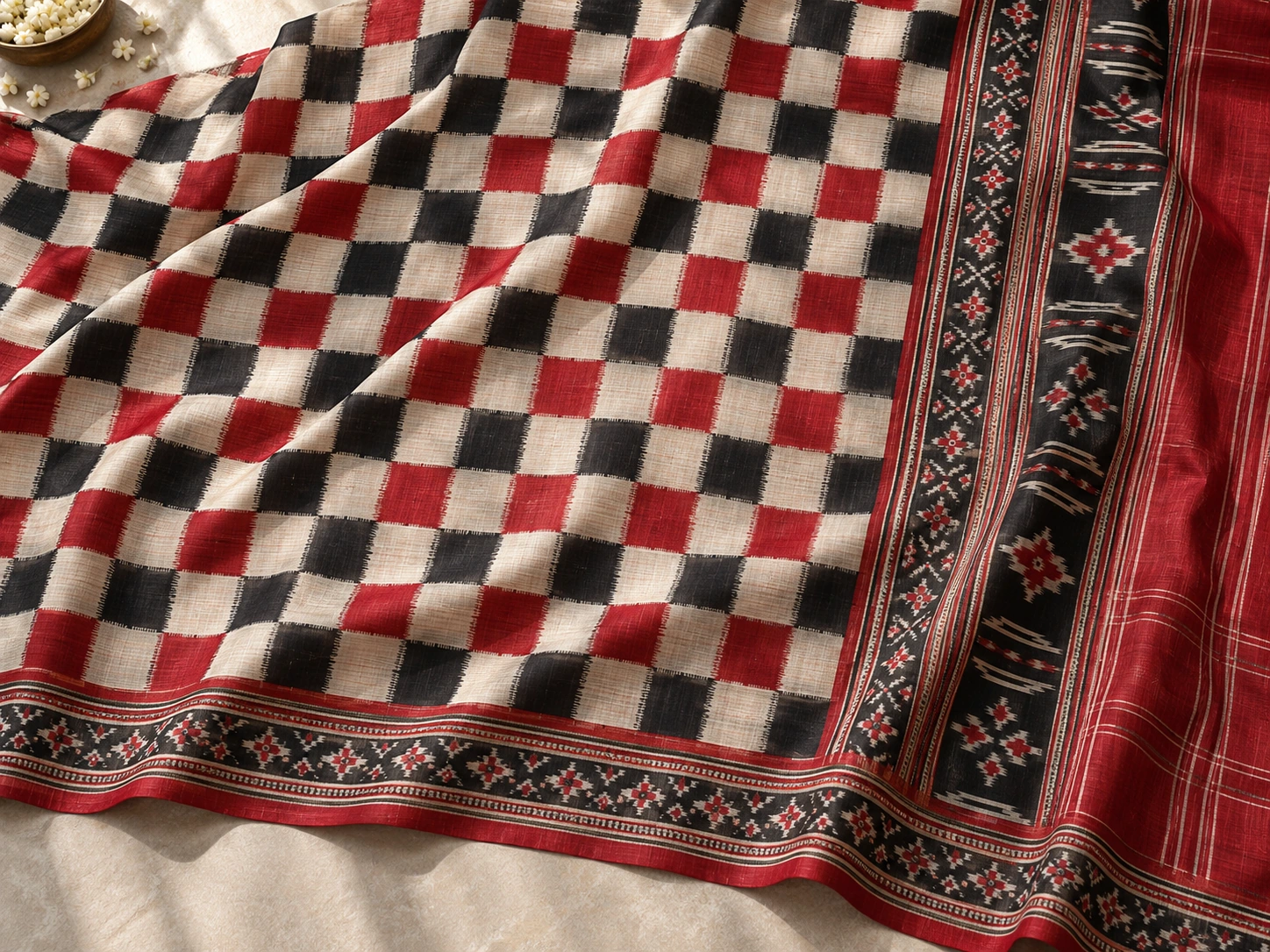
    Gharchola is especially associated with bridal and auspicious occasions in Gujarat. The most familiar examples combine a checked grid with Bandhani dots, using red, maroon or other traditional colours and often gold-coloured grid lines. Individual squares may contain flowers, dots or symbolic arrangements.

    A typical look: An orderly framework of squares with decorated sections inside. How it differs from ordinary Bandhani: Bandhani tells you the dot-making technique; Gharchola identifies a more specific ceremonial saree style with a characteristic gridded arrangement.

    Before you buyInspect and ask: the Gharchola guide in the Showroom Companion
    Registry record ↗

    Panetar — Gujarat

    Panetar — Gujarat↗

    પણેતર

    Region / centreGujarat
    FibreSilk, cotton-silk and other ceremonial cloths
    TechniqueContrasting border and pallu design
    GI relationshipNo exact GI verifiedNo matching registered product name verified
    Indicative budget (Oct 2026)Approx. ₹12,000–₹20,000Grade represented: Pure-silk/Gaji silk Panetar in the red-white wedding family; tying and base loom stated where availableConfirm tying, border work and delivery time; heavily embellished bridal versions are quoted separately.

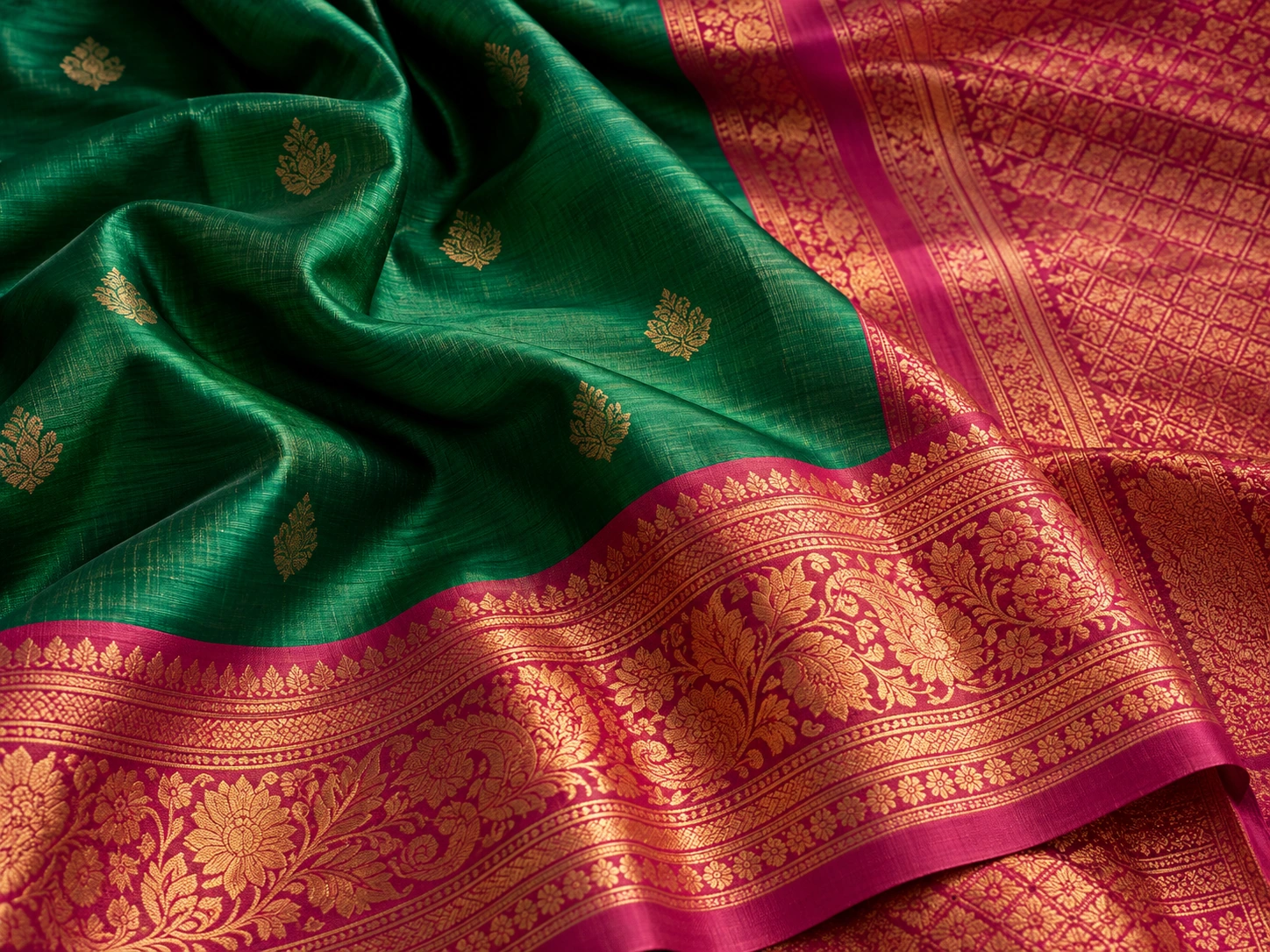
    Panetar is traditionally linked with Gujarati bridal dress. Its most recognisable palette is white or ivory with red, often accompanied by decorative borders, Bandhani work or other wedding-related detailing. The precise styling varies.

    A typical look: A pale field set off by striking red and sometimes gold-coloured ornament. How it differs from Gharchola: Panetar is strongly recognized by its bridal colour relationship; Gharchola is strongly recognized by its checked, richly patterned ceremonial layout. They can appear together in Gujarati wedding contexts.

    Before you buyInspect and ask: the Panetar guide in the Showroom Companion
    Leheriya — Rajasthan

    Leheriya — Rajasthan↗

    लहरिया

    Region / centreJaipur/Jodhpur and Rajasthan
    FibreLightweight cotton, silk, chiffon variants
    TechniqueDiagonal wave-pattern resist dyeing
    GI relationshipNo exact GI verifiedNo matching registered product name verified
    Indicative budget (Oct 2026)Approx. ₹3,000–₹12,000Grade represented: Hand tie-dyed Leheriya on seller-declared natural-silk chiffon or handloom tussar; fibre explicitly namedSpecify chiffon or tussar; extra work is priced separately.

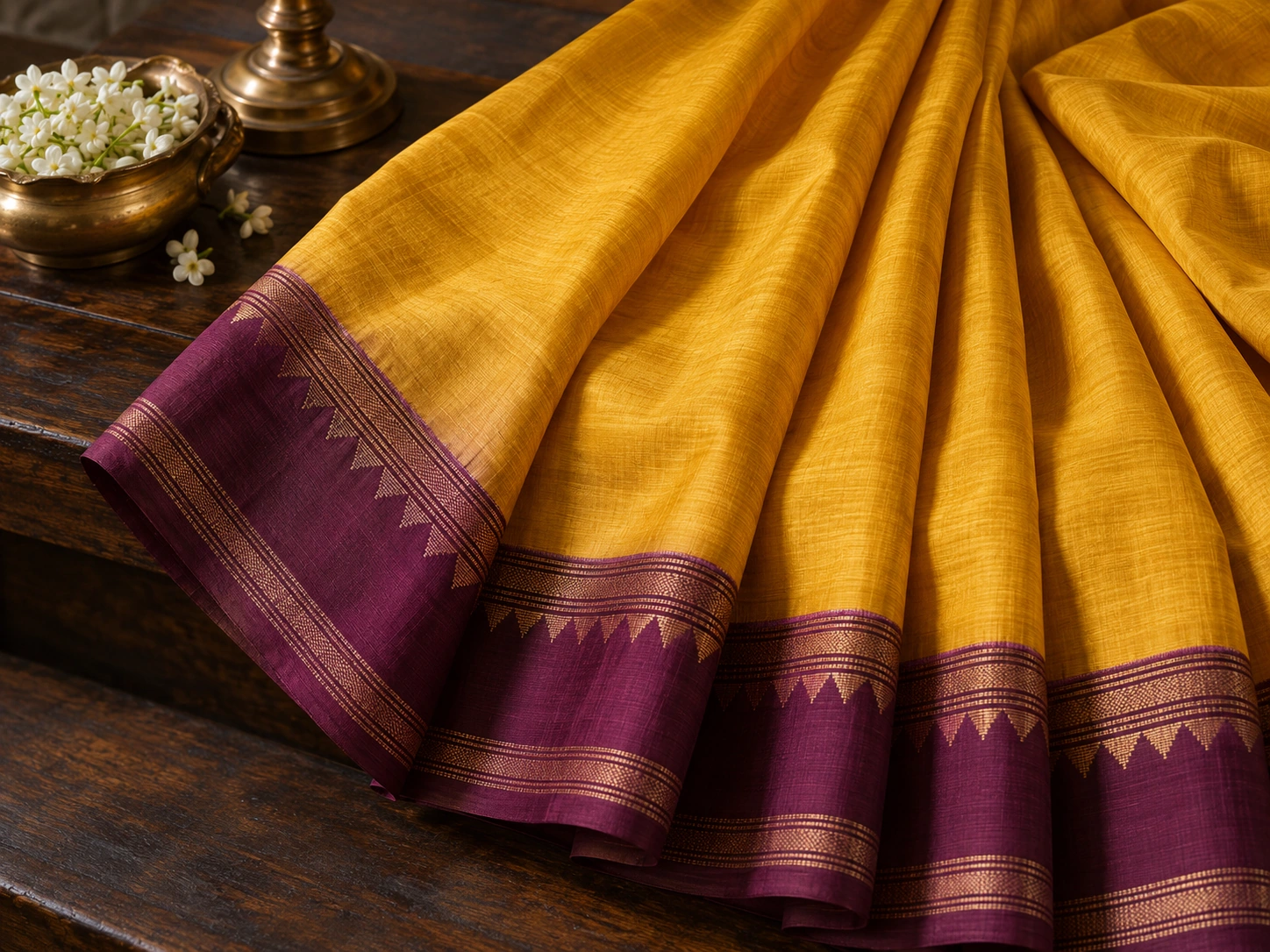
    Leheriya sarees are dominated by diagonal, wave-like bands of colour. Some look playful and bright, with yellow, green, pink and orange; others use more restrained colour palettes. Because the lines come from tie-dyeing, they often have softened, flowing edges.

    A typical look: Colourful waves stretching diagonally across the cloth, frequently on lightweight fabric. How it differs from ordinary striped sarees: The characteristic rippling and colour transitions are central to the Leheriya identity.

    Before you buyInspect and ask: the Leheriya guide in the Showroom Companion
    Kota Doria — illustrative textile portrait

    Kota Doria — Rajasthan↗

    कोटा डोरिया साड़ी

    Region / centreKaithoon, Kota/Bundi/Baran, Rajasthan
    FibreCotton-silk, sometimes cotton
    TechniqueFine square khat checks formed in weave
    GI relationshipRegistered GI (2005)Kota Doria
    Indicative budget (Oct 2026)Approx. ₹6,000–₹18,000Grade represented: Handwoven Kota Doria cotton-silk with characteristic khat checks; ordinary to woven zari-butta workPure-silk Kota and substantial embroidery have separate budgets; pure-cotton Kota is a legitimate lower-cost parallel.

    Kota Doria is prized for its exceptionally light, airy cloth. Look closely: the fine square khat checks should arise from the interlacing of yarns, not simply appear as a printed grid.

    Weaving is particularly associated with Kaithoon near Kota in Rajasthan. Cotton and silk are commonly combined, although fibre composition varies, and the very openness that makes the fabric comfortable also calls for careful handling.

    Distinguishing clue: a regular woven grid that becomes apparent when held up to the light. Ask the seller about yarn composition and whether the squares are woven rather than printed.

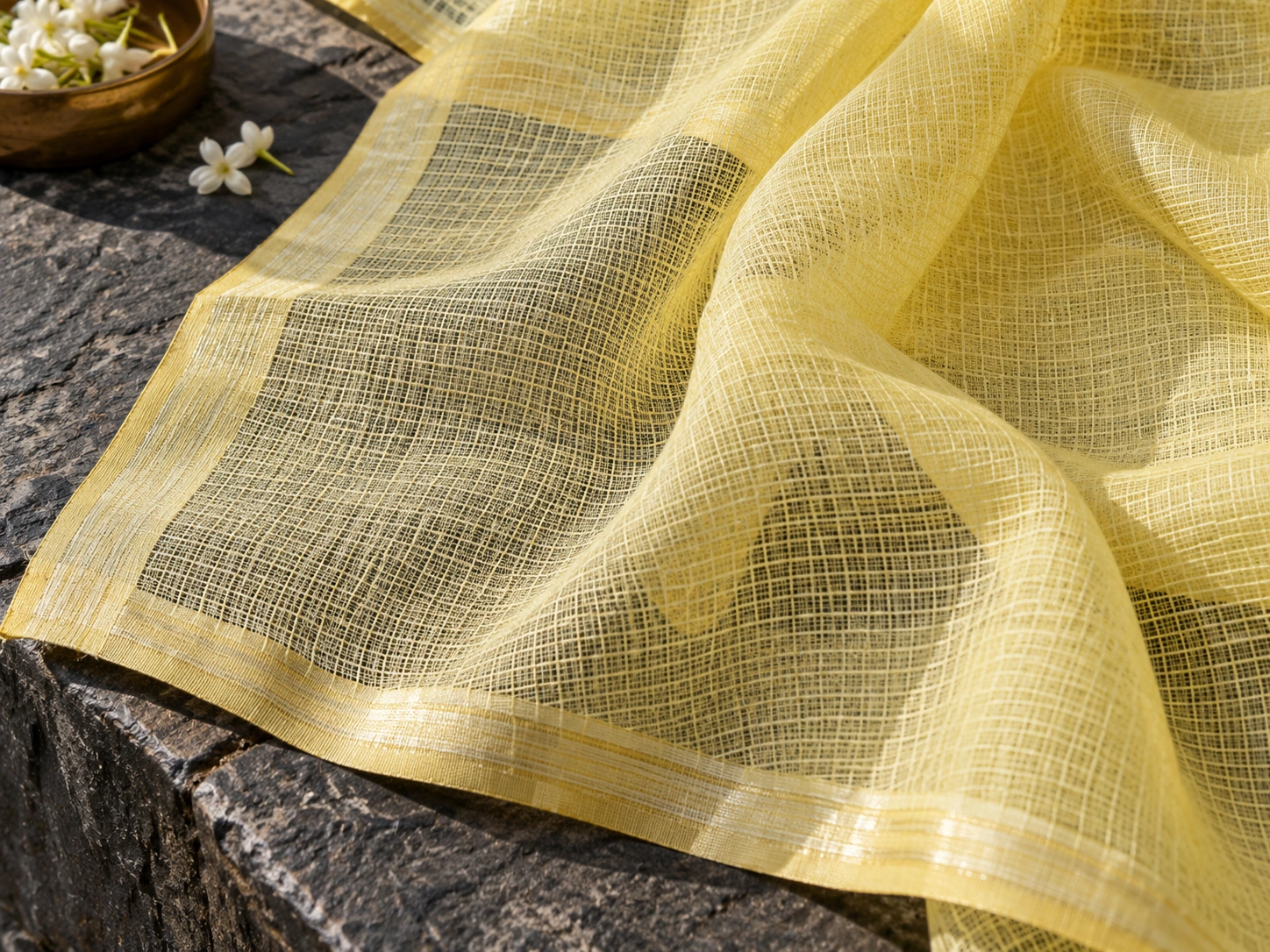
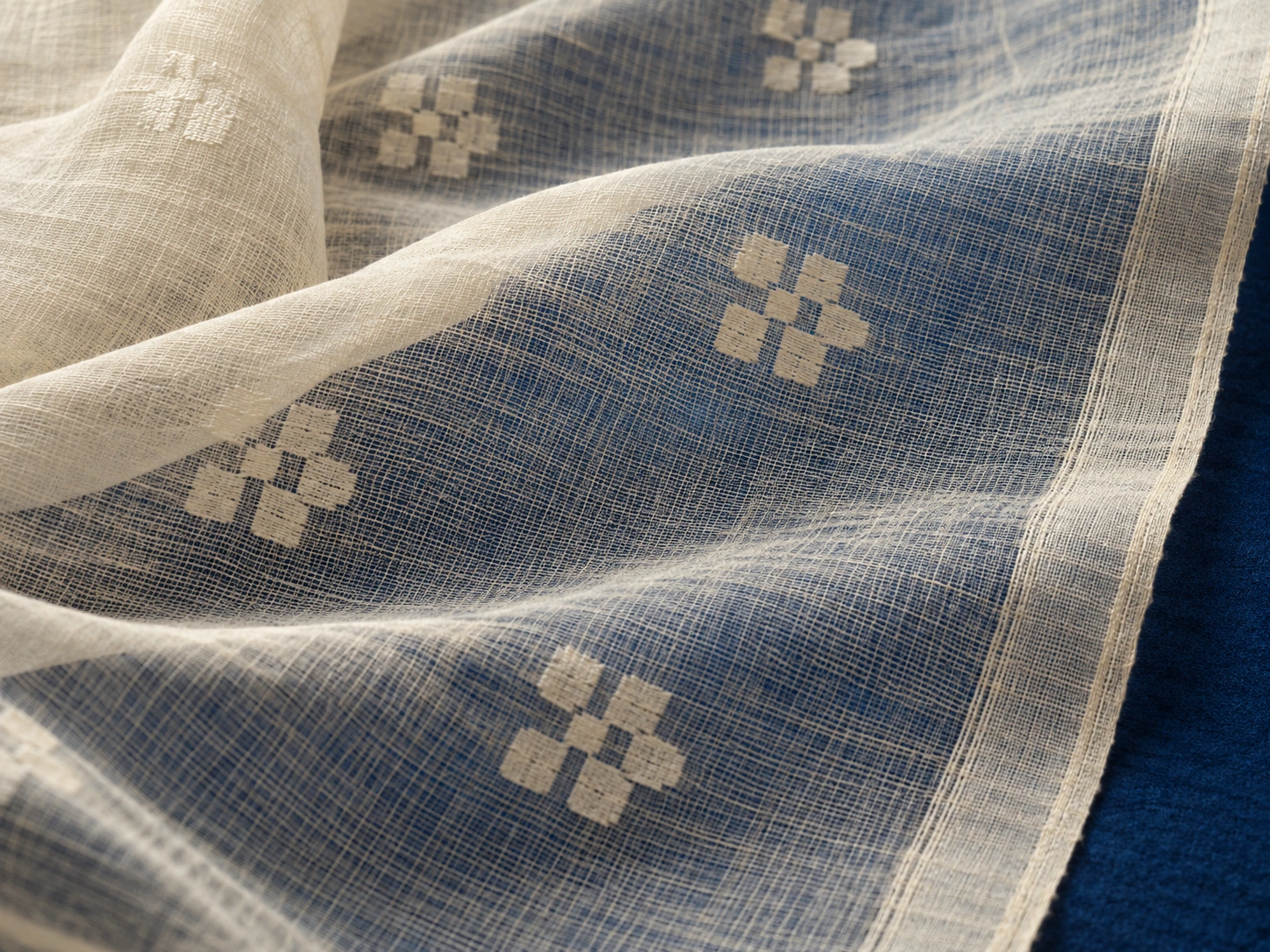
    An airy square-checked ground is visible in a lightly folded pale textile.
    Khats and airy ground The square-checked khat grid, visible in a lightly folded pale cloth.

    Before you buyInspect and ask: the Kota Doria guide in the Showroom Companion
    Registry record ↗

    Goa Kunbi-inspired textile — contemporary illustrative drape (traditional draping varies)

    Goa Kunbi — Goa↗

    कुणबी साडी

    Region / centreGoa
    FibreCotton
    TechniqueCheck/stripe weave in traditional sturdy drape
    GI relationshipGI application under examination (checked 20 Oct 2026)Goa Kunbi Saree & FabricsGoa Kunbi Saree & Fabrics: application under examination, checked 20 October 2026. That is different from a registered GI.
    Indicative budget (Oct 2026)Approx. ₹3,000–₹9,000Grade represented: Handwoven cotton Goa Kunbi, classic checks plus clearly labelled contemporary revival variantsDesigner adaptations and uncommon lengths should be identified individually.

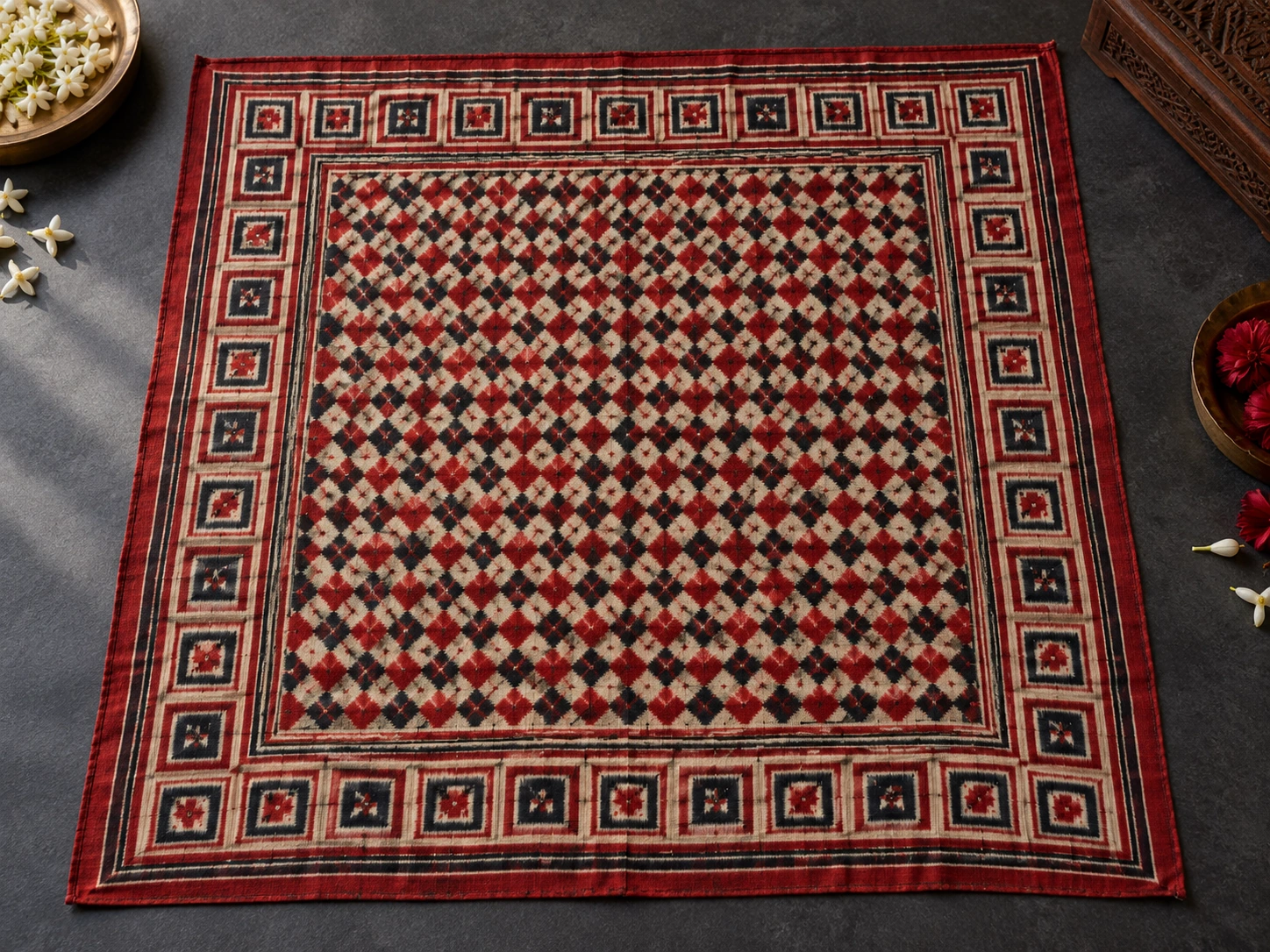
    The Kunbi saree belongs to Goa’s traditional dress culture. Its recognisable visual language is usually a sturdy cotton cloth with checks or stripes, frequently in red-based combinations, rather than heavy ceremonial zari. The Christian Kunbi working drape is traditionally calf-length, while a documented Hindu variant extends nearer the ankle; both can be secured with shoulder knots. A modern full-length fashion drape is not the same as documenting these traditional forms.

    The garment’s cultural context matters as much as the pattern: a checked cotton saree produced elsewhere is not automatically an authentic Goan Kunbi textile.

    Important GI distinction: Goa Kunbi Saree & Fabrics is an application under examination in the Indian registry, not a granted registration.

    Before you buyInspect and ask: the Goa Kunbi guide in the Showroom Companion
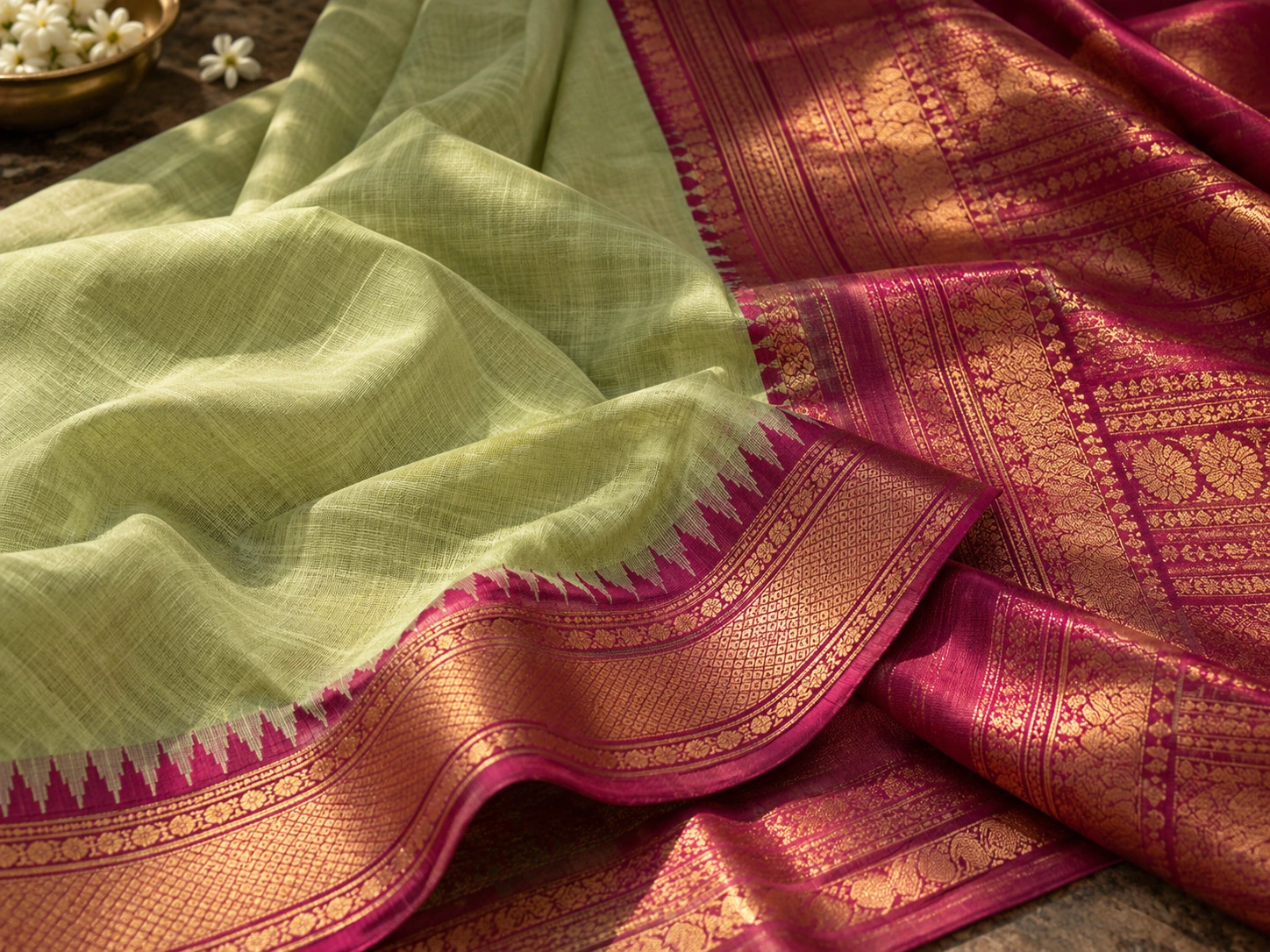
    GI application under examination; not a registered GI. Registry record ↗

    Central India↗

    Chanderi — Madhya Pradesh

    Chanderi — Madhya Pradesh↗

    चंदेरी साड़ी

    Region / centreChanderi, Ashoknagar district, Madhya Pradesh
    FibreSilk, cotton, silk-cotton
    TechniqueFine sheer plain weave with supplementary motifs
    GI relationshipRegistered GI (2005)Chanderi Sarees
    Indicative budget (Oct 2026)Approx. ₹4,000–₹8,000Grade represented: Handwoven Chanderi cotton-silk, ordinary borders/butta; zari fineness variesPure-silk Chanderi, dense jala work or precious-metal zari is a separate grade. Block-printed Chanderi on a handwoven base can cost less; printed decoration is not a woven buti.

    Chanderi is associated with very fine, light, often slightly sheer fabric, frequently decorated with small, delicate butis and borders that do not overwhelm the cloth. Traditional silk–cotton Chanderi is especially well known, but Chanderi is sold in other fibre combinations too.

    A typical look: Airy fabric, gentle lustre, understated scattered motifs, delicate border. How it may feel: Light but sometimes a little crisp rather than limp. How it differs from Kota Doria: Kota Doria has the small khat check structure; Chanderi's well-known examples are identified more by their fine, translucent cloth and delicate decorative vocabulary.

    In depth

    7 sections · one open at a time

    Understand what the light is passing through

    Chanderi's familiar impression is of a fine, light ground carrying restrained motifs and a border that frames rather than overwhelms it. That is a useful visual introduction, not the whole definition: the region makes more than one fibre combination, and transparency is not proof of origin.

    A regional tradition with changing materials

    Chanderi is a weaving centre in Madhya Pradesh. The India Handloom Brand sheet describes a silk-warp, cotton-weft construction, while the Craft Revival Trust reference also discusses increasing use of silk in the weft. Read the technical sheet as an account of an important silk–cotton grade, not a rule excluding every other composition.

    Cotton, silk and silk–cotton all belong here. A good history distinguishes fine-cotton antecedents, changes in yarn sourcing and contemporary mixtures, rather than describing one material combination as unchanged for centuries; the available references do not support a complete dated chronology, or a named royal inventor.

    Ground, border and buti

    In the documented silk–cotton example, silk supplies the lengthwise warp and cotton the crossing weft. Additional yarn systems produce ornament: the technical account distinguishes extra-warp border work from extra-weft work in the body and pallu. Dobby, jala and sometimes Jacquard mechanisms take part in pattern selection; none of those words establishes motor-driven weaving.

    A buti names a small motif, not a method of making it. First see a ground with a motif, then ask which yarn creates the motif. A border can use a different patterning arrangement from the body, and calling all three areas simply “woven flowers” loses that useful distinction.

    Sheerness, crispness and yarn specification

    The India Handloom Brand source associates its light, open silk–cotton cloth with an un-degummed silk warp. That is one documented relationship between material processing and handle. It does not mean every sheer cloth is Chanderi, that every stiff Chanderi is superior, or that transparency has only one possible cause.

    Handle and openness are qualities to compare in the actual saree. Look at a plain area rather than judging through the motif, and ask whether the feel is expected to change with finishing or care. A light test does not reveal fibre.

    Yarn fineness, yarn system, fabric density and finish are separate specifications. A count number should come with its counting system and the direction it describes; it is not a measurement of craftsmanship and does not identify town or loom.

    Chanderi, Maheshwari and Kota Doria

    The short contrast remains useful. Chanderi often presents a translucent ground and delicate ornament; Maheshwari often foregrounds geometric borders, stripes and a more compact effect; Kota Doria's khat grid belongs to its fabric structure. These are routes through representative examples, not rules for classifying every saree from a photograph.

    When two light cloths look alike, move from appearance to construction. Is the grid structural? What creates the border? Which yarns make the ground? Then ask who made it and where.

    Fine work can be quiet

    Look at proportion, evenness of the ground and how a small motif sits without visibly distorting its surroundings. Follow the border's relationship to the body, including turns and changes in design density. A sparse layout makes small defects easier to see, and excellent drawing easier to appreciate.

    Pure silk is not automatically above cotton or silk–cotton. A material choice changes the cloth; it does not rank the maker's judgement or workmanship, and a wearer may prefer a particular balance of openness, body and drape.

    Price and use

    The Atlas's price guide is for an ordinary handwoven cotton–silk grade with ordinary borders and butis. Pure-silk Chanderi, dense work or precious-metal zari belong to other comparisons.

    Handle the fine ground and any exposed decorative yarn without stretching or snagging it, and ask about the actual finish and border materials before choosing a treatment. Saree Care explains the general principles.

    Further reading: India Handloom Brand: Chanderi Saree · Craft Revival Trust / Asia InCH: Chanderi Weaving

    Before you buyInspect and ask: the Chanderi guide in the Showroom Companion
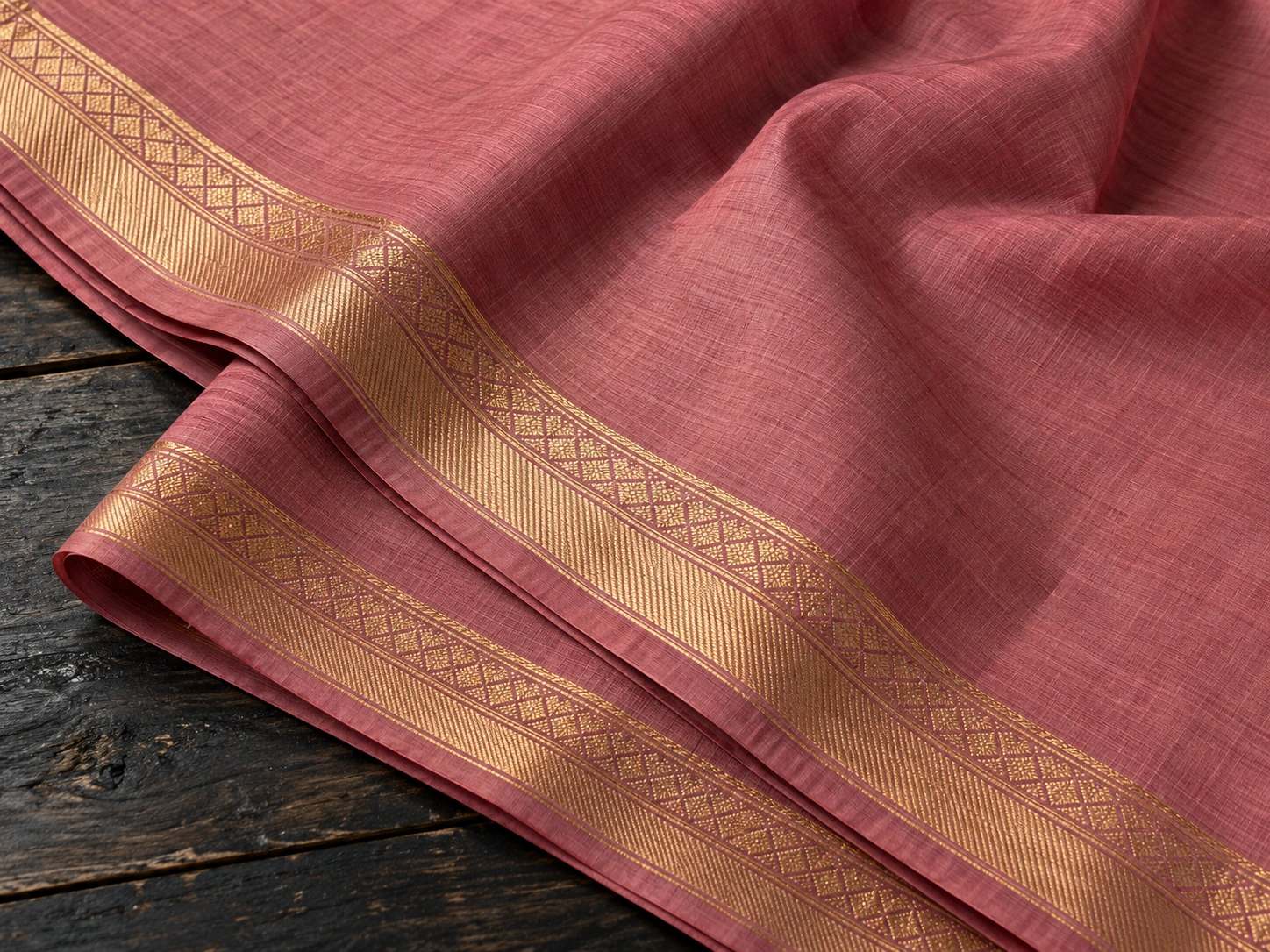
    Registry record ↗

    Maheshwari — Madhya Pradesh

    Maheshwari — Madhya Pradesh↗

    महेश्वरी साड़ी

    Region / centreMaheshwar, Khargone district, Madhya Pradesh
    FibreSilk-cotton, silk, cotton
    TechniqueHandwoven stripes/checks and contrasting borders
    GI relationshipRegistered GI (2012)Maheshwar Sarees & Fabric
    Indicative budget (Oct 2026)Approx. ₹4,000–₹8,000Grade represented: Handwoven Maheshwari cotton-silk with ordinary woven border/palluUnusually dense motifs, pure silk or extra hand embellishment are priced separately.

    Maheshwari sarees are known for a cleaner, more geometric appearance than many richly floral silk brocades. Stripes, checks and neatly designed borders are common. Silk–cotton compositions are particularly characteristic, though cotton and silk variants also exist.

    A typical look: Smooth-looking body, restrained geometric patterns, a carefully designed border and striped or ornamented pallu. Some traditional borders have a similar look on both sides. How it differs from Chanderi: Maheshwari commonly has a slightly more compact feel and more prominent striped or geometric border language; Chanderi is especially associated with airy lightness and scattered delicate butis.

    Before you buyInspect and ask: the Maheshwari guide in the Showroom Companion
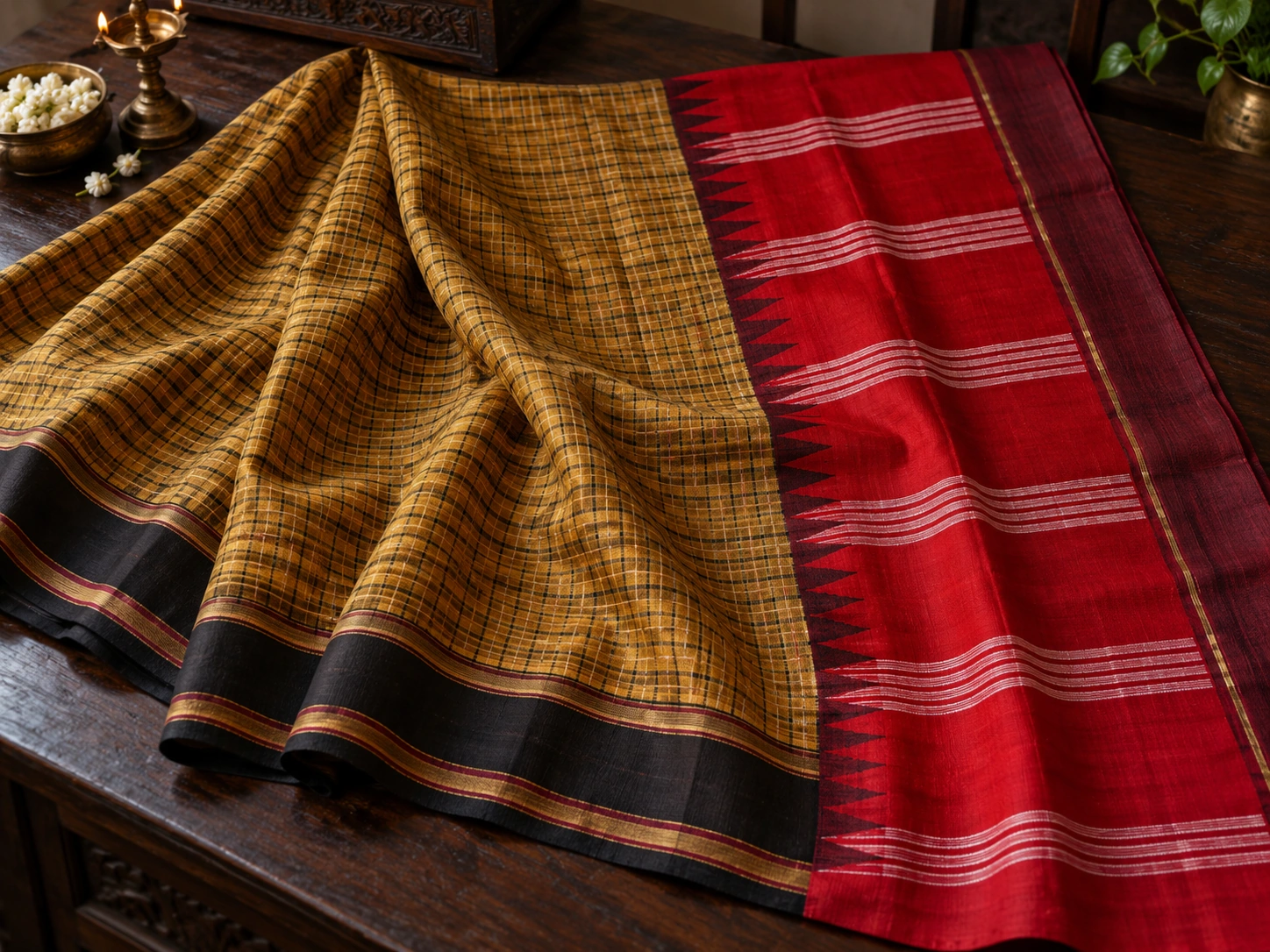
    Registry record ↗

    Champa/Kosa Silk — illustrative textile portrait

    Champa / Kosa Silk — Chhattisgarh↗

    चांपा कोसा साड़ी

    Region / centreChampa, Janjgir-Champa, Chhattisgarh
    FibreTussar/kosa silk
    TechniqueNatural honey/copper tussar, irregular slubbed surface; decorative traditional borders
    GI relationshipRegistered GI (2010)Champa Silk Saree and FabricsRegistered GI: Champa Silk Saree and Fabrics (2010). The name is broader than one yarn-processing method.
    Indicative budget (Oct 2026)Approx. ₹7,000–₹25,000Grade represented: Handwoven Champa Kosa/tussar silk, plain through jala/temple-border workDense jala and added painting or embroidery sit at the upper end or are quoted individually.

    Champa and nearby weaving centres of Chhattisgarh are associated with kosa, a regional name used for tussar silk. Its surface is often slightly irregular and softly lustrous rather than glassy-smooth.

    Natural-looking honey, copper and beige shades are familiar, but finished sarees can be dyed and elaborately designed. Kosa describes a silk tradition, not a promise that any garment called “kosa” comes from a particular cooperative or loom.

    For comparison: identify the silk yarn, its preparation and the weaving centre. The registered GI name is Champa Silk Saree and Fabrics.

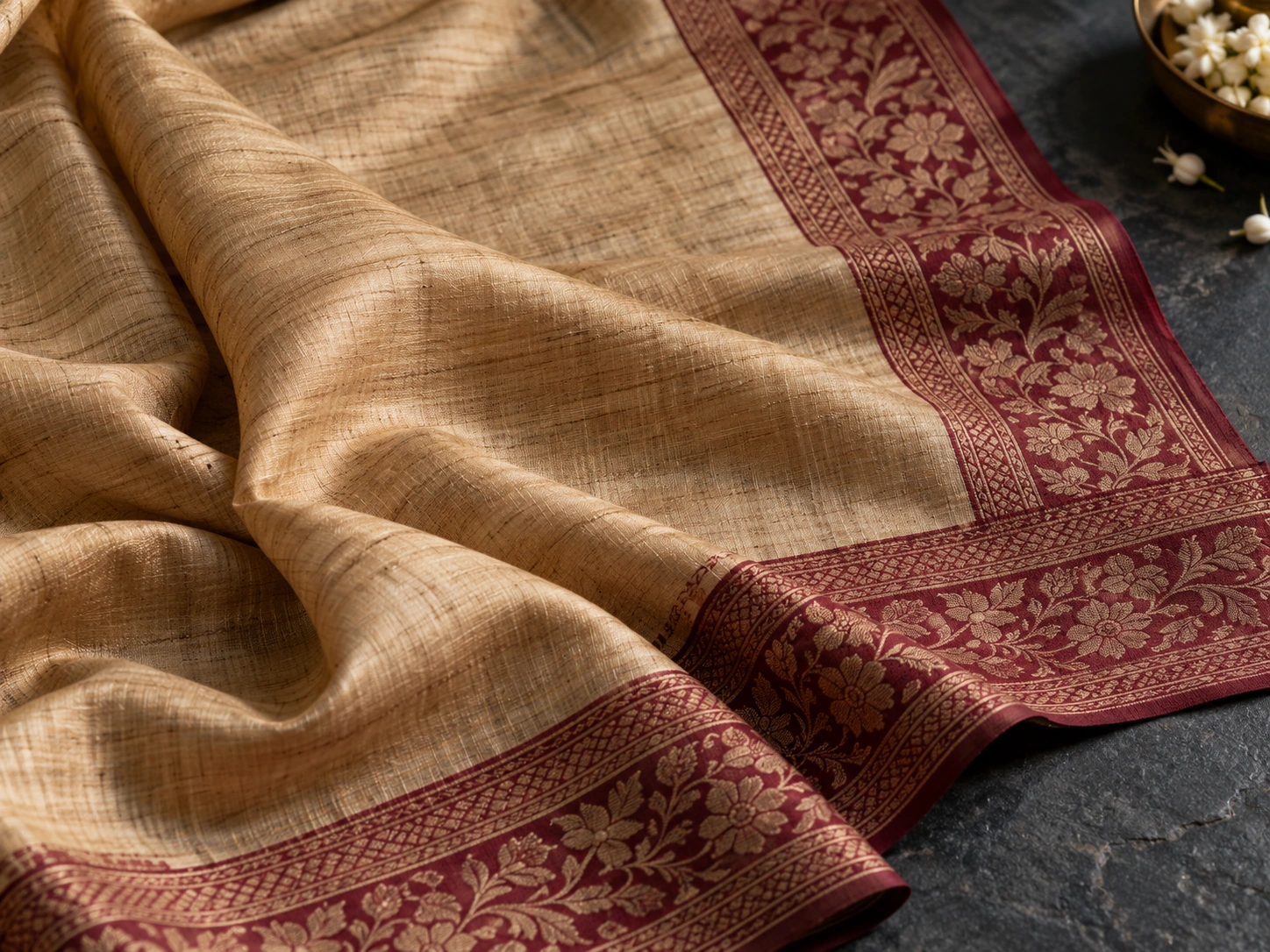
    Warm undyed tussar-like silk meets a restrained lattice-patterned border.
    Yarn character and border A warm, undyed, tussar-like silk meets a restrained lattice border.

    In depth

    1 section

    A yarn-making story as well as a weaving story

    Champa's Kosa tradition brings two kinds of work into the same cloth: preparing silk yarn from cocoons, then preparing and weaving that yarn. The government GI account explicitly describes sericulture and reeling alongside weaving. This matters because the slightly textured surface familiar to shoppers is an outcome, not the complete explanation of how the material was made.

    Reeled silk uses usable continuous filament unwound from cocoons; spun yarn is made by drawing and twisting fibres together. Tasar can be reeled, so neither Kosa nor tussar should be defined as automatically handspun. Different yarn preparations can be used in different parts of a textile. A rougher-looking thread does not tell you its whole processing history.

    There is a documented change within local practice, too. An August 2017 parliamentary answer records the distribution of 105 Buniyaad reeling machines in the Champa project to replace thigh reeling, together with reeling/spinning demonstrations and weaver training. This is a dated development, not a count of today's equipment. It prevents a romantic but misleading rule that every genuine Kosa must still be prepared against a reeler's thigh. Improving a strenuous preparation stage does not erase the weaving tradition.

    The registered specification describes extra-warp border patterns and lattice-dobby work, including cotton-flower forms such as rui phool and related variations. That gives a reader another way to look: a quiet body can leave the border's lengthwise pattern yarn to do the drawing. The border and ground need not tell the same structural story.

    In a shop, ask what yarn forms the body and what forms the border, then whether the maker describes it as reeled, spun or a combination. The answer is more informative than a promise of “natural texture”. Judge whether the texture feels intentional and consistent with the design, and whether the cloth suits the wearer's use. Ask separately about added painting or embroidery. Kosa's interest lies in its material and local working knowledge; it does not need every irregular thread to be promoted into a certificate of antiquity.

    Sources: Government GI brochure, Champa Silk section · Central Silk Board, processing of tasar cocoons · Rajya Sabha written answer, 11 August 2017, printed p. 325 · Champa GI specification, printed p. 12, preserved copy

    Before you buyInspect and ask: the Champa Silk / Kosa guide in the Showroom Companion
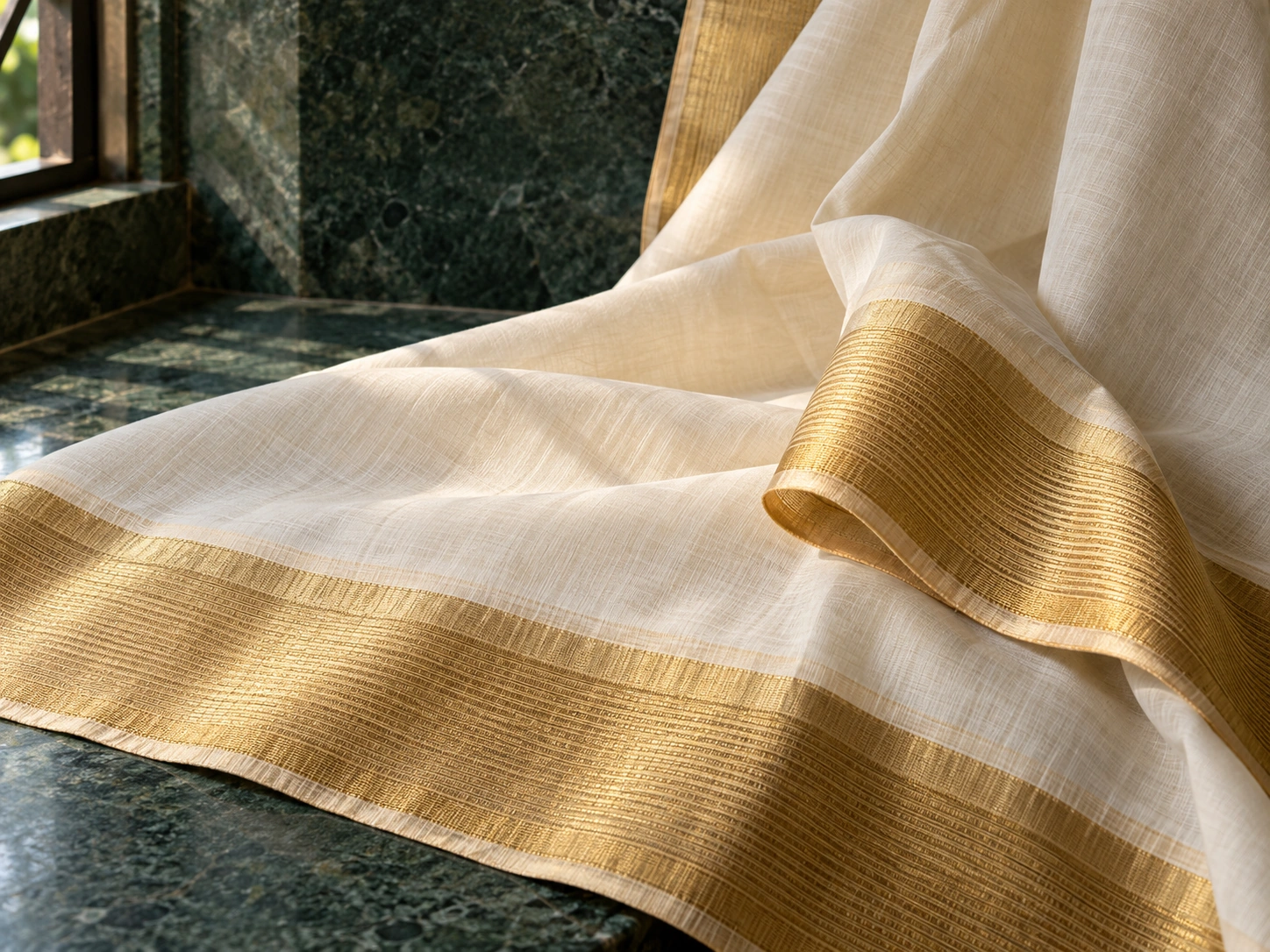
    Registry record ↗

    East India↗

    Baluchari — West Bengal

    Baluchari — West Bengal↗

    বালুচরী শাড়ি

    Region / centreBishnupur, Bankura district, West Bengal
    FibreSilk
    TechniqueFigurative brocade-like woven narrative pallu
    GI relationshipRegistered GI (2012)Baluchari Saree
    Indicative budget (Oct 2026)Approx. ₹12,000–₹30,000Grade represented: Handwoven pure-silk Baluchari with narrative figures in thread work; metallic variants identifiedElaborate narrative Baluchari with accomplished, dense figure work is a separate collecting grade (about ₹25,000–₹45,000).

    Baluchari is memorable because its pallu can look like a series of illustrated story panels. The designs often depict figures, social scenes or mythological episodes. Instead of a purely floral pallu, you may see people arranged in rows and ornamental frames.

    A typical look: Silk with carefully organized narrative motifs, often in contrasting colours. The body may be relatively restrained so the pallu becomes the central attraction. How it differs from an embroidered story scene: Traditional Baluchari figural designs are woven into the textile rather than simply stitched on later.

    In depth

    7 sections · one open at a time

    Read the whole panel

    Baluchari invites the eye to read. The pallu can organise people, ornaments and repeated figures inside frames, while a quieter body gives that pictorial end room to speak. Its fascination lies in the relationship between cloth, repeat and scene: a small woven figure has to remain legible within a larger arrangement. Recognising an epic episode is only one way to appreciate that achievement.

    Baluchar and Bishnupur are different historical moments

    The name belongs to Baluchar in the Murshidabad region. The Metropolitan Museum records a nineteenth-century silk end panel attributed to Baluchar, Murshidabad, giving the historical locality a specific object. Bishnupur is a major present centre, consistent with the India Handloom Brand technical sheet. One should not quietly replace the other.

    The distinction allows revival without assuming complete technical continuity. An older Baluchar object and a modern Bishnupur saree can belong to a connected tradition while differing in pattern control, materials or market. A detailed account of who revived what, and in which year, needs a fuller chain of historical sources than these concise references provide.

    Narrative does not always mean mythology

    Social scenes belong here as well as mythological episodes. The Penn Museum's nineteenth-century silk record describes repeated seated figures holding flowers, together with floral bands, so the whole tradition cannot be defined by one pair of epics.

    Ask how the scene is arranged. Is it a repeated vignette, a progression of panels, or a larger central element surrounded by borders? Repetition is not a failure to tell a story; it is one of the ways woven design gives a scene rhythm. Nor does a familiar story establish where the object was made.

    Making images with pattern yarn

    The core explanation is a woven ground with additional pattern yarn forming the figured design. The India Handloom Brand sheet describes extra-weft ornament, and the Penn Museum records supplementary patterning wefts. The crossing pattern yarn supplies visual information beyond the yarns needed for the ground.

    Pattern control is a separate question. The technical account describes earlier jala practice and contemporary Jacquard-assisted weaving. A Jacquard controls which warp threads lift; it is not the opposite of handloom, and a museum record's brief loom label does not date its adoption in the region.

    Workmanship is drawing, placement and cloth together

    Unfold the whole pallu before judging a face or hand in isolation. Notice how frames meet at corners, whether repeated figures remain readable and how the pallu's scale relates to the body. Then look at the quieter ground for condition and consistency: a brilliant panel does not cancel a hole or weak patch elsewhere.

    These are ways to assess execution, not rules that every figure must have a fixed thread count or that every saree must follow one layout. More figures can increase design complexity without making a composition more successful, and higher contrast may help one drawing and overwhelm another.

    Baluchari and Swarnachari

    Baluchari introduces the coloured-thread narrative tradition; Swarnachari highlights metallic-looking figure work. Contemporary retail categories keep the names separate, but a shop category does not determine metal composition or supply an exact historical date.

    Swarnachari is not automatically better. It changes the surface effect and the questions a buyer must ask: a coloured-silk narrative may offer more subtle drawing, and reflective yarn may produce a more emphatic pallu. Neither is a quality ranking.

    Buying context and care

    The Atlas's price guide compares a handwoven pure-silk narrative grade, with metallic variants identified. A regional name, an elaborate scene or a high price cannot by themselves prove silk, handloom or Bishnupur manufacture.

    Look at exposed pattern yarn and the repeated folds through the worked pallu for pulls, weak ground or earlier repairs before choosing any intervention. Saree Care covers general practice.

    Further reading: India Handloom Brand: Baluchari Silk Saree · The Metropolitan Museum of Art: Baluchari end panel, 2011.576.9 · Penn Museum: Sari 43-12-72A · Kaniska, Bishnupur: Swarnachari collection (retail terminology)

    Before you buyInspect and ask: the Baluchari guide in the Showroom Companion
    Registry record ↗

    Swarnachari — West Bengal

    Swarnachari — West Bengal↗

    স্বর্ণচরী শাড়ি

    Region / centreBishnupur, West Bengal
    FibreSilk
    TechniqueBaluchari-related figurative pattern with gold/silver-coloured ornamental threads
    GI relationshipRelated GI: Baluchari SareeBaluchari SareeRelated registration: Baluchari Saree. Swarnachari is not presented here as a separately registered GI.
    Indicative budget (Oct 2026)Approx. ₹12,000–₹20,000Grade represented: Handwoven pure-silk Swarnachari with gold/silver-toned narrative motif yarn; metal fineness not assumedExceptionally dense figure work and verified precious-metal yarn are assessed and quoted individually.

    Swarnachari is related to the Baluchari visual tradition but is especially associated with gold- or silver-coloured figure work in its designs. The story-panel effect remains, but the metallic-looking decoration produces a more luminous, ceremonial impression.

    A typical look: Dark or richly coloured silk with metallic-looking figures and ornamental frames. Compared with Baluchari: Both can have narrative scenes; Swarnachari commonly places greater emphasis on reflective metallic-coloured patterning.

    In depth

    7 sections · one open at a time

    A reflective surface, a separate material question

    Swarnachari belongs beside Baluchari but deserves an entry of its own. Its distinction is the use of gold- or silver-coloured ornamental yarn to emphasise narrative figures and frames. That changes how the picture catches light, and changes what a buyer needs to ask. “Swarna” in a name is not a metal assay.

    What it shares with Baluchari

    The historical Baluchar material and the current Bishnupur account give context for the wider figured-silk tradition; the Baluchari entry carries that shared history. They do not date the emergence of the name Swarnachari or identify a single inventor.

    A Bishnupur retailer separates Swarnachari and Baluchari categories and uses descriptions such as all-over and jori/mina. That establishes current retail vocabulary on that site. It does not establish a universal structural definition, precious-metal content or the history of the category.

    Ground and ornament remain different yarns

    Think of a silk ground with figured ornament whose actual material needs stating. The eye registers reflective shapes; a technical description should explain how their yarn is worked into the cloth. Regional story, loom operation and metallic-yarn composition are separate claims.

    The whole saree is not gold because the design looks gold, and a silk-purity statement cannot authenticate the ornament. If the decorative yarn's composition is unknown, “gold-coloured” is more accurate than an unstated upgrade to precious-metal zari.

    Read the figure in changing light

    A reflective design can be clear from one angle and less clear from another. View the pallu spread flat, then at the angle at which it will hang, and ask whether the figures and frames remain coherent as the reflections change. This is a way of looking at the design, not a test of its composition.

    Notice how coloured accents relate to reflective areas. Does the ornament clarify the picture or compete with it? More metallic coverage can increase visual intensity while reducing the quieter spaces that make a scene readable. That is a design choice for the wearer, not evidence of a superior grade.

    Workmanship and condition

    Consider panel alignment, intelligible drawing, secure decorative yarn and a sound ground. A metallic-looking pallu should not distract from a pulled body thread or an old repair, and fold lines deserve a separate look because wear concentrates there.

    A darkened or abraded decorative yarn needs a condition explanation, not a showroom chemical diagnosis. Different yarns and finishes can show similar changes, and observation alone cannot measure gold or silver content. A neat reverse does not independently prove handloom.

    Compare with Baluchari without ranking the siblings

    Baluchari's coloured-thread work and Swarnachari's reflective figure work offer different visual experiences, and either can have thoughtful drawing and excellent making. Ask the same questions of both: ground fibre, pattern yarn, pattern construction, loom operation and producer, adding the metal-specification question where it matters.

    Price and preservation

    The Atlas's price guide concerns handwoven pure-silk sarees with gold- or silver-toned narrative ornament, and metal fineness is not assumed. A particular premium should be explained by actual differences in material, work, design or maker evidence; the name alone supplies none of those.

    Identify the decorative yarn and any existing wear before asking a cleaner or conservator to treat a worked pallu. Saree Care covers general preservation.

    Further reading: India Handloom Brand: Baluchari Silk Saree · The Metropolitan Museum of Art: Baluchari end panel, 2011.576.9 · Kaniska, Bishnupur: Swarnachari collection (retail terminology) · Baluchari Saree GI record 173

    Before you buyInspect and ask: the Swarnachari guide in the Showroom Companion

    Registry record ↗

    Bengal Jamdani — West Bengal; related traditions in Bangladesh

    জামদানি শাড়ি

    Region / centreFulia and Nadia area, West Bengal; Bangladesh has related distinct heritage
    FibreFine cotton and modern variants
    TechniqueDiscontinuous supplementary-weft motifs
    GI relationshipPending GI applications (checked 20 Oct 2026)Fulia Jamdani Sarees · Jamdani Sarees of West BengalFulia Jamdani Sarees: application under examination. Jamdani Sarees of West Bengal: pending application. Both checked 20 October 2026; neither shows a certificate. UNESCO’s 2013 Jamdani inscription concerns Bangladesh’s living heritage, not merchandise.
    Indicative budget (Oct 2026)Approx. ₹2,000–₹6,000Grade represented: Handwoven Bengal cotton Jamdani, including ordinary 100-count work; discontinuous extra-weft motifsFine handspun-muslin Jamdani is a separate collecting grade (about ₹25,000–₹40,000); finer commissions are quoted individually.

    Jamdani is admired for light cloth carrying delicate, almost floating motifs. Traditional fine cotton versions can look particularly airy. The patterns are worked into the cloth rather than merely printed on the surface. Flowers, leaves and geometric motifs may be widely spaced or arranged into denser designs.

    A typical look: Fine, often transparent or translucent fabric with crisp little decorative shapes. Compared with Chanderi: Both can be light and delicate; Jamdani names an ornamental weaving technique and family of textile traditions, whereas Chanderi is a specific regional cloth tradition.

    Small opaque woven floral motifs appear against a translucent cotton ground.
    Figured motifs and ground Small, opaque woven floral motifs against a translucent cotton ground.

    In depth

    7 sections · one open at a time

    A pattern woven into a light ground

    Jamdani names a making technique and a family of textile traditions, rather than one mandatory fibre or one product identity. Its characteristic motifs are formed with supplementary yarn as the cloth is woven, so the light ground and the design are appreciated together: the quiet spaces are part of the composition.

    Two Bengal contexts

    The India Handloom Brand cotton-Jamdani sheet documents production in West Bengal's Nadia and Burdwan areas. UNESCO's 2013 inscription concerns the traditional art of Jamdani weaving in Bangladesh, particularly among craftspeople around Dhaka. Both belong in the story; they are not interchangeable geographic statements.

    The inscription recognises a living heritage practice and its transmission within a community. It does not certify a saree in a shop, establish its fibre or extend that recognition to every product sold as Jamdani. In India, the Fulia Jamdani Sarees and Jamdani Sarees of West Bengal GI records were pending applications when checked on 20 October 2026.

    What discontinuous supplementary weft means

    The ground cloth has its own warp and crossing weft. An additional pattern weft is worked locally where a motif is needed, returning within the design area rather than necessarily travelling across the whole width.

    “Supplementary” means the ornament is woven in relation to a ground; “discontinuous” describes the local journey of the pattern yarn. Neither word makes a floating-looking flower proof of handwork, cotton or a particular place. A photograph can suggest what to ask; it does not supply the construction record.

    The India Handloom Brand account describes hand insertion without a design device for its cotton example. That is not a rule that any Jacquard-assisted cloth is powerloom, or that every variation is an imitation: the Uppada sheet explicitly records jala and more recent Jacquard use. Ask separately how the yarn is inserted, how the pattern is controlled and how the loom is operated.

    Fine cotton is one important expression

    The classic fine cotton example deserves explanation without excluding other materials. Ground yarn can be much finer than the pattern yarn, giving the motif a noticeable surface presence. But cotton count is not the same as threads per inch, and an impressive number without a counting system or a maker's specification is incomplete.

    Ask separately about the ground and the ornament. A silk decorative yarn does not make an all-cotton ground a pure-silk saree, and a modern silk-ground piece should be described on its own terms rather than judged as a failed cotton.

    Spacing is part of workmanship

    Look at a whole repeat, not just one attractive flower. How do motifs relate across the body? How does a border meet a pallu corner? Does the pattern stay coherent where densities change? A sparse composition leaves a fine ground beautifully visible; an all-over design asks different things of drawing and coordination.

    More coverage is not automatically better, and handwork need not look visibly uneven. Nor does a perfectly readable outline settle how a motif was made. Condition is a separate check: a delicate ground should not have holes, pulled yarn or undisclosed repairs hidden inside dense motifs.

    Jamdani, Chanderi, Banarasi and Uppada

    Chanderi is a regional cloth tradition; Banarasi is a varied regional weaving identity; Jamdani is a technique with particular living traditions. Compare examples by ground, pattern insertion, visual composition and provenance, rather than assuming one category's technique makes another impossible.

    Uppada uses related technique vocabulary while keeping its own regional history and material specification. The word Jamdani alone does not make an Uppada saree a Dhaka product; textile terms can cross boundaries without erasing local makers.

    Price and delicate handling

    The Atlas's price guide separates ordinary handwoven Bengal cotton Jamdani from fine muslin and other exceptional grades. A broad upper price should not be imposed on the ordinary cotton range, and the ordinary band should not be used to dismiss extraordinary documented work.

    Support the cloth when looking closely at a motif, and never pull a design yarn to see whether it stays in place. Saree Care covers storage, cleaning and conservation.

    Further reading: India Handloom Brand: Jamdani Cotton Sari · UNESCO: Traditional art of Jamdani weaving · India Handloom Brand: Uppada Jamdani Silk Saree · Fulia Jamdani Sarees GI application 892 · Jamdani Sarees of West Bengal GI application 1181

    Before you buyInspect and ask: the Bengal Jamdani guide in the Showroom Companion

    GI record 1 ↗ · GI record 2 ↗

    Tangail — West Bengal and Bangladesh

    Tangail — West Bengal and Bangladesh↗

    টাঙ্গাইল শাড়ি

    Region / centreWest Bengal, India; wider Tangail heritage in Bangladesh
    FibreCotton and silk-cotton
    TechniqueFine woven ground and decorative borders
    GI relationshipRegistered GI (2024)Tangail Saree of Bengal
    Indicative budget (Oct 2026)Approx. ₹1,500–₹5,000Grade represented: Handwoven Bengal Tangail cotton saree; ordinary woven borders/motifsSilk, silk-cotton and more elaborate collecting pieces are separate grades.

    Tangail sarees are associated with fine, comfortable cloth, often cotton or silk–cotton, and decorative borders with small repeating motifs. There are several locally recognized types, so no one colour palette defines every Tangail.

    A typical look: A relatively light body, neat borders, and fine linear or geometric design elements. Compared with Jamdani: Both may be lightweight eastern Indian textiles, but not every Tangail is a Jamdani and the names refer to different textile histories and production identities.

    Before you buyInspect and ask: the Tangail guide in the Showroom Companion

    Registry record ↗

    Dhaniakhali — West Bengal

    Dhaniakhali — West Bengal↗

    ধনেখালি শাড়ি

    Region / centreDhaniakhali, Hooghly district, West Bengal
    FibreCotton
    TechniqueHandloom everyday cotton weave
    GI relationshipRegistered GI (2012)Dhaniakhali Saree
    Indicative budget (Oct 2026)Approx. ₹1,500–₹3,500Grade represented: Handwoven Dhaniakhali pure cotton, ordinary checks/stripes/bordersBoutique styling variations can cost more than this ordinary guide.

    Dhaniakhali is best known as a practical cotton saree tradition. Many examples are comfortable and relatively straightforward in appearance, with a plain or minimally decorated body and characteristic woven borders. It is a reminder that not every important saree tradition is ceremonial silk.

    A typical look: Cotton with stripes or restrained patterns, often a clearly defined border. Compared with a lightweight silk saree: The attraction is usually cotton comfort and everyday usability rather than metallic decoration or strong lustre.

    Before you buyInspect and ask: the Dhaniakhali guide in the Showroom Companion

    Registry record ↗

    Garad and Korial — West Bengal

    Garad and Korial — West Bengal↗

    গরদ ও কোরিয়াল শাড়ি

    Region / centreWest Bengal
    FibreSilk
    TechniqueLight/pale silk with traditional ceremonial border treatments
    GI relationshipRegistered GIs (certificates 2024)Garad Saree · Korial SareeGarad Saree and Korial Saree are registered separately (certificates 2 January 2024).
    Indicative budget (Oct 2026)Approx. ₹8,000–₹16,000Grade represented: Handwoven pure-silk Garad/Korial family; modest woven border or butiHeavier brocade, added embroidery or verified precious-metal border work is quoted separately.

    Garad is commonly associated with a pale, often off-white silk body, sometimes with red or another strong border. The pale silk has an understated ceremonial character. Garad and Korial have separate registered identities, although shops sometimes combine the names; compare the actual silk, border and pallu.

    A typical look: White, cream or ivory silk with a striking red border or other limited colour accents. Compared with Banarasi brocade: These styles may look much less densely decorated, emphasizing colour restraint and silk character instead.

    Two pale silk sarees show narrow and fuller red borders.
    Compare the actual border Two pale silks with red borders of different weight. Names describe a family of looks; inspect the body, border and pallu of the piece in front of you.

    In depth

    1 section

    Two names with a weaving landscape behind them

    Garad and Korial are more than a convenient white-and-red colour description. India's GI Registry records Garad Saree and Korial Saree separately, with certificates dated 2 January 2024. That distinction is worth preserving even when a shop places them on the same shelf. Registration dates mark the protected records, rather than the beginning of the weaving traditions.

    The local connection is unusually helpful. The Central Sericultural Research and Training Institute's regional account identifies Mirzapur in Murshidabad as a centre making both Garad and Korial, alongside other silk cloth. A government export plan also lists both among Mirzapur's products. This is a shared production landscape, not evidence that one name must describe an imitation of the other. The same regional silk economy can support several distinct cloths.

    There is more happening at the border than the colour change suggests. A government consultation document records intricate three-shuttle interlocking work in the Garad–Korial cluster at Mirzapur and Jiaganj. Separate shuttles let the weaver manage adjacent colour areas as the cloth grows. That is different from sewing a finished red ribbon onto a pale body. It is a documented cluster practice, not a promise that every contemporary saree sold under either name has identical construction.

    The useful showroom comparison has three parts: the quiet body, the lengthwise borders and the end panel. Ask the seller to put their Garad and Korial examples next to each other and explain the difference in those areas. A fuller pallu or more decorative border may explain that shop's distinction; it need not become a historical law for every workshop. Tantuja's own retail channel includes a Garad explicitly described as plain silk, a useful reminder that restraint is an intended design choice.

    Give the undecorated silk some attention. How does it fall into pleats? Does the border support the drape or dominate it? If the appeal is the relationship between luminous pale cloth and a narrow accent, extra ornament may add cost without adding anything the wearer wants.

    Sources: Garad official record · Korial official record · CSRTI sericulture-tourism account · Murshidabad district export plan, Mirzapur product table · Development Commissioner for Handlooms, West Bengal cluster table · Tantuja/Bengal Handloom Garad product

    Before you buyInspect and ask: the Garad & Korial guide in the Showroom Companion

    GI record 1 ↗ · GI record 2 ↗

    Murshidabad silk — West Bengal

    Murshidabad silk — West Bengal↗

    মুর্শিদাবাদ সিল্ক শাড়ি

    Region / centreMurshidabad, West Bengal
    FibreSilk
    TechniqueFine silk weaving and finishing
    GI relationshipRegistered GI, class 23 (yarns and threads)Murshidabad SilkMurshidabad Silk is registered; the record displayed is class 23 (yarns and threads). This is not blanket certification of a finished printed or painted saree.
    Indicative budget (Oct 2026)Approx. ₹4,000–₹10,000Grade represented: Pure Murshidabad silk saree, handloom base where explicitly stated; modest printing or paintingCheck whether the base is handloom. Dense embroidery and commissioned painting are separate grades.

    Murshidabad has a long silk heritage, and in modern saree shops the name often points to light, smooth silk sarees, many of which are printed or hand-painted. Some have small motifs or flowing designs rather than heavy, woven brocade.

    A typical look: Relatively fluid silk with prints, painted scenes, florals or restrained borders. Important distinction: “Murshidabad silk” names a regional textile connection; it does not tell you by itself whether a design is printed, painted or woven.

    A painted botanical design lies on a softly folded pale silk ground.
    Cloth and added decoration A painted botanical design on a pale silk ground — decoration added to the woven cloth, which should be described separately from the silk itself.

    In depth

    1 section

    Follow the silk before following the picture

    Murshidabad's textile story starts before the saree reaches a printing table. The district is a sericulture landscape as well as a weaving centre. Central Silk Board records identify cocoon markets at Sagarpara, Panchgram and the State Filature campus in Berhampore, with seed and nursery facilities elsewhere in the district. Cocoons, yarn preparation and cloth production belong to different stages of the same regional economy. A printed saree can have substantial textile work beneath its most immediately visible decoration.

    It is also a landscape of different silk preparations. CSRTI's regional account associates Islampur Chak with matka spinning and Mirzapur with Garad, Korial and other silk cloth. Reeling usable filament and spinning fibres are different ways of preparing silk yarn; “silk from Murshidabad” need not mean one identical surface or one yarn recipe. This helps make sense of the relationship between the broader regional name and the more specific saree families beside it.

    An older object provides a different view of the district's silk history. The Metropolitan Museum holds a nineteenth-century Baluchari end panel associated with Baluchar. Its woven imagery belongs to a historical figured-silk tradition, whereas a contemporary painted Murshidabad saree builds its picture on an already woven ground. Both can belong in a discussion of Bengal silk without being the same construction. An old regional reputation is not a reason to describe a new print as an old weave.

    For a contemporary example, the distinction can be quite literal: Poshak describes a handloom silk base with a hand-painted pallu. The loom makes the cloth; painting supplies a separate layer of authorship. A seller offering block, screen or digital printing should be equally clear about that stage. These are descriptions to obtain, rather than techniques to diagnose from whether a flower looks perfectly sharp.

    When buying, inspect a quiet area of the ground before becoming absorbed in the picture. Then open the decorated end and ask how it was made and whether the maker's cleaning advice accounts for that decoration. Compare two painted sarees as painted sarees, and two woven-pattern sarees as woven-pattern sarees. The regional name gives the story a place; the making description tells you what you are actually choosing.

    Sources: CSB marketing centres · CSB seed-production centres · CSRTI regional account · Metropolitan Museum, Baluchari end panel, object 2011.576.9 · Producer-retailer product description

    Before you buyInspect and ask: the Murshidabad Silk guide in the Showroom Companion

    Registry record ↗

    Bhagalpuri Tussar — Bihar

    Bhagalpuri Tussar — Bihar↗

    भागलपुरी तसर साड़ी

    Region / centreBhagalpur, Bihar
    FibreTussar and other silks
    TechniqueSpun/textured silk traditions
    GI relationshipRelated GI(s) registeredBhagalpur Silk Fabrics & Sarees
    Indicative budget (Oct 2026)Approx. ₹4,000–₹12,000Grade represented: Handwoven genuine Bhagalpuri tussar/ghicha silk, plain or modestly printed/decoratedDense hand embroidery or major commissioned painting is priced separately; spun ghicha differs from fine reeled tussar.

    Bhagalpur is widely associated with silk processing and weaving, especially Tussar-linked sarees. Many such sarees celebrate the naturally textured look of silk rather than trying to resemble ultra-smooth satin.

    A typical look: Earthy or richly dyed silk with subtle unevenness; prints, stripes or woven motifs may be added. Compared with smooth mulberry silk: The character often comes from texture and a more muted surface. Important: Not everything sold as “Bhagalpuri silk” has an identical fibre composition; confirm what the actual saree contains.

    Before you buyInspect and ask: the Bhagalpuri Tussar guide in the Showroom Companion

    Registry record ↗

    Sambalpuri — Odisha

    Sambalpuri — Odisha↗

    ସମ୍ବଲପୁରୀ ଶାଢ଼ୀ

    Region / centreBargarh and Sambalpur clusters, Odisha
    FibreCotton, silk
    TechniqueBandha resist-yarn dyeing (ikat)
    GI relationshipRegistered GI (2012; 2006)Sambalpuri Bandha Saree & Fabrics · Orissa Ikat
    Indicative budget (Oct 2026)Approx. ₹5,000–₹30,000Grade represented: Handwoven Sambalpuri bandha ikat, explicitly separated into cotton and pure-silk choicesA fine pure-silk collecting choice is about ₹18,000–₹30,000; demonstrable pure-silk double ikat is a separate grade (about ₹25,000–₹35,000).

    Sambalpuri sarees are strongly associated with Odisha's Bandha/Ikat dyeing tradition, in which patterns are prepared on yarn before weaving. Many designs are geometric or symbolic, but the range also includes more flowing and figurative motifs. The borders and pallus can carry strong colour contrasts.

    A typical look: Bold patterned cloth, characteristic Ikat edges, strong traditional symbols and an emphatic pallu. Compared with Pochampally: Both may be Ikat, but their regional pattern vocabulary often differs; Odisha textiles may show more flowing forms alongside the geometric designs.

    In depth

    7 sections · one open at a time

    Bandha is a plan in the yarn

    Sambalpuri's pattern begins before the cloth exists. In bandha, selected sections of yarn are bound to resist dye, and the patterned yarn then contributes its design during weaving. The sequence matters more than the familiar observation that ikat can look blurred.

    Region, technique and pattern names

    Sambalpur and Bargarh belong in the geographical account, but not every Odisha ikat is Sambalpuri, and one broad label does not describe all local cloth. A district gazetteer documents a single-ikat Sambalpuri cotton process, and National Institute of Design field documentation describes cotton bandha making. Neither establishes how much current production is single or double ikat.

    Bomkai, Pasapalli and Sonepuri do not all answer the same question. A pattern family, a regional identity and a supplementary motif technique can coexist in one saree; the India Handloom Brand Bomkai account explicitly allows bandha and supplementary ornament together.

    From binding to alignment

    Resist binding controls where colour reaches the yarn. Weaving then brings the prepared pattern into a fabric, so order and alignment matter after dyeing as well as before it.

    In single ikat, the resist pattern is prepared in one yarn direction. In double ikat, patterned warp and weft both contribute to the intended design. Neither term means “two colours”, “double border” or “both sides look the same”. Ask which yarns were resist-patterned, then ask what evidence supports that for the actual piece.

    Sharp registration does not prove printing, and a deliberately feathered print does not become ikat because it resembles yarn-dyed work.

    More than the body pattern

    Unfold the body, border and pallu separately and ask which effects come from resist-dyed yarn and which from additional woven pattern yarn; the answer may differ across the saree. Supplementary ornament is not embroidery simply because it sits visibly above the ground.

    A checkerboard layout such as Pasapalli is not, by itself, a description of single or double ikat. The squares are what the design depicts; the resist-patterned yarn systems are how it is made.

    Visual vocabulary without regional stereotypes

    Conch, wheel, flower and geometric motifs are good examples, but Odisha is not simply “flowing motifs” and Telangana “angular ones”: both traditions have varied vocabularies, and a motif can be shared, adapted or newly invented.

    For a meaningful comparison, set two fully specified sarees side by side: resist-pattern direction, ground fibre, border method, motif arrangement and maker. Shapes are not geographic certificates.

    What fine workmanship looks like

    Assess the intended registration over a whole repeat, the relation of the body pattern to the border and pallu, the clarity of the drawing and the integrity of the ground. A local shift is neither automatically a defect nor proof of handwork; judge whether it disrupts the design and ask the maker to explain unusual areas.

    Cotton is not a lesser cultural category than silk. A complex cotton design can deserve more attention than a simpler silk, and an everyday cloth does not need ceremonial language to earn its place.

    Price and use

    The Atlas's price guide keeps cotton and pure-silk choices explicitly separate within the Sambalpuri range. A price is not a single- or double-ikat certificate, and an attractive retail title does not resolve contradictory fibre descriptions.

    Identify all the components before any treatment: a resist-patterned body and a separately ornamented pallu may need different care. Earthy colours do not establish natural dyes. Saree Care covers general preservation.

    Further reading: Government of Odisha: Bargarh District Gazetteer · NID / Dsource: Saree Weaving, Sambalpur · India Handloom Brand: Bomkai Saree

    Before you buyInspect and ask: the Sambalpuri guide in the Showroom Companion

    GI record 1 ↗ · GI record 2 ↗

    Bomkai / Sonepuri — Odisha

    Bomkai / Sonepuri — Odisha↗

    ବୋମକାଇ ଶାଢ଼ୀ

    Region / centreBomkai and Sonepur/Subarnapur traditions, Odisha
    FibreCotton and silk
    TechniqueExtra-weft motif work; decorative borders and pallus
    GI relationshipRegistered GI (2012)Bomkai Saree & Fabrics
    Indicative budget (Oct 2026)Approx. ₹4,500–₹32,000Grade represented: Handwoven Bomkai/Sonepuri, cotton through pure silk; extra-weft work and place namedGanjam handspun or coarser cotton is a premium craft subgrade, not automatically a cheap cotton.

    Bomkai sarees are known for richly worked borders and pallus, often featuring small geometric elements and traditional motifs. They may be cotton, silk or blends. Some combine a fairly quiet body with a decorative end that carries the strongest visual character.

    A typical look: Fine geometric details at the border, strong pallu ornament and sometimes contrasting body colour. Compared with Sambalpuri Ikat: Bomkai is especially recognized by its border and pallu design vocabulary; Sambalpuri is strongly associated with yarn-dyed Ikat patterns, though regional techniques and designs can overlap.

    Before you buyInspect and ask: the Bomkai / Sonepuri guide in the Showroom Companion

    Registry record ↗

    Pasapalli — Odisha

    Pasapalli — Odisha↗

    ପାସାପଲ୍ଲୀ ଶାଢ଼ୀ

    Region / centreWestern Odisha, especially Sambalpur/Bargarh
    FibreCotton and silk
    TechniqueCheck and ikat patterning
    GI relationshipRelated GI(s) registeredSambalpuri Bandha Saree & Fabrics
    Indicative budget (Oct 2026)Approx. ₹8,000–₹20,000Grade represented: Handwoven Pasapalli/checkerboard bandha, cotton and pure silk distinguished; includes Bichitrapuri variantsDemonstrable pure-silk double ikat keeps its own collecting budget (about ₹25,000–₹35,000).

    Pasapalli sarees are known for their board-game-like checks. The word is associated with the traditional game of pasa, and the repeated squares or rectangular arrangements are a familiar visual cue. The effect can be striking even when only a few colours are used.

    A typical look: Contrasting square layouts—often black, white, red or other bold colours—appearing in the body, border or pallu. Compared with an ordinary checked saree: Pasapalli names a regional design tradition, not just any cloth that happens to have squares. Pasapalli names a design family; ask separately whether one or both yarn directions were resist-patterned.

    Black, red and ivory squares form a board-like ikat-inspired repeat.
    Read the board Black, red and ivory squares in a board-like repeat with a patterned border.

    In depth

    1 section

    Read the board, then read the yarn

    Pasapalli's squares are a particularly clear way into Odisha's textile vocabulary. Keep three questions apart: Pasapalli tells you about the board-like design; bandha describes resist-patterning yarn before weaving; Sambalpuri supplies a regional weaving identity. A saree can carry all three descriptions without the words being interchangeable. The name of the picture does not, by itself, say which yarn directions made it.

    In bandha, bound portions of yarn resist a dye bath. After dyeing, the patterned yarn has to be arranged so its colour segments form the intended design as weaving proceeds. In double ikat, both lengthwise warp and crossing weft are resist-patterned to contribute to that design. Single ikat patterns one direction. Two colours, two borders and a pattern visible on both faces answer different questions. This is why “double Pasapalli” needs an explanation of the actual yarn preparation rather than an approving nod at the squares.

    The border and pallu need their own reading. Boyanika describes one Pasapalli silk saree with a black board-pattern body, a maroon rudraksha-pattern dobby border and a maroon pallu carrying ikat work. That product is a useful example of several design and construction descriptions on one garment. “Pasapalli” need not mean that every square inch repeats the same grid, or that all its ornament is made by one mechanism.

    Follow a row of squares across the unfolded body. Notice the scale of the board, the rhythm of light and dark, and the change into the border. Small squares make a different visual texture from broad blocks; neither size is automatically the more accomplished choice. Then fold a few pleats loosely to see how much of that rhythm the wearer will actually show. A saree is much easier to understand once the eye stops treating the pallu as the entire garment.

    Cotton deserves the same attention as silk here. Compare the ground, the planned repeat and the handling of the transitions in each. Ask which parts use bandha and which use additional woven ornament. The answer should explain the piece's work and price, rather than turn an everyday cotton into a lesser version of a ceremonial silk.

    Sources: Bargarh district gazetteer, handloom discussion · Sambalpur weaving field documentation · IHB ikat definitions · Boyanika product description, SKU 7638/A/974

    Before you buyInspect and ask: the Pasapalli guide in the Showroom Companion

    Registry record ↗

    Kotpad — Odisha

    Kotpad — Odisha↗

    କୋଟପାଡ଼ ହସ୍ତତନ୍ତ

    Region / centreKotpad, Koraput district, Odisha
    FibreTraditionally cotton; Tussar examples also occur
    TechniqueAal-root natural dyeing; Mirgan weaving; supplementary motifs
    GI relationshipRegistered GI (2005)Kotpad Handloom fabric
    Indicative budget (Oct 2026)Approx. ₹15,000–₹30,000Grade represented: Handspun pure-cotton Kotpad, pit-loom woven with aul/aal-root natural dyeGreater motif density and commissioned lengths are quoted individually; blended tussar-cotton is a separate category.

    Kotpad handloom from Koraput district, Odisha, is closely associated with the Mirgan weaving community and traditional Aal-root vegetable dyeing. Cotton yarn is dyed in an earthy range of deep rust, maroon, brown and black, often combined with undyed or pale yarns. Woven motifs may draw on local plants, animals and everyday objects.

    A typical look: sturdy cotton with strong, earthy contrasts and carefully worked motifs. Traditional Aal-root dyeing is an important part of this specific craft, but do not assume that every contemporary Kotpad-style cloth uses that process. Ask the seller about the weaver, dyeing method and fibre content.

    Before you buyInspect and ask: the Kotpad guide in the Showroom Companion

    Registry record ↗

    Santipur — illustrative textile portrait

    Santipur (Santipore) — West Bengal↗

    শান্তিপুর শাড়ি

    Region / centreSantipur, Nadia, West Bengal
    FibreFine cotton
    TechniqueFine even handloom cotton; restrained checks/stripes and borders
    GI relationshipRegistered GI (2009)Santipore Saree
    Indicative budget (Oct 2026)Approx. ₹1,000–₹3,000Grade represented: Handwoven Santipur cotton, ordinary borders and motifsElaborate boutique or silk variants are separate grades.

    Santipur, in West Bengal’s Nadia district, is an important centre of fine cotton saree weaving. Many recognizable pieces favour comfortable, lightweight bodies and disciplined stripes or borders over heavy embellishment.

    The term Santipore Saree appears in the Indian GI Register. Particular designs vary; it would be misleading to reduce the tradition to a single colour combination.

    Distinguishing clue: fine woven cotton, crisp yarn definition and proportionate stripes or borders. Examine the cloth itself rather than treating any striped cotton saree as Santipur-made.

    Before you buyInspect and ask: the Santipur (Santipore) guide in the Showroom Companion

    Registry record ↗

    South India↗

    Kanjivaram — Tamil Nadu

    Kanjivaram — Tamil Nadu↗

    காஞ்சிபுரம் பட்டுச் சேலை

    Region / centreKanchipuram, Tamil Nadu
    FibreSilk
    TechniqueHeavy silk weaving, traditional korvai joining in some variants
    GI relationshipRegistered GI (2005)Kancheepuram Silk
    Indicative budget (Oct 2026)Approx. ₹18,000–₹60,000Grade represented: Handwoven pure-silk Kanjivaram, from accessible silk-thread border work to richer zari borders and pallus; tested, half-fine or pure zari statedContrast korvai with declared pure zari is a separate grade (about ₹30,000–₹80,000+). Heavy precious-metal-zari work has its own specification and quotation.

    Also known as Kanchipuram or Kancheepuram silk, and sometimes spelt Kanchivaram. Its Geographical Indication is registered as Kancheepuram Silk; the Atlas uses the familiar name Kanjivaram throughout.

    Kanjivaram is one of India's best-known silk saree traditions. Many classic examples have a substantial silk body, a clearly defined border and a striking pallu. The borders may feature temple forms, checks, flowers, peacocks or geometric decoration. Contrasting colours can create a very commanding appearance.

    A typical look: Rich silk with body and border that feel intentionally designed as distinct parts. Some pieces are relatively plain except for their borders; others are richly woven throughout. Traditional construction terms: korvai interlocks the body and side-border wefts during weaving; petni changes the warp where the pallu begins. Not every contemporary Kanjivaram uses them, and a saree without them is not thereby a counterfeit.

    A rich silk body, contrasting side border and ornamental end meet in one view.
    Side border and pallu A rich silk body, a contrasting side border and the ornamental end in one view.

    In depth

    11 sections · one open at a time

    Understand the joins before admiring the gold

    The pleasure of a Kanjivaram often lies in the relationship between three parts: body, border and pallu. A quiet field can make a contrasting border exceptionally powerful; a densely worked pallu can give the saree its final change of rhythm. Look at those relationships before counting how much ornament the saree carries.

    Kanjivaram is the familiar name for the Kanchipuram silk tradition; Kancheepuram is the spelling in the registered product name. None of these names establishes the composition or production of an individual saree, which still needs fibre, decorative yarn, construction, loom and provenance.

    A place and a production network

    Kanchipuram, in Tamil Nadu, is both a temple town and a weaving centre. Dastkari Haat Samiti's field account follows yarn preparation, dyeing, warp preparation and weaving rather than treating the finished saree as an isolated object. The loom stage depends on earlier work, including colour decisions and control of the yarn.

    That history should not be compressed into a founding legend or a claim that every maker follows an unchanged ancient method. Photographs of named artisans show a particular practice at a particular time.

    A temple-shaped border belongs to a design vocabulary used across many textiles. It is neither a map nor a maker's signature. For the history of a particular motif, an identified, dated object is stronger evidence than an attractive origin story.

    Start with warp and weft

    Warp yarn runs along the saree's length; weft crosses its width. This makes two often-confused terms intelligible. Korvai concerns the meeting of body and side-border wefts during weaving. Petni, in the documented construction, concerns a change between body and pallu warp sections. One junction runs lengthwise at an edge; the other crosses the cloth where the pallu begins.

    A traditional border is not a finished strip sewn onto a finished body: working distinct colour zones on the loom is different from assembling ready-made fabric. Conversely, not every visible colour boundary is evidence of a special join.

    Korvai: meeting at the border

    The India Handloom Brand description of traditional korvai uses separate shuttles for the central body and the two side borders. The adjacent wefts interlock as the cloth is made, allowing a strongly contrasting border, and coordinating those separate colour zones is part of the skill.

    Dastkari Haat Samiti's field photographs show body and border being worked together. They place the technique in an actual making sequence; they are not a rule that two people must stand at every loom, or that three shuttles are a shopper's visual test.

    The essential idea is a junction formed during weaving. A slight visual boundary may prompt a question, but nobody is expected to diagnose the construction by eye. The productive conversation is: where is the join, what yarns meet there, and what evidence connects this piece with that method?

    Petni: changing the pallu's lengthwise yarns

    In the documented petni construction, new pallu warp yarns overlap with the body warp in a short woven junction; the earlier warp is then cut and the ends finished. That is why a change of pallu colour can involve more than replacing the crossing yarn.

    It also retires an unhelpful phrase: “the pallu is attached”. Attached how — sewn later, interworked on the loom, or merely contrasted in colour? A seller who claims petni should be able to show you the body-to-pallu area.

    There is no single mandatory junction width or fringe appearance, and nothing should ever be cut or unravelled to reveal a join. A collector seeking a particular traditional construction needs documentation and expert examination more than a showroom demonstration.

    Tradition includes technical change

    The India Handloom Brand sheet explicitly records contemporary Jacquard-assisted Kanchipuram weaving with or without korvai. Jacquard names pattern selection, not a powerloom.

    A saree without korvai is not thereby a counterfeit. A contemporary Kanchipuram silk can be judged on its own specifications, while a collector who wants korvai can ask for that construction. Respecting the traditional method does not require contempt for other honestly described methods.

    Weight describes an object; it does not identify town, loom or fibre. A lighter contemporary cloth is not disqualified by a rule that genuine Kanjivaram must outweigh every other silk.

    Silk and zari answer different questions

    The classic material is mulberry silk with decorative zari, but the exact yarn and metal specification belongs to the particular saree. One documented metal recipe is not “the gold percentage in Kanjivaram”, and tested, half-fine and pure zari cannot be told apart by colour.

    If a percentage is quoted, ask whether it refers to the entire decorative yarn, its metallic wrapping or another measured component, and whether the evidence concerns this product, a yarn batch or a manufacturer's general practice. These are different levels of assurance.

    Silk Mark addresses silk purity within its scheme. It does not certify precious-metal content, korvai, handloom or Kanchipuram origin. A saree can be genuine silk while those other claims remain unresolved.

    Looking at motifs without making them certificates

    Temple forms, flowers, peacocks, checks and geometric ornament are the visual vocabulary. Look at placement: does a motif sit inside a border band, define the edge itself, repeat across the body or organise the pallu? Two sarees can share the same bird and make very different design statements.

    A temple shape names what the edge resembles; korvai names a method of joining colour zones. They can appear together, but one does not prove the other. And not every repeated shape carries a precise religious meaning: a maker's design title, a local name and an art-historical interpretation may be related without being identical.

    What to value in workmanship

    Assess the saree as a whole first. Are body, border and pallu proportionate? Does the drawing stay clear through a repeated band? Is the ground stable, without thin areas or damage? Does the cloth suit how the wearer wants to pleat and carry it?

    Then consider the claimed technical achievement. A well-executed join, controlled patterning and secure ornament deserve attention even in a restrained design. More silk, more zari or a wider border does not automatically make a better textile, and irregularity is not a required badge of handwork.

    When two pieces are offered at different prices, ask for a difference that can be named: construction, material specification, pattern coverage, maker or provenance. “Traditional”, “bridal” and “premium” are invitations to ask another question.

    Related South Indian silks

    Arani, Dharmavaram and Molakalmuru keep their own identities. Broad borders, lustre and ceremonial scale overlap, and a glance cannot reliably assign a town. Compare documented centre, body–border–pallu construction and declared decorative yarn before deciding which regional label fits.

    Ilkal is an especially useful comparison: its tope teni also concerns a body–pallu warp junction, but it is not petni. Each tradition explains its own method.

    Care begins with the actual construction

    A richly ornamented border and a plainer silk body can respond differently to wear. Look at the junctions and metallic areas for abrasion, loose yarns or existing repairs, and ask the maker what matters for this particular combination. The Kanjivaram name does not call for blanket steaming, washing, refolding on a calendar or a fire test; Saree Care explains how to decide.

    Further reading: India Handloom Brand: Kancheepuram Silk Sarees · Dastkari Haat Samiti / Google Arts & Culture: Kanjivaram Sari

    Before you buyInspect and ask: the Kanjivaram guide in the Showroom Companion

    Registry record ↗

    Arani silk — Tamil Nadu

    Arani silk — Tamil Nadu↗

    ஆரணி பட்டுச் சேலை

    Region / centreArani, Tiruvannamalai district, Tamil Nadu
    FibreSilk
    TechniqueSilk weaving of ceremonial sarees
    GI relationshipRegistered GI (2008)Arani Silk
    Indicative budget (Oct 2026)Approx. ₹10,000–₹25,000Grade represented: Handwoven pure-silk Arani; thread-border and zari-border variants explicitly distinguishedDense brocade or precious-metal zari is quoted separately.

    Arani is another important Tamil Nadu silk-weaving centre. Arani silk sarees often resemble familiar South Indian ceremonial silks, with lustrous bodies, woven borders and decorative pallus, but they have their own production traditions and design ranges.

    A typical look: Traditional silk colours, zari or decorative borders, and a balance between a plain or patterned body and richer pallu. Compared with Kanjivaram: A casual glance may not reliably distinguish every Arani silk from every Kanjivaram; origin and production details matter. The two may share an appearance without sharing their weaving centre.

    A restrained geometric border frames a softly lustrous mulberry-silk field.
    A quiet border A restrained geometric border framing a softly lustrous silk field.

    In depth

    1 section

    A silk centre with its own construction choices

    Arani, also written Arni, has an independent silk-weaving identity. A Ministry of Textiles account specifically discusses its handloom sarees and weaving organisations; the GI is registered as Arani Silk. The useful comparison with Kanchipuram begins with two centres and their products, rather than a full-price original and a discount substitute.

    The government's GI compendium describes an Arani construction using doubled mulberry silk in warp and weft, with dobby or Jacquard pattern control. It records borders with a narrow zari line or small designs, in single- or double-border arrangements. Importantly, that account describes the body and border without the korvai interlocking used in its Kanchipuram comparison. This gives a reader something more precise than “similar, but lighter”: there can be a difference in how the colour zones are woven together.

    Treat that as a documented construction, not a ban on technical variation. A later Weavers' Service Centre equipment tender lists a korvai sley attachment suitable for Kancheepuram/Arni saree weaving. The two records make an absolute rule—“Arani never uses korvai”—unhelpful. Ask what the offered saree uses. The name of a centre and the name of a junction are related information, but one cannot replace the other.

    The weavers' own range is broader than a compulsory gold-heavy wedding silk. A government producer catalogue describes Arni mulberry-silk sarees with contemporary as well as traditional floral and geometric motifs. Current retail research also includes thread-woven borders alongside zari work. An understated border is therefore a choice to examine on its merits: how it frames the body, how the pallu answers it and whether the cloth suits the wearer's preferred drape.

    At the counter, put two actual specifications beside one another: yarn, body–border construction, pallu treatment and ornamental thread. If one saree costs less, those details may explain the difference. They may also reveal that the quieter, more comfortable piece is the one you wanted all along. Arani does not need borrowed grandeur to earn its place in a wardrobe.

    Sources: Ministry of Textiles, 19 July 2019 · Arani Silk registry record · Government GI compendium, Arani Silk, printed p. 21 · WSC Kancheepuram equipment tender, item 43 · Government weavers' catalogue, entry 12

    Before you buyInspect and ask: the Arani Silk guide in the Showroom Companion

    Registry record ↗

    Dharmavaram — Andhra Pradesh

    Dharmavaram — Andhra Pradesh↗

    ధర్మవరం పట్టు చీర

    Region / centreDharmavaram, Sri Sathya Sai district, Andhra Pradesh
    FibreSilk
    TechniqueSouth Indian handloom silk
    GI relationshipRegistered GI (2014)Dharmavaram Handloom Pattu Sarees and Paavadais
    Indicative budget (Oct 2026)Approx. ₹9,000–₹20,000Grade represented: Handwoven pure-silk Dharmavaram, lighter sarees through heavier tested-zari brocadeExceptional heavy bridal work or independently specified precious-metal zari is a separate grade.

    Dharmavaram silk sarees are well known for rich colours, comparatively broad borders and ceremonial designs. Some have contrasting pallus and decorative motifs inspired by traditional South Indian imagery. They can present a substantial, formal look.

    A typical look: Deep or bright colours, strong border-pallu emphasis, and reflective ornament. Compared with Kanjivaram: Both may be imposing silk sarees, so price, weight or appearance alone will not prove origin. Look at documented provenance rather than assuming that every broad-bordered South Indian silk is Kanjivaram.

    Before you buyInspect and ask: the Dharmavaram guide in the Showroom Companion

    Registry record ↗

    Pochampally Ikat — Telangana

    Pochampally Ikat — Telangana↗

    పోచంపల్లి ఇకత్ చీర

    Region / centreBhoodan Pochampally, Telangana
    FibreCotton, silk and blends
    TechniqueSingle or double ikat resist-yarn dyeing
    GI relationshipRegistered GI (2004)Pochampally IkatPochampally Ikat is registered (2004). Telia Rumal has its own registered GI (certificate 2021); a rumal-inspired layout alone does not establish the named process or protected origin.
    Indicative budget (Oct 2026)Approx. ₹3,500–₹20,000Grade represented: Handwoven Pochampally ikat: cotton at entry, silk-cotton and genuine silk at higher pricesDense double ikat and Telia Rumal are separate process grades; Rajkot and Patan are not interchangeable labels.

    Pochampally is strongly associated with bold, often geometric Ikat patterns. Diamonds, angular shapes and repeated colour blocks are common. Because Ikat designs are created using dyed yarns, edges may look softly stepped or feathered rather than perfectly printed.

    A typical look: Clear, modern-feeling geometry in strong or sophisticated colours. Materials: Cotton, silk and blends. Compared with Patan Patola: Both may use Ikat, but traditional Patan Patola is particularly famous for double Ikat; Pochampally includes different Ikat constructions and has its own regional design history.

    A square cotton textile carries a red, black and pale geometric layout.
    Pattern and process are separate A square cotton textile in a Telia-Rumal-inspired red, black and pale layout. A layout can be imitated; the documented oil-treated double ikat is a matter of process.

    In depth

    8 sections · one open at a time

    Technique and innovation in the same story

    Pochampally Ikat explains both patterned yarn and the work that makes patterned yarn possible. The familiar diamonds and angular repeats are an entrance, not a technical definition or a proof of place. Start with the sequence: yarn preparation, resist tying, dyeing, loom preparation and weaving.

    A regional account with more than sarees

    The India Handloom Brand reference links the regional history with rumal production and describes a later development into cotton and silk sarees. It presents a transfer from Chirala as a belief, and that is how it should stay: qualified, not a precise, uncontested origin story.

    Older documents may use Andhra Pradesh or former district names for what is now Telangana; an older administrative label is not evidence of a different craft.

    Single and double are technical descriptions

    Warp ikat resist-patterns the lengthwise yarn; weft ikat patterns the crossing yarn; double ikat patterns both to contribute to the design. The technical sheet explains all three and includes both cotton and silk. The whole region is not double ikat, and the process cannot be inferred from the fibre.

    Two plain colours in warp and weft do not make double ikat, and a “double-ikat-inspired” layout does not establish two resist-patterned systems. The seller needs to explain what was actually prepared. The same distinction applies in Patan, Odisha and Pochampally alike.

    Asu: give preparatory labour a name

    A government innovation account describes the Asu yarn-winding task and C. Mallesham's machine for automating it before tie-dyeing and weaving. The finished cloth depends on preparatory labour that romantic descriptions of the loom often leave out.

    It also prevents a common category error. Mechanised winding does not make the subsequent weaving powerloom: a craft can adopt labour-saving preparation while a weaver still operates the loom by hand. Conversely, an attractive preparation story does not prove the loom operation of every product sold under the regional name. Ask which stage is mechanised and which claim is being made.

    Read the design through the yarn

    Ikat can be closely registered, and a print can imitate feathered edges, so neither sharpness nor blur decides the construction. The process — a marked yarn bundle, its dyed segments, and the repeat they form in cloth — is what matters.

    Birds, flowers and newer designs also appear alongside the graphic vocabulary. Compare the actual motif organisation and ground specification rather than declaring one region exclusively geometric and another exclusively floral.

    Telia Rumal: process as well as pattern

    Telia Rumal is a particular textile tradition, not another name for every Pochampally double ikat. Museum accounts describe fine cotton square cloths made with double-ikat patterning and an extensive oil-treatment stage associated with the dye process. Telia refers to oil; rumal to the kerchief or square-cloth format. Those two parts of the name explain more than a familiar red, black and pale geometric layout alone.

    The imagery need not be timeless geometry. Sanskriti's documented example incorporates airplanes, boats and gramophones: modern subjects worked within the textile's compositional language. A revival can therefore innovate without pretending every motif is ancient. What matters is a clear account of which parts of the tradition the maker has carried forward.

    For a contemporary saree, distinguish a rumal-inspired layout from a specifically represented Telia process. Ask whether the yarn received the oil-treatment preparation and how both patterned yarn directions were made. A design adaptation can be enjoyed as an adaptation. The separate Telia Rumal GI record, associated with the Puttapaka cluster in Telangana, is also distinct from the broader Pochampally identity.

    Sources: Queensland Art Gallery, Tarun Nagesh, “Telia rumal textiles” · Sanskriti Museum textile account · Official Telia Rumal record

    Compare with Patan and Odisha

    The shared ikat framework makes comparisons easier: which yarns are patterned, which fibres are used, how the design is coordinated and who made the cloth? Then keep each regional identity. Double ikat alone does not establish Patan, and an Odisha masterwork is not a Pochampally variant.

    No regional craft is inherently more authentic. Accurate registration, thoughtful drawing, stable cloth and documented provenance can be discussed without pretending that a pattern name proves them.

    Price and use

    The Atlas's price guide separates cotton, silk–cotton and silk, with about ₹11,000–₹20,000 for a pure-silk shopping target. A pure-silk band should not be applied to a cotton–silk mixture or a single-ikat example without explanation, and a surprisingly low offer is not counterfeit merely because of its price: unresolved specifications are the reason to withhold judgement.

    Care depends on the actual fibres, dyes and ornament, not the pattern name. Ask what was used in the piece and what the maker knows about its finish; Saree Care covers general cleaning and preservation.

    Further reading: India Handloom Brand: Pochampally Ikats · DST / National Innovation Foundation: Asu making machine

    Before you buyInspect and ask: the Pochampally Ikat guide in the Showroom Companion

    Registry record ↗

    Gadwal — Telangana

    Gadwal — Telangana↗

    గద్వాల్ చీర

    Region / centreGadwal/Alampur region, Telangana
    FibreCotton body with silk borders/pallu; pure silk variants
    TechniqueInterlocked body–border and body–pallu construction; regional terminology varies
    GI relationshipRegistered GI (2010)Gadwal Sarees
    Indicative budget (Oct 2026)Approx. ₹7,000–₹25,000Grade represented: Handwoven Gadwal cotton-silk through pure silk; kuttu border where explicitly statedHeavy silk or precious-metal borders are quoted separately.

    Gadwal sarees are famous for combinations such as a cotton body with silk borders and pallu. The meeting of different materials can create an elegant contrast between a relatively comfortable body and richly decorative edges. All-silk and other contemporary varieties also exist.

    A typical look: A comparatively simple body and an emphatic silk-looking border or pallu, sometimes in strong colour contrasts. Compared with an all-silk ceremonial saree: The cotton-and-silk combination often gives a different feel and balance, though the fibre content should be checked.

    A matte cotton body meets a lustrous silk border and a decorated pallu.
    Body, border and pallu A matte cotton body meeting a lustrous silk border and a decorated pallu.

    In depth

    1 section

    Name the junction, then ask about the yarn

    The classic mixed-fibre Gadwal can involve two changes at once: material and colour. The official technical account describes cotton in both yarn directions of the body and silk in the border and pallu, while acknowledging other combinations. It describes a lengthwise body–border junction and a crosswise body–pallu junction. A single word such as “attached” hides this useful map.

    Local vocabulary needs context. Aadyam's account of Gadwal practice calls the interlocked work kuttu and uses kupadam for the cotton body. Elsewhere in trade, kupadam is used more broadly for the textile or joining construction. The safest conversation names the part before the term: “How are the cotton body and silk border joined here?”

    Ask the same question at the pallu rather than assuming the answer is identical. The pleasure of the classic combination is that different materials can do different jobs: the body provides one wearing experience, the decorated edges another. An all-silk Gadwal deserves its own comparison, rather than being treated as a failed cotton-and-silk example.

    Sources: IHB Gadwal sheet · Aadyam craft account

    Before you buyInspect and ask: the Gadwal guide in the Showroom Companion

    Registry record ↗

    Uppada — Andhra Pradesh

    Uppada — Andhra Pradesh↗

    ఉప్పాడ జాందానీ చీర

    Region / centreUppada, East Godavari/Kakinada area, Andhra Pradesh
    FibreFine silk; cotton variants
    TechniqueJamdani supplementary-weft motifs on fine ground
    GI relationshipRegistered GI (2009)Uppada Jamdani Sarees
    Indicative budget (Oct 2026)Approx. ₹6,000–₹30,000Grade represented: Handwoven Uppada silk with genuine Jamdani extra-weft motif work; density variesA finer, denser pallu or motif choice is about ₹18,000–₹30,000; exceptional all-over or precious-metal work is quoted separately.

    Uppada is especially associated with fine, lightweight silk sarees and delicate Jamdani-style decorative work. Many examples place colourful flowers, birds or ornamental motifs against an airy fabric, producing a light appearance even when the design is elaborate.

    A typical look: Fine silk, a graceful drape and clearly defined motifs, sometimes multicoloured. Compared with a heavy brocade saree: Uppada is often valued for delicacy rather than bulk. Remember: “Uppada Jamdani” combines a regional textile name and a design-weaving technique; they answer different questions.

    Before you buyInspect and ask: the Uppada Jamdani guide in the Showroom Companion

    Registry record ↗

    Venkatagiri — Andhra Pradesh

    Venkatagiri — Andhra Pradesh↗

    వెంకటగిరి చీర

    Region / centreVenkatagiri, Tirupati district (formerly Nellore), Andhra Pradesh
    FibreCotton and silk
    TechniqueFine light handloom ground; supplementary-weft and zari motifs
    GI relationshipRegistered GI (2011)Venkatagiri Sarees
    Indicative budget (Oct 2026)Approx. ₹2,500–₹18,000Grade represented: Handwoven Venkatagiri, cotton at entry; silk-cotton and pure silk explicitly namedFine pure-silk or high-count elaborate work has its own budget.

    Venkatagiri sarees are associated with fine, often lightweight fabrics in cotton or silk, frequently with delicate decorative elements and pleasing borders. The more understated examples can look elegant without relying on heavy patterning.

    A typical look: Light-coloured or softly lustrous body with fine butis or subtle border detailing. Compared with Chanderi: Both can be delicate and airy, but they come from different regional traditions. A light, semi-sheer saree is not automatically Chanderi.

    Before you buyInspect and ask: the Venkatagiri guide in the Showroom Companion

    Registry record ↗

    Narayanpet — Telangana

    Narayanpet — Telangana↗

    నారాయణపేట చీర

    Region / centreNarayanpet, Telangana
    FibreCotton and silk-cotton
    TechniqueHandloom striped/check borders
    GI relationshipRegistered GI (2013)Narayanpet Sarees
    Indicative budget (Oct 2026)Approx. ₹1,500–₹3,000Grade represented: Handwoven Narayanpet cotton saree; ordinary checks and woven borderPure-silk Narayanpet is a separate fibre grade.

    Narayanpet sarees are often recognizable by striped or checked bodies and clearly patterned borders, with traditional colour combinations that can be cheerful or subdued. Cotton and silk-related variants are found.

    A typical look: Neat repeated checks or stripes with a decorative edge, often easier to wear informally than heavily brocaded occasion silks. Compared with Maheshwari: Both may use stripes and borders, but the regional patterns and materials differ; those simple shapes alone cannot establish provenance.

    Before you buyInspect and ask: the Narayanpet guide in the Showroom Companion

    Registry record ↗

    Mangalagiri — Andhra Pradesh

    Mangalagiri — Andhra Pradesh↗

    మంగళగిరి చీర

    Region / centreMangalagiri, Guntur district, Andhra Pradesh
    FibreCotton (silk variants also sold)
    TechniqueFine handloom cotton; generally plain body and zari borders
    GI relationshipRegistered GI (2013)Mangalagiri Sarees and Fabrics
    Indicative budget (Oct 2026)Approx. ₹1,500–₹4,000Grade represented: Handwoven Mangalagiri pure cotton, plain body or specified checks/stripes with ordinary woven borderSilk-cotton, pure silk and added hand painting are separate grades.

    Mangalagiri sarees are often admired for clean, simple bodies with well-defined borders, sometimes with little or no decoration in the main field. Many examples use cotton, though other commercial variants exist. This relative simplicity can look distinctly elegant.

    A typical look: Smooth plain-coloured body, crisp woven border and a straightforward, wearable drape. Compared with a brocaded silk: The charm comes from refined simplicity and border treatment rather than dense decorative motifs.

    A narrow geometric woven border edges an even plain cotton field.
    Let the border do the drawing A narrow geometric woven border edging an even, plain cotton field.

    In depth

    1 section

    Let the border do the drawing

    Mangalagiri's quiet ground does not mean that its border has nothing technical to say. The IHB account describes a Nizam border through an arrangement of twill, rib and diamond structures extending towards the selvedge. That is more informative than defining it simply as a row of tiny temple shapes: the vocabulary concerns the woven arrangement as well as the silhouette.

    Look at the quiet field and patterned edge separately. In the body, follow the cloth's evenness and the way it falls; at the border, follow the repeat and its transition into the ground. A smaller border can demand close attention because it has fewer distractions. The point is to understand the design, rather than to demand more ornament before calling a cotton saree accomplished.

    Ask the seller which parts are woven and whether any further decoration was added after weaving. A plain body is an intentional option, while checks and stripes should be described when present. The design should be described by what is present, with no requirement that a plain field contain checks.

    Sources: IHB Mangalagiri sheet

    Before you buyInspect and ask: the Mangalagiri guide in the Showroom Companion

    Registry record ↗

    Ilkal — Karnataka

    Ilkal — Karnataka↗

    ಇಳಕಲ್ ಸೀರೆ

    Region / centreIlkal, Bagalkot district, Karnataka
    FibreCotton, silk and blends
    TechniqueCharacteristic tope teni joining of pallu and body
    GI relationshipRegistered GI (2007)Ilkal SareesRegistered in 2007. Current renewal status was not verified for this edition.
    Indicative budget (Oct 2026)Approx. ₹1,500–₹5,000Grade represented: Handloom Ilkal with cotton ground; art-silk or natural-silk pallu must be identified individuallyPure-silk Ilkal and substantial kasuti embroidery are separate grades; their costs do not apply to plain cotton-ground Ilkal.

    Ilkal sarees are especially known for the relationship between the body, a contrasting border and a distinctive pallu. Traditional pallus often have red and white bands or characteristic striped arrangements. Cotton–silk combinations and all-silk versions exist.

    A typical look: Solid colours, stripes or checks in the body, broad borders and a strongly patterned pallu. Tope teni joins separately prepared lengthwise yarn sections for the body and pallu through a series of loops. The red-and-white bands describe the pallu’s appearance; the looped warp junction describes how the sections meet. Compared with Kanjivaram: Ilkal often has a very different striped pallu personality rather than a dense ceremonial brocade look.

    A checked body transitions to a red-and-white striped pallu beside a dark border.
    Pallu appearance and construction A checked body changing to a red-and-white striped pallu beside a dark border.

    In depth

    1 section

    How the pallu joins

    The striped pallu and the looped junction behind it are different pieces of information, and the technical account documents both.

    The same technical account describes kondi three-shuttle work for a solid-coloured border. This gives the saree two distinct construction questions: how the side border is woven, and how the body warp meets the pallu warp. A customer who asks only about the familiar pallu stripes may miss the first entirely.

    Compare Ilkal with Kanjivaram by keeping the yarn directions in view. Tope teni and the documented petni construction both concern the body–pallu warp transition, but the named methods should retain their own explanations. Korvai concerns side-border/body wefts instead. Shared contrast colours do not make all three interchangeable. Ask the seller to indicate each claimed junction on the unfolded cloth, without pulling it apart.

    Sources: IHB Ilkal sheet · Kanchipuram account

    Before you buyInspect and ask: the Ilkal guide in the Showroom Companion

    Registry record ↗

    Mysore silk — Karnataka

    Mysore silk — Karnataka↗

    ಮೈಸೂರು ರೇಷ್ಮೆ ಸೀರೆ

    Region / centreMysuru, Karnataka
    FibreMulberry silk
    TechniqueSmooth plain weave with lustrous finish; restrained woven zari border
    GI relationshipRegistered GI (2005)Mysore Silk
    Indicative budget (Oct 2026)Approx. ₹8,000–₹60,000Grade represented: Seller-declared pure Mysore silk or silk crepe from an identified manufacturer; loom method not assumed, and “KSIC-style” is not official KSICOfficial KSIC silk is a distinct manufacturer grade: about ₹30,000–₹65,000 with a selected border, and well above for elaborate official articles. “KSIC-style” or a KSIC-like weight is not official KSIC manufacture.

    Mysore silk is associated with finely finished mulberry silk from Karnataka, often with a smooth, lustrous body and relatively restrained zari decoration. Karnataka Silk Industries Corporation (KSIC) is a prominent producer of this tradition; its genuine branded sarees use a hologram and unique identification code as product-authentication features.

    A typical look: polished plain-colour silk and a neat border, often visually simpler than heavily patterned brocade. Distinguish the registered Mysore Silk tradition from claims that an individual piece is KSIC-made: request the seller’s provenance and check KSIC identification details when buying a KSIC-labelled saree.

    Before you buyInspect and ask: the Mysore Silk guide in the Showroom Companion

    Registry record ↗

    Kerala Kasavu — Kerala

    Kerala Kasavu — Kerala↗

    കേരള കസവ് സാരി

    Region / centreBalaramapuram, Kuthampully and Kasaragod related cotton traditions, Kerala
    FibreCotton/handloom base with kasavu metallic-looking border
    TechniqueTraditional plain body with metallic-looking border
    GI relationshipRelated GI(s) registeredBalaramapuram Sarees and Fine Cotton Fabrics · Kasaragod Sarees · Kuthampully Sarees and Fine Cotton Fabrics
    Indicative budget (Oct 2026)Approx. ₹2,000–₹9,000Grade represented: Kerala Kasavu cotton saree, handloom where stated; border width and metallic grade disclosedBroad borders, fine yarn and genuine precious-metal kasavu are quoted separately; gold colour alone does not establish metal content.

    The familiar Kerala ceremonial saree often has an off-white or ivory body with a gold-coloured border. This palette makes it instantly recognizable. Some versions are quite plain; others add gold-coloured motifs or more decorative pallus.

    A typical look: Calm pale cloth with narrow or broad metallic-looking edge. Material: Cotton is common, along with other variants; “Kasavu” is associated with the gold-coloured border/decorative thread tradition and does not itself guarantee precious metal. Compared with Kanjivaram: Kasavu's classic effect relies on restrained ivory-and-gold colouring rather than contrasting jewel tones. A kasavu saree is one continuous garment; set mundu is a two-piece format, so check which is being offered.

    A fine ivory cotton ground bends beside a broad gold-coloured woven border.
    Ground and border A fine ivory cotton ground beside a broad gold-coloured woven border.

    In depth

    1 section

    One palette, several weaving conversations

    Start by unfolding the garment. A saree and a set mundu can share pale cotton and a metallic-looking edge while dressing the body differently. The Balaramapuram technical account describes set mundu as a lower cloth with a separate upper cloth, the kavani or neriyathu. It also describes the related development into a saree. A set is not an incomplete saree, and a saree is not simply the same purchase with a different name.

    Balaramapuram's recorded practice gives the plain ground real technical interest. Fine, undyed cotton yarn is prepared with brush sizing before weaving. Sizing is a yarn-handling preparation; it helps explain the initial surface without becoming a quality test or a home-care recipe. In the documented cross-border, rib weaving produces small transverse ridges. Larger motifs can involve locally handled extra wefts, guided by a temporary marked design. The visible simplicity is supported by decisions about yarn preparation and how ornament meets the ground.

    Kuthampully brings another account. The official sheet places production in Kuthampully, Thiruvilwamala, Eravathody and Kondozhi, and describes fine cotton with extra-weft zari borders, body butis and Jacquard-patterned pallus. It records street sizing of the warp. Here, a Jacquard is part of the explanation of pattern selection; its presence does not turn handloom into a contradiction.

    These are useful examples of regional practice, not two compulsory templates for every Kerala saree. Kasaragod is another separately named cotton-weaving tradition represented in the Atlas, rather than a synonym for all cream-and-gold cloth. A seller's centre should lead to a description of the work, not be inferred from the palette.

    When comparing pieces, open the border across the width as well as along the edge. A broad metallic band changes how much cotton remains visible and how the cloth bends; a narrower band can let the ground take the lead. Ask whether motifs are woven or added afterwards and what the decorative thread contains. Then check length and piece count. “Kasavu” explains an important part of the effect; it does not settle the garment format, production centre or metal specification all by itself.

    Sources: IHB Balaramapuram account · IHB Kuthampully sheet · Kasaragod Sarees official record

    Before you buyInspect and ask: the Kerala Kasavu guide in the Showroom Companion

    GI record 1 ↗ · GI record 2 ↗ · GI record 3 ↗

    Chettinad cotton — Tamil Nadu

    Chettinad cotton — Tamil Nadu↗

    செட்டிநாடு கண்டாங்கி சேலை

    Region / centreChettinad/Karaikudi, Sivaganga, Tamil Nadu
    FibreCotton
    TechniqueCheck/stripe weaving; traditional Kandangi variants
    GI relationshipRelated GI(s) registeredKandangi Sarees
    Indicative budget (Oct 2026)Approx. ₹1,500–₹3,500Grade represented: Handwoven Chettinad cotton / Kandangi checks, ordinary yarn and bordersHeavier handspun revival pieces can sit above ordinary lines.

    Chettinad cotton sarees are valued for bold checks, stripes and lively contrasting colours, often with a relatively substantial everyday-cotton feel. A classic example may be straightforward but visually striking because of its colour blocks.

    A typical look: Strong checked or striped designs, often with pronounced borders. Compared with very fine Chanderi: The visual character is more robust and graphic, though actual fabric weight varies.

    Before you buyInspect and ask: the Chettinad Cotton / Kandangi guide in the Showroom Companion

    Registry record ↗

    Madurai Sungudi — illustrative textile portrait

    Madurai Sungudi — Tamil Nadu↗

    மதுரை சுங்குடி புடவை

    Region / centreMadurai, Tamil Nadu
    FibreCotton
    TechniqueTiny tie-resist dots on cotton with contrasting borders
    GI relationshipRegistered GI (2005)Madurai Sungudi
    Indicative budget (Oct 2026)Approx. ₹6,000–₹12,000Grade represented: Artisan hand-knotted / kaikattu Sungudi cotton; base loom disclosed separatelyNot a minimum price for genuine hand tying; check the tying process and base loom separately.

    Madurai Sungudi is closely associated with small resist-dyed dots arranged on a cotton ground, often set off by contrasting borders. The pinpoint dot work gives it a very different character from a printed polka-dot fabric.

    Traditional tie-and-dye involves binding portions of cloth before dyeing; contemporary products sold under related descriptions may use other methods. If the process matters to you, ask for a clear explanation.

    Distinguishing clue: clustered, small resist-dot patterns and a practical cotton drape; assess whether a particular saree is traditionally tied or merely Sungudi-inspired.

    Before you buyInspect and ask: the Madurai Sungudi guide in the Showroom Companion

    Registry record ↗

    Molakalmuru — illustrative textile portrait

    Molakalmuru — Karnataka↗

    ಮೊಳೆಕಾಲ್ಮೂರು ಸೀರೆ

    Region / centreMolakalmuru, Chitradurga, Karnataka
    FibreSilk
    TechniqueRich brocade motifs and contrast borders
    GI relationshipRegistered GI (2008)Molakalmuru Sarees
    Indicative budget (Oct 2026)Approx. ₹7,000–₹16,000Grade represented: Handloom pure-silk Molakalmuru, ordinary woven thread/zari bordersSubstantial Lambani embroidery is a separate added-work comparison.

    Molakalmuru, a weaving centre in Karnataka’s Chitradurga district, is associated with rich silk sarees, pronounced contrast borders and an occasion-wear character.

    The design vocabulary may include elaborate pallus and woven ornamental details, but the weaving tradition should not be confused with every generic silk saree carrying a wide border.

    Distinguishing clue: its centre of production, silk ground and deliberately contrasting border-and-pallu design. Ask for fibre and provenance details in addition to the name.

    A jewel-blue silk field changes to a magenta pallu with restrained ornament.
    Contrast can begin in the warp A jewel-blue silk field changing to a magenta pallu with restrained ornament.

    In depth

    1 section

    Contrast can begin in the warp

    The documented Molakalmuru construction is a useful lesson in how much can happen before the shuttle crosses the loom. The IHB account describes a traditional three-shuttle arrangement, with separate shuttles for the body and two side borders. It also describes preparing contrast in the pallu through tie-dyeing the warp, so the pallu and borders take a related colour while the body gives a different effect.

    This is not a reason to call every contrast pallu petni. Changing the colour in prepared warp yarn and joining new pallu warp sections are different operations. Two sarees can share an emphatic colour boundary while reaching it through different making decisions. Ask what happens to the lengthwise yarn at that boundary.

    The same account distinguishes mulberry filature silk in the warp from charkha silk in the weft and records Jacquard-controlled extra-warp and extra-weft ornament. Those are details of a documented grade, not compulsory specifications for all today's stock. They make a better comparison with another South Indian silk than border width alone: identify the yarns, the contrast method and the ornamental work, then decide which cloth the wearer prefers.

    Sources: IHB Molakalmuru sheet

    Before you buyInspect and ask: the Molakalmuru guide in the Showroom Companion

    Registry record ↗

    Northeast India↗

    Assam Muga silk — Assam

    Assam Muga silk — Assam↗

    অসমৰ মুগা ৰেচমৰ শাৰী

    Region / centreSualkuchi and Assam silk-weaving clusters
    FibreMuga silk
    TechniqueGolden non-mulberry silk weaving
    GI relationshipRegistered GI (2007)Muga Silk of Assam
    Indicative budget (Oct 2026)Approx. ₹60,000–₹1,00,000Grade represented: Traditional handwoven saree with a genuine Muga-silk ground; any Eri or other decorative yarn and any zari disclosed separatelyFiner and markedly elaborate Muga-ground work is a separate grade (about ₹75,000 to ₹1,60,000 or more). A printed saree marketed as “Muga” is a different, unpriced category: see the note below.

    Assamese Muga silk sarees are best known for the natural golden tone of the silk, which can make even relatively restrained designs look special. Traditional Assamese textile motifs may appear on borders and pallus, with colours and arrangements varying among makers.

    A typical look: Warm golden silk with deliberate, sometimes quite delicate motifs. Compared with a gold zari saree: In Muga, the fibre itself supplies the characteristic golden colour; a gold-looking border on an unrelated saree does not make it Muga.

    In depth

    8 sections · one open at a time

    The gold belongs to the silk

    Muga's celebrated golden colour belongs to the fibre, rather than needing a metallic border to supply it. A golden ground and gold-coloured ornament therefore answer different material questions. But a golden-looking cloth is not proof of Muga.

    Assam is central; exclusivity needs care

    Assam's sericulture authority gives Muga and Eri a central place in the state's silk story, and the regional association is strong. It is not true, though, that Muga is produced only in Assam: a Ministry of Textiles announcement records a Muga seed production centre in Tura, Meghalaya.

    That wider context does not settle the scope of the registered name Muga Silk of Assam. Where the silkworm occurs, where cocoons are reared, where yarn is processed, where fabric is woven and what qualifies for a protected designation are distinct questions, and no single answer stands in for the rest.

    The fibre depends on a living agricultural system

    Central Silk Board rearing guidance describes host-plant management, crop cycles and environmental risks. A saree begins long before a loom; its raw material comes from a rearing system that depends on host plants and conditions.

    That background does not set a fixed rarity premium. A retail price still depends on actual composition, construction, ornament, maker and evidence.

    A Muga ground can carry different ornament

    Ask what yarn runs in the warp, what crosses as weft and what makes the motif. A Muga ground with Eri ornament is a different specification from one in which every yarn is Muga, and a garment containing some Muga does not support an unqualified pure-Muga label.

    Colour can start the conversation; it cannot identify a silk species or its proportion in the cloth. Lighting, finishing and other materials can produce similar appearances.

    Saree and mekhela chador are different purchases

    A saree and a mekhela chador differ in piece count, dimensions and how they are worn. Choose the format that suits the wearer, not just an attractive photograph or a familiar material name. Format also controls comparability: the price of a set is not the price of one unstitched saree.

    Workmanship without an indestructibility story

    Look at the integrity of the ground, the execution of the motifs, the border relationships and the drape. A restrained saree can give great attention to yarn and proportion without a dense pallu. More motifs, greater stiffness or more metallic ornament do not by themselves mean better work.

    Some promotional descriptions promise lifelong durability, better results from repeated washing or universal ultraviolet protection. They are not care or health assurances. A fabric's age, dyes, ornament and damage affect what can safely be done to it, and no regional reputation removes those variables.

    Evidence and value

    Silk purity, silk species, percentage composition, loom operation and origin are separate claims. A general silk label does not confirm the species. A maker's specific composition record is more informative than an undifferentiated “Assam silk” phrase, though still distinct from independent testing.

    A low-detail or inexpensive listing is not counterfeit simply because of its price; unresolved evidence is unresolved, in either direction.

    Preservation

    Identify the ground and motif yarns and any added dye or ornament before choosing a treatment, and tell a cleaner about older damage or alterations. Muga does not survive any washing or last forever; Saree Care covers handling, cleaning and storage.

    Further reading: Directorate of Sericulture, Assam: Silk and its production in Assam · Central Silk Board: Muga silkworm rearing · PIB, Ministry of Textiles: silk-sector projects in the North East

    Before you buyInspect and ask: the Assam Muga Silk guide in the Showroom Companion

    Registry record ↗

    Eri silk sarees — Assam and the Northeast

    Eri silk sarees — Assam and the Northeast↗

    অসমৰ এৰি ৰেচমৰ শাৰী

    Region / centreAssam/Bodoland and other northeastern clusters
    FibreEri silk
    TechniqueSpun silk yarn produces matte/warm character
    GI relationshipRelated GI(s) registeredEri Silk / Indi Silk
    Indicative budget (Oct 2026)Approx. ₹12,000–₹30,000Grade represented: Handwoven Eri-silk ground; motif yarn and any other silk must be disclosedHeavier handspun or commissioned work is quoted individually; mixed tussar-Eri fabrics are a separate comparison.

    Eri sarees are valued for a softer, warmer, often more matte character. They can look more relaxed and tactile than highly glossy ceremonial silks. Fine variations may look refined and elegant; heavier versions can appear more textured.

    A typical look: Muted or softly coloured silk, natural surface, sometimes traditional motifs. Compared with Muga: Both are non-mulberry silks, but Muga's celebrated identity is its golden lustre; Eri is often discussed for softness, warmth and a quieter surface.

    Before you buyInspect and ask: the Assam Eri Silk guide in the Showroom Companion

    Registry record ↗

    What counts as a “type” of saree?↗

    The names discussed here belong to different categories. Chanderi and Maheshwari are places and textile traditions; Bandhani and Ikat describe techniques that are also used to label saree categories; Panetar and Kasavu identify familiar dress traditions or appearances. They should not be mistaken for equivalent fabric classifications.

    A useful mental habit is to follow the category name with its meaning:

    • “Pochampally Ikat” — a regional saree tradition closely associated with a dyed-yarn pattern technique.
    • “Bandhani silk” — a dyeing method applied to silk cloth.
    • “Chanderi silk–cotton” — a regional textile tradition using a blend of two fibres.
    • “Kanjivaram with a temple border” — a regional silk saree with a particular border shape.
    • “Kashmiri-style paisley print” — a motif/style reference, not proof that it was made or embroidered in Kashmir.

    You are now ready to decode shop descriptions without confusing fibres, styles and decorative techniques.


    The Saree Spotter’s Cheat Sheet↗

    A field guide to telling regional traditions apart after you have met them. These are clues, not certificates of fibre, origin or weaving method. The last column matters as much as the first.

    Saree tradition First clues to look for Most useful distinction or caution
    Banarasi Woven flower/paisley butis, connected floral jaal, ornate borders and pallu; may be dense brocade or airy silk Banarasi is unusually varied; flowers and gold-coloured yarn alone cannot prove Varanasi origin
    Kanjivaram Often rich, fairly substantial silk with a well-defined border and strong pallu; temple forms, checks, peacocks A plain body with a powerful contrasting border is common; Arani or Dharmavaram can look similar
    Paithani Silk with a dramatic pallu featuring peacocks, parrots, flowers, lotus or circular bangle-like arrangements More attention is often concentrated in the pictorial pallu than across the whole body
    Patan Patola Dense, precisely laid-out geometric or figurative double-Ikat pattern; bold repeating symmetry Printed 'Patola' and Rajkot single Ikat can resemble the design but are different constructions
    Jamdani Fine, often nearly transparent ground with delicate raised, woven-looking motifs Confirm that motifs are made with additional threads, not ordinary printing or machine imitation
    Chanderi Fine, light, subtly lustrous, sometimes translucent cloth with tiny butis and a narrow or elegant border Compare with Kota Doria's little checked squares and Maheshwari's geometric borders
    Maheshwari Stripes, checks, geometric borders and regularly arranged pallu stripes; silk–cotton common Usually a more orderly geometric border language than floral Chanderi styles
    Kota Doria Airy cloth with a faint all-over grid of tiny square khats The grid belongs to the fabric structure, not merely printed checks
    Baluchari Pallu arranged in woven panels with figures, people or narrative scenes Swarnachari is a related style with more metallic-looking figured work
    Swarnachari Pictorial panels highlighted with gold- or silver-coloured woven threads Metallic appearance alone does not identify zari composition
    Sambalpuri Odisha Bandha/Ikat with characteristic circles, symbols, sometimes conch, wheel, flowers or flowing motifs Not all Ikat is Sambalpuri; compare with Pochampally's graphic geometry
    Bomkai Decorative pallu and borders with small geometric or traditional motifs, sometimes in contrasting colour Do not identify it solely by bold Ikat geometry; many Bomkai are distinctive at the edges
    Pasapalli Strong checkerboard-like repeated squares, often with contrasting blocks Ordinary checks or prints can borrow this look
    Kotpad Earthy rust, black, brown and cream, simple geometric design and an understated handwoven surface 'Natural dye' must be a documented production claim
    Pochampally Bold diamonds, zigzags and angular Ikat colour blocks, edges softly stepped Single and double Ikat exist; angular prints may imitate the style
    Gadwal Relatively plain, often cotton body joined visually to an ornate contrasting silk border and pallu All-silk variants exist; material contrast is a strong clue but not universal
    Uppada Very fine, light silk with tiny coloured or zari Jamdani-like woven motifs Less rigid and often more delicate-looking than a substantial Kanjivaram silk
    Venkatagiri Fine, smooth cotton or silk with restrained motifs and refined borders Similar visual effect to several lightweight South Indian handlooms
    Dharmavaram Bright/deep silk, broad decorative border and richly worked pallu May resemble Kanjivaram; origin cannot reliably be established from weight alone
    Arani Traditional Tamil silk with lustrous body, contrasting or zari border and decorated pallu Appearance overlaps with Kanjivaram and Dharmavaram
    Ilkal Characteristic striped pallu, often red-white in older examples, with a contrasting body Look for distinctive pallu stripes and traditional joining details
    Narayanpet Regular checks or stripes on the body, often a relatively narrow contrasting border Cleaner and less elaborate than a typical Kanjivaram bridal silk
    Mangalagiri Plain or finely striped body, a neat zari/contrasting border, relatively crisp cotton feel Often simpler in its body design than more heavily figured sarees
    Mysore silk Smooth, lustrous, generally light-to-medium silk with simple border and uninterrupted colour Much plainer body than many brocades; smooth shine alone does not prove origin
    Kasavu Cream/off-white field and characteristic gold-coloured border Colour combination alone does not establish genuine Kerala weaving
    Chettinad Bold checks and stripes in cotton, lively contrasts, substantial everyday appearance More robust graphic cotton look than delicate sheer Chanderi
    Bandhani Multiple tiny round resist-dyed dots arranged in circles, flowers or patterns A printed dot is not the same as a tied-and-dyed dot
    Gharchola Clearly gridded squares, frequently in gold-coloured lines, with tie-dyed dots inside The grid distinguishes it from many open-field Bandhani designs
    Panetar Classic pale or ivory body with red accents in Gujarati bridal styling A bridal colour identity, not a distinctive fibre or weaving structure
    Leheriya Diagonal undulating stripes or waves, with coloured edges softened by resist dyeing Different from geometric yarn-dyed Ikat or sharp printed stripes
    Tangail Fine cotton or mixed cloth, crisp borders, ornamental motifs and a tidy pallu Shared history across Bengal and Bangladesh; nomenclature and geographic claims require care
    Dhaniakhali Comparatively everyday, firm cotton with clearly defined borders, restrained design Less sheer and ornate than the iconic fine Jamdani appearance
    Garad / Korial White/ivory Bengal silk with red-bordered ceremonial styling; Korial often more emphatic Not every cream-and-red saree is Garad or Korial
    Murshidabad silk Light, fluid silk, often with hand-painted or printed motifs Many silks can share this look; fibre and origin need independent verification
    Bhagalpuri Tussar Relatively textured, earthy silk with muted natural glow 'Bhagalpuri' is also loosely used in trade for other compositions
    Assam Muga silk Golden-toned natural silk with traditional Assamese design vocabulary Muga may also be used for a mekhela chador, which is a different garment construction
    Eri silk Softer, matte, handspun-looking silk often seen in the Northeast A fibre classification rather than a single regional saree design
    Chikankari Embroidered, often delicate white or coloured florals on soft fabric The designs are stitches added to cloth, not necessarily woven motifs
    Kashmiri embroidered Rich paisley/chinar/floral motifs executed in embroidery Printed motifs may imitate embroidery, so inspect the stitch work
    Champa / Kosa silkTextured, naturally earthy tasar (Kosa) silk associated with Champa and ChhattisgarhKosa identifies a silk tradition/fibre, not by itself proof of a particular weaving centre
    Santipur (Santipore)Lightweight fine cotton, defined yarns, measured stripes and tidy bordersStriped cotton alone does not establish Santipur origin
    Madurai SungudiRepeated small resist-dyed dots on cotton; contrasting borders and pallusDifferentiate traditional tied dots from printed simulations
    MolakalmuruRich silk with contrast borders and ornamental pallus, from the Chitradurga weaving beltA contrasting silk border alone does not prove Molakalmuru manufacture
    Goa KunbiSturdy checked or striped cotton, often in red-based colourways; culturally distinctive functional drapingA checked modern cotton drape is not evidence of origin or an identical traditional draping method

    About the price guides: indicative Indian online retail prices, checked in October 2026, for the grade stated beside each figure. They are representative shopping ranges, not market-wide minimums and maximums, and exceptional pieces are quoted separately. Seller descriptions are claims, not authentication; check the specification and return terms before buying.