The Saree Atlas
Search

Tool six · for the camera

The Saree Posebook

Forty-eight poses that turn a saree photograph into a portrait — on your own, close up, with a friend or with the whole family — with plain directions for the body, the hands, the pleats and the pallu, and a note on why each one works.

  • Angle the body, not just the face.
  • Give the hands a job — pleats, pallu, a doorframe.
  • Fix the drape first: crisp pleats, a smooth pallu.
  • Show the best part of the saree — border, pallu or blouse back.

Showing all 48 poses.

01 · Standing

The Classic Front Stance

A softened knee and two different hands break the “passport photo” symmetry while keeping the whole saree — body, pleats, border and pallu — in view.

How to pose
Body
Face the camera, shift your weight onto the back foot and soften the front knee slightly towards the other. Shoulders down and relaxed.
Hands
Rest one hand lightly at the waist, just above the pleats; let the other arm hang relaxed, a little away from the body.
Pleats & pallu
Fan the front pleats so they fall straight to the floor and let the pallu hang long from the shoulder, so the border reads from shoulder to hem.
For the photographer
Shoot from chest height so the figure is not distorted, and leave a little floor below the feet.

02 · Standing

The Three-Quarter Turn

Angling the body narrows the silhouette and shows the drape’s diagonal line — the most flattering line a saree makes.

How to pose
Body
Turn your body about 45° away from the camera, then bring your face back towards it with an easy smile. Weight on the back foot.
Hands
Lift one hand to tuck a strand of hair behind the ear, elbow soft; rest the other lightly at the waist.
Pleats & pallu
Let the pallu fall long and straight from the shoulder so its full border shows, and keep the pleats facing the lens.
For the photographer
Stand a little to the side of the light so it rakes across the silk and picks up the weave.

03 · Pallu

The Over-the-Shoulder Look

It shows what a front view hides: the open blouse back on one side and the full fall of the pallu on the other.

How to pose
Body
Stand with your back mostly to the camera and turn your head to look back over the shoulder opposite the pallu, so the pallu side stays open to the lens.
Hands
Rest the hand on the far side lightly on a railing; keep both hands away from the blouse back so its cut is visible.
Pleats & pallu
Let the pallu hang straight from the other shoulder to the floor with its border facing out, and smooth any bunching at the shoulder pin.
For the photographer
Shoot from slightly above shoulder height and wait for the head turn to finish — the half-turn is the frame.

04 · Seated

Seated Gracefully

Sitting forward with angled knees keeps the line elegant and lets the pleats cascade as they do when standing.

How to pose
Body
Sit towards the front edge of the seat with your back long; angle both knees to one side and let the feet rest together.
Hands
Rest the hands one over the other on the upper knee.
Pleats & pallu
Before sitting, lift the pleats slightly so they fan over the knees instead of bunching; let the pallu fall forward across the lap to the floor.
For the photographer
Lower the camera to seated eye level; a higher angle shortens the figure.

05 · Movement

Walking Towards the Camera

Movement brings the fabric to life — real walking makes the drape swing in a way no standing pose can.

How to pose
Body
Walk slowly and naturally towards the lens, crossing each foot slightly in front of the other, chin level and smiling.
Hands
Let one hand catch the pallu edge at hip height so it swings out a little; the other arm moves naturally.
Pleats & pallu
A light, sheer saree works best. Secure the pleats so they open with each step and let the loose pallu trail beside you.
For the photographer
Use burst mode and choose the frame where the front foot lands and the pleats flare.

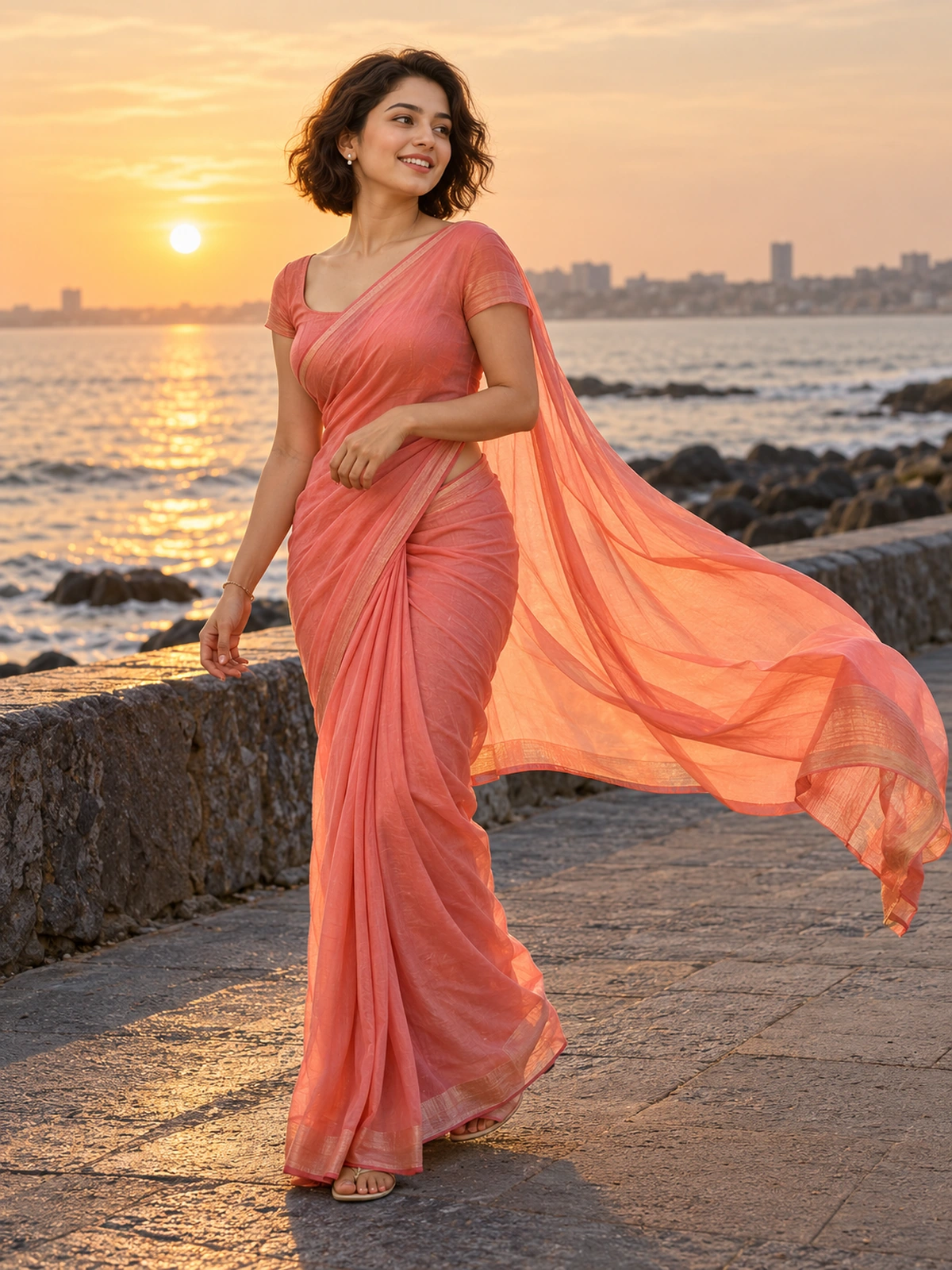
06 · Movement

Walking in Profile

The profile reveals the drape’s silhouette from shoulder to hem, especially beautiful in breezy cottons and organzas.

How to pose
Body
Walk across the frame, not towards it, with a long neck and the chin parallel to the ground.
Hands
Keep the arms relaxed and moving; let the hand nearest the camera hang loosely by the pleats.
Pleats & pallu
A lightweight saree shows its line best here: let the pallu float out behind you.
For the photographer
Leave space in front of the figure — the direction of travel needs room in the frame.

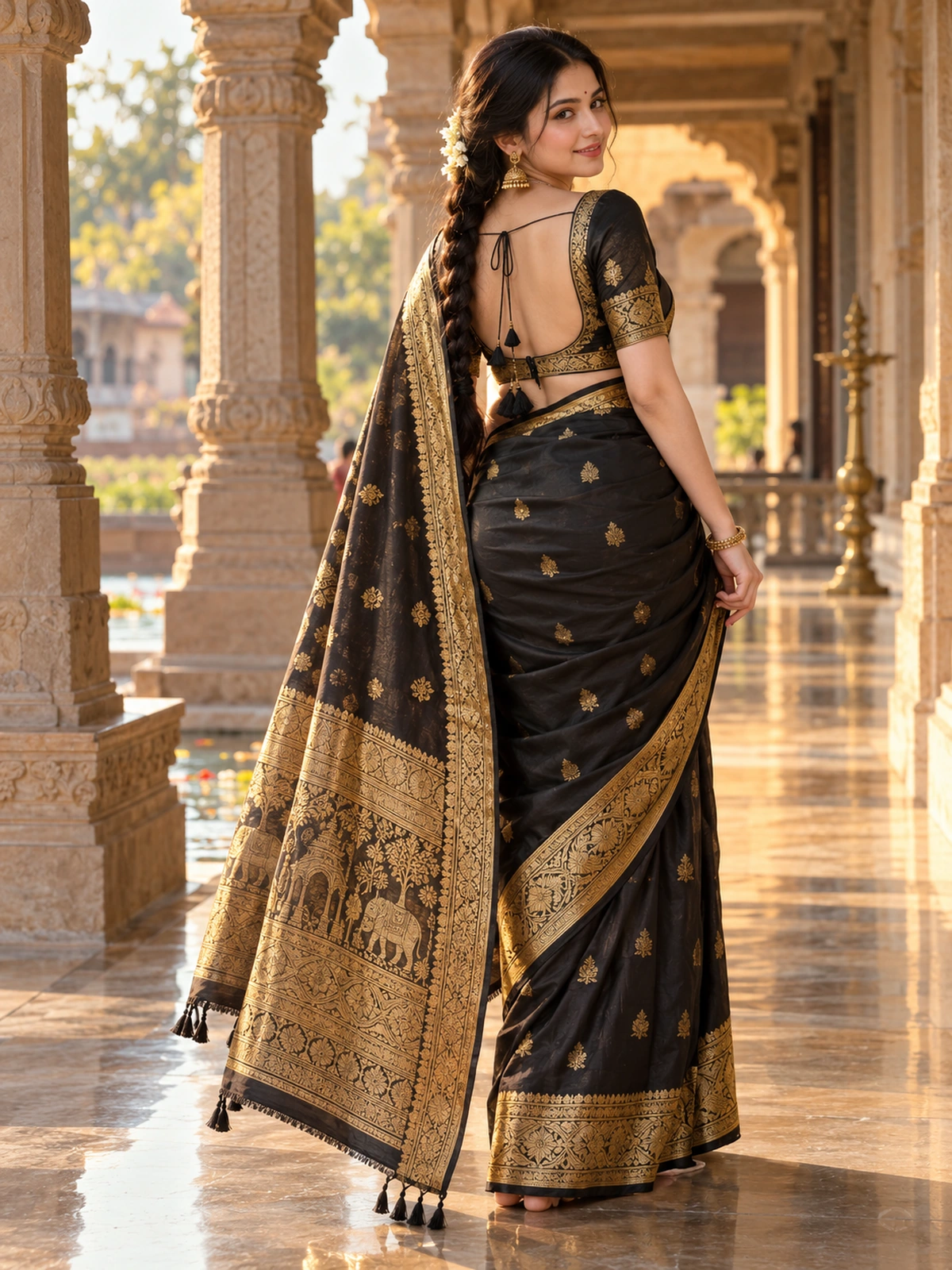
07 · Pallu

Presenting the Pallu

A woven pallu — narrative panels, peacocks or brocade — is often the saree’s masterpiece. This pose opens it like a page while keeping the wearer in the picture.

How to pose
Body
Turn your back three-quarters to the camera and look back over the shoulder with an easy smile.
Hands
Reach one arm out to the side and hold the pallu end at about shoulder height so the whole panel opens; keep the other arm relaxed.
Pleats & pallu
Smooth the pallu across the back first, then open it until the end panel and border hang flat. A narrative or figurative pallu should read from top to bottom.
For the photographer
Shoot from a little behind and to the side, at waist height, so the pallu faces the lens squarely and the face is still visible.

08 · Movement

The Pallu Sweep

A floating pallu adds drama and a sense of joy, and shows how sheer and fluid a fabric really is.

How to pose
Body
Stand three-quarters to the camera with your face turned slightly away towards the light, and let the breeze — or a helper — lift the pallu behind you.
Hands
Release the pallu and keep the hands low and relaxed at the sides as it lifts.
Pleats & pallu
Best with light fabrics — chiffon, georgette, organza or a fine cotton — that lift and float.
For the photographer
Use a fast shutter (1/1000 s) or burst mode; shoot with the light behind the fabric so it glows.

09 · Detail

Holding the Pleats

A natural gesture that draws the eye to the pleats and the border — the heart of a well-draped saree.

How to pose
Body
Stand at a slight angle with weight on the back foot; tilt the head and look down towards the pleats.
Hands
Pinch the pleats lightly a little below the waist, as you would to step forward; relax the other hand.
Pleats & pallu
Straighten the pleats before the shot so they are crisp and evenly spaced from waist to hem.
For the photographer
Frame from just above the head to just below the feet so the pleats run the height of the picture.

10 · Standing

Hand on the Waist

The triangle between arm and body defines the waist and gives a confident, editorial shape.

How to pose
Body
Stand at a slight three-quarter angle and shift your weight to the back leg.
Hands
Place one hand on the waist with the fingers forward and the elbow back; let the other arm hang softly by the pallu.
Pleats & pallu
Keep the pallu on the shoulder away from the posing arm so the waistline and drape stay visible.
For the photographer
Shoot from just below chest height to give presence without exaggeration.

11 · Candid

The Soft Laugh

Real expressions make the warmest portraits — the saree becomes part of a moment, not a costume.

How to pose
Body
Sit side-on at a small table and look just off camera at a friend who is talking to you.
Hands
Hold a cup in one hand and rest your chin lightly on the other, elbow on the table.
Pleats & pallu
Settle the pallu first so it falls over the chair to the floor with its border showing — tidy even in a relaxed moment.
For the photographer
Ask someone to make you laugh, and shoot continuously; the second after the laugh is often the best.

12 · Detail

Looking Down at the Border

A portrait of appreciation — perfect for heirloom sarees and fine weaves whose details deserve a close look.

How to pose
Body
Stand near a window and lower the eyes to the saree, not the chin.
Hands
Lift a section of the pallu border between both hands, fingertips only.
Pleats & pallu
Choose the most beautiful stretch of border or zari and hold it towards the light.
For the photographer
Focus on the hands and fabric; a close mid-length crop keeps the face, hands and weave together.

13 · Setting

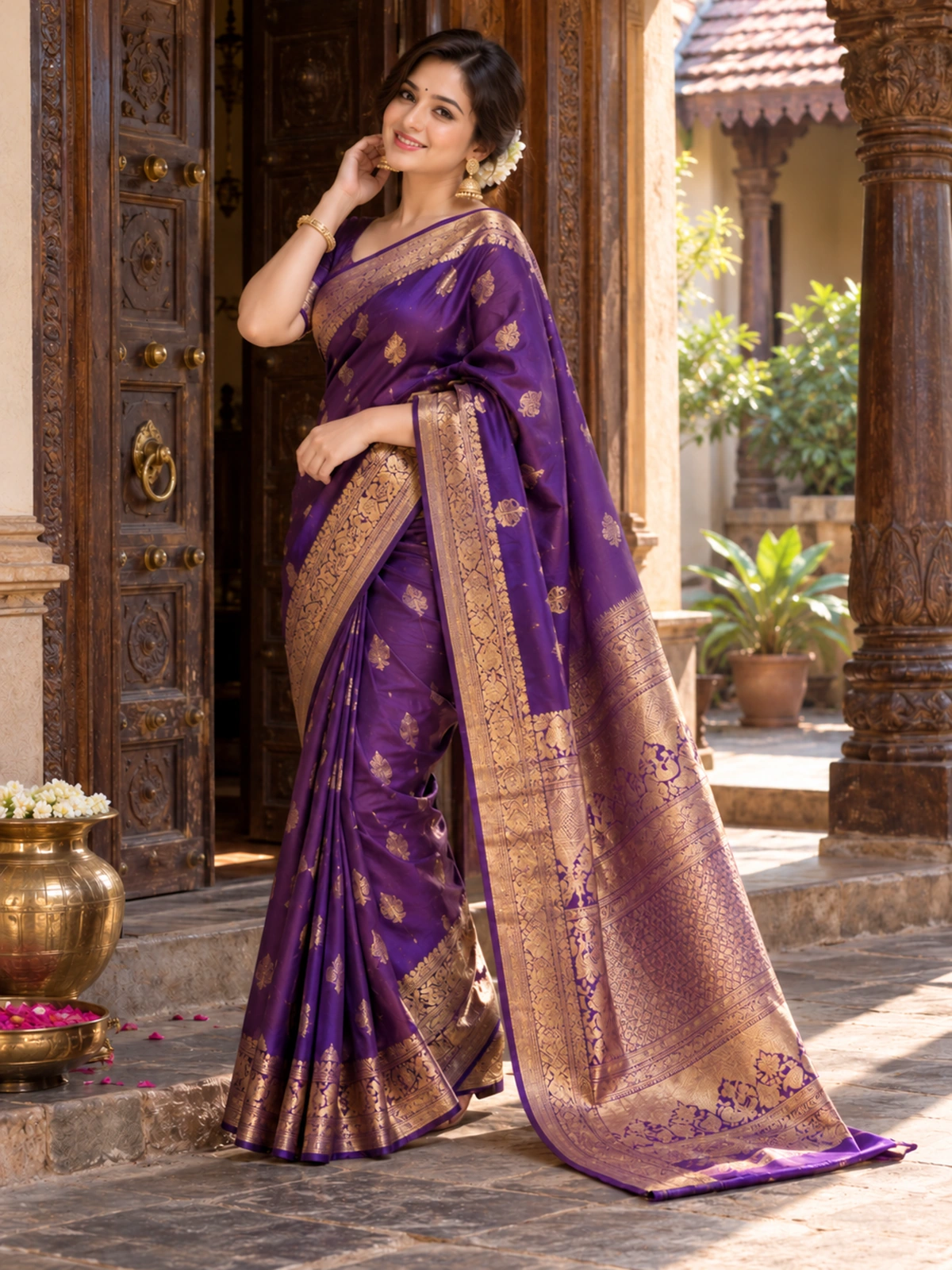
By a Doorway

Architecture frames the figure; a carved or coloured door adds a sense of place and contrast to the saree.

How to pose
Body
Lean one shoulder against the door frame, cross one foot in front of the other and look down with a soft smile.
Hands
Raise the hand nearest the frame to rest on it above shoulder height; let the other rest lightly on the pleats.
Pleats & pallu
Let the pallu fall on the side away from the frame so it isn’t crushed against the wall.
For the photographer
Step back so the doorway frames the whole figure with space around it.

14 · Seated

On a Staircase

Stairs create layers for the drape to fall over and lines that lead the eye straight to you.

How to pose
Body
Sit two or three steps up, angled across the stairs, knees together and drawn up, one foot a step lower than the other.
Hands
Rest an elbow on the knee and your chin lightly on that hand; let the other hand rest on the knee.
Pleats & pallu
Let the pallu spill down the steps beside you and the border fall over the lower step.
For the photographer
Shoot from the bottom of the stairs, slightly to the side, so the steps become leading lines.

15 · Setting

By a Window

Window light is the most flattering light there is, and it shows the translucency of a fine weave.

How to pose
Body
Stand side-on to a window and turn the face slightly towards the light.
Hands
Rest one hand on the window frame; keep the other soft at the waist.
Pleats & pallu
Sheer fabrics — organza, chiffon, fine cotton — glow when backlit; let the pallu hang between you and the window.
For the photographer
Expose for the face, not the window; a reflector or white wall opposite softens shadows.

16 · Setting

Terrace at Golden Hour

Warm, low light makes silk and zari glow and gives the whole photograph a celebratory warmth.

How to pose
Body
Stand by a parapet with the shoulders turned towards the setting sun and the face towards the camera.
Hands
Rest one hand on the parapet and the other lightly at the waist.
Pleats & pallu
Rich silks and zari come alive at golden hour; turn so the pallu border catches the warm light.
For the photographer
Shoot in the last half hour before sunset; keep the sun just out of frame or behind the shoulder.

17 · Movement

The Garden Path

Relaxed and natural — ideal for everyday handloom cottons that look best in daylight.

How to pose
Body
Walk slowly along the path, glancing away to one side as if something caught your eye.
Hands
Gather the pallu lightly in one hand at the waist; let the other arm swing.
Pleats & pallu
A day cotton or light silk shows its fine motifs best in open shade.
For the photographer
Shoot from a distance with a longer lens to compress the greenery into a soft background.

18 · Setting

Under an Archway

Arches and jaali frame the figure and echo the geometry of woven borders.

How to pose
Body
Stand in the arch at a three-quarter angle and look down and away from the camera; keep the face out of strong pattern shadows.
Hands
Rest one hand on the pillar at shoulder height; let the other sit at the waist.
Pleats & pallu
Let the pallu fall towards the light so its weave is lit, not shaded.
For the photographer
Centre the figure in the arch and step back until the architecture surrounds her.

19 · Pallu

The Back Pallu View

Narrative and figurative pallus — Baluchari, Swarnachari, Paithani — are designed to be seen from behind.

How to pose
Body
Stand with your back to the camera and turn the head partly towards it.
Hands
Let the hands rest at the sides, a little behind the hips, so nothing covers the pallu.
Pleats & pallu
Smooth the pallu flat down the back so its full panel — figures, motifs or border — is visible to the hem.
For the photographer
Shoot square-on to the back, at mid-height, so the pallu isn’t distorted.

20 · Movement

The Twirl

Pure joy — the hem and pallu circle outwards and capture the movement of six yards in a single frame.

How to pose
Body
Turn away from the camera and spin slowly on the balls of the feet, looking back over the shoulder mid-turn — controlled, not fast.
Hands
Lift the arms slightly away from the body and let the pallu fly out behind the turn.
Pleats & pallu
Lighter sarees flare best; tuck the pleats securely before twirling.
For the photographer
Burst mode, a fast shutter and plenty of space. Comfortable flat footwear and safety first on stone floors.

21 · Seated

Seated on Garden Steps

A relaxed, informal pose that still shows the full drape — good for family gatherings and festivals.

How to pose
Body
Sit on a low step with the knees drawn up and angled to one side, and look away from the camera.
Hands
Rest one hand on the knee and the other lightly on the step beside you.
Pleats & pallu
Let the pallu fall down the steps behind you so its border shows, and arrange the pleats over the lower step.
For the photographer
Crouch to seated eye level and include greenery behind for a soft background.

22 · Together

Friends, Together

Interaction tells a story, and complementary sarees look richer side by side.

How to pose
Body
Stand side by side, turned slightly towards each other, close enough for the shoulders to touch.
Hands
Link arms at the elbow; let the free hands hold the pleats or relax.
Pleats & pallu
Choose complementary rather than identical sarees, and keep both pallus visible.
For the photographer
Shoot while they talk and smile at each other; ask them to look at the camera only for the last frames.

23 · Together

The Group Arrangement

Triangles of heads and a mix of standing and seated poses make a group photograph feel composed, not crowded.

How to pose
Body
Three stand, one perches on a ledge in front; stagger the heights so no face is directly behind another.
Hands
Vary the gestures — a hand on a friend’s shoulder, one resting on the ledge, one at the waist.
Pleats & pallu
Arrange each pallu or border to fall to the front or outside, and spread the brightest sarees through the group.
For the photographer
Shoot from slightly above eye level and take many frames; catch them looking at each other, and someone will always blink.

24 · Setting

Evening Lamps

Warm, intimate light suits festive sarees and creates the most evocative portraits of all.

How to pose
Body
Stand three-quarters to the camera among the lamps and look towards the lens.
Hands
Hold a lit diya in one hand at waist height and lift the other to the earring or hair.
Pleats & pallu
Zari and silk shimmer in lamplight; let the pallu border fall where it catches the glow.
For the photographer
Raise the ISO rather than using flash, and keep the lamps in the frame for atmosphere.

25 · Portraits

The Waist-Up Turn

Closer than the over-the-shoulder look, it reads as a portrait yet still shows the brocade, the blouse cut and the pallu.

How to pose
Body
Turn your back three-quarters to the camera and look back over your shoulder, chin level, eyes to the lens.
Hands
Clasp the hands loosely in front at the waist so only a glimpse of the bangles shows.
Pleats & pallu
Let the pallu fall straight down the back so its border runs from the shoulder out of the frame, and keep the blouse back clear.
For the photographer
Crop at the hips: a waist-up frame keeps the face, blouse back and pallu border together. Lamplight behind adds depth.

26 · Portraits

The Soft Window Portrait

Side light and a gentle head tilt make the softest portrait of all, and a sheer weave glows in it.

How to pose
Body
Sit beside a window, turn the shoulders slightly towards the camera and tilt the head gently towards the light.
Hands
Keep the hands out of the frame, resting in the lap.
Pleats & pallu
Bring a sheer pallu smoothly over the shoulder so its border crosses the body in one clean diagonal.
For the photographer
Let the window light fall from one side; frame from mid-chest up and focus on the nearer eye.

27 · Portraits

The Jewellery Glance

A small gesture gives the hands a job and draws the eye to the jewellery and the border beside it.

How to pose
Body
Turn the shoulders three-quarters to the camera and look away past the lens, as if someone has just called your name.
Hands
Raise one hand to touch the earring, fingers relaxed; keep the other out of the frame.
Pleats & pallu
Bring a braid or the hair forward over one shoulder and the pallu border over the other, so the necklace sits between them.
For the photographer
A tight mid-length frame focused on the face and jewellery, with a bright background softly out of focus.

28 · Seated

The Blouse-Back Profile

A considered blouse back and a figured pallu deserve their own photograph — this pose shows both at once.

How to pose
Body
Sit side-on with your back angled towards the camera, and turn your head back over the shoulder that is free of the pallu.
Hands
Keep the hands in front, out of sight, so nothing interrupts the blouse back.
Pleats & pallu
Let the pallu fall from the other shoulder across the back and down to the seat, with its motif facing outwards.
For the photographer
Shoot from slightly behind at seated eye level; the blouse tie, sleeve border and pallu all need to be in the frame.

29 · Portraits

The Seated Close Portrait

Leaning in creates warmth and intimacy, and the hand at the cheek gives the frame a relaxed, editorial feel.

How to pose
Body
Sit forward in a chair with the knees angled, lean slightly towards the camera and tilt the head.
Hands
Rest an elbow on the knee and the cheek lightly against the hand; lay the other arm across the lap.
Pleats & pallu
Let the pallu fall in front over the knees so its border frames the body.
For the photographer
Shoot close at seated eye level; a crop from the head to the knees keeps the drape in the story.

30 · Candid

The Candid Smile

An off-camera gaze and a real smile make the most natural everyday portrait — ideal for handloom cottons.

How to pose
Body
Sit comfortably, lean slightly forward and look up and away from the camera at something that makes you smile.
Hands
Rest the elbow on the knee or the arm of the seat and touch the knuckles lightly to the cheek.
Pleats & pallu
Let a light cotton pallu fall loosely over the shoulder and arm; a little softness suits a candid frame.
For the photographer
Shoot in open shade from just below eye level, and keep shooting while she talks — the unposed half-smile is the frame.

31 · Portraits

The Pallu-Framed Portrait

The pallu becomes a frame for the face — elegant, a little dramatic and ideal for richly bordered silks.

How to pose
Body
Face the camera with the shoulders slightly angled and tilt the head towards the raised pallu.
Hands
Lift a fold of the pallu with one hand and hold it softly against the cheek.
Pleats & pallu
Choose the most decorated stretch of the pallu border and bring it up so it frames the face and runs down the front.
For the photographer
Frame from the waist up against a dark, plain background so the woven border glows.

32 · Detail

Hands and Border

It shows the border’s full width and design in context, without losing the person wearing it.

How to pose
Body
Stand at a slight angle to the camera and look at the lens with a soft smile.
Hands
Hold the pallu border away from the body with both hands — one near the shoulder, one at the waist — fingertips only.
Pleats & pallu
Open the pallu so the full width of the border and a little of the body sit side by side.
For the photographer
Frame from the head to the hips so the face, hands and border are equally clear; use even light without harsh shadows on the zari.

33 · Together

Two Friends Walking

Movement and a shared laugh make a friendship photograph that feels lived rather than posed.

How to pose
Body
Walk side by side towards the camera at an easy pace, turning towards each other as you talk.
Hands
Keep the hands light: one rests by the pallu, one at the waist, the free arms relaxed.
Pleats & pallu
Keep both pallus free and visible rather than overlapping, and secure the pleats so they open with each step.
For the photographer
Shoot full-length from a little ahead, in burst mode; the frame where they laugh at each other mid-stride is the one.

34 · Together

Shoulder to Shoulder

Closeness reads instantly as friendship, and the frame becomes a side-by-side study of two sarees.

How to pose
Body
Stand close with the shoulders touching and lean the heads gently towards each other.
Hands
Clasp the hands loosely in front at the waist; keep the arms soft.
Pleats & pallu
Bring both pallus to the front so the two textiles sit side by side across the frame.
For the photographer
A waist-up frame at eye level; ask both to look at the lens, then to smile at a shared joke.

35 · Together

The Seated Conversation

A real conversation relaxes faces and hands, and seated poses show off the drape across the lap.

How to pose
Body
Sit side by side on a bench, turned towards each other mid-conversation.
Hands
One rests her chin on her hand with the elbow on the knee; the other clasps her hands over her knee.
Pleats & pallu
Let both pallus fall forward over the knees so the borders and motifs show.
For the photographer
Shoot from a slight angle at seated eye level. Don’t ask them to look up — the conversation is the photograph.

36 · Together

The Three-Woman Arrangement

Varied heights and gestures stop three people lining up like a queue, and the architecture ties them together.

How to pose
Body
Stand in a loose triangle under an arch: one tall at one side, one a step forward in the middle, one at the other side, each angled differently.
Hands
Give each person a different job — a hand on the pillar, hands at the waist, a hand at the necklace.
Pleats & pallu
Let each pallu fall to the front or the outer side so all three borders are visible.
For the photographer
Shoot full-length, centred on the arch, and step back so the architecture frames the group.

37 · Together

Three Friends, Close

Turning inward creates a circle of warmth; the laughter does the rest.

How to pose
Body
Sit close together, the two outer friends turned in towards the friend in the middle.
Hands
Rest the hands on each other’s arms and shoulders — touching, not gripping.
Pleats & pallu
Spread the three pallus so each colour has its own space across the frame.
For the photographer
Get close and frame from the waist up; tell a story or a joke and shoot the laugh, not the smile.

38 · Together

Four Across the Courtyard

A diagonal line shows four complete sarees at once without anyone hiding behind someone else.

How to pose
Body
Stand in a gentle diagonal line, each body angled slightly towards the centre and the feet a little apart.
Hands
Vary the hands: one at the waist, one at the necklace, one holding the pleats, one relaxed.
Pleats & pallu
Bring every pallu forward so its border falls to the front, and spread contrasting colours along the line.
For the photographer
Shoot full-length from slightly to one side so the line recedes, leaving space at both ends.

39 · Together

The Mixed-Height Group

Two levels of faces make a large group feel composed and intimate rather than crowded.

How to pose
Body
Seat two in front and stand three behind, placing each standing face in the gap between the faces below.
Hands
Standing friends rest a hand on a seated friend’s shoulder; seated friends rest a cheek on one hand.
Pleats & pallu
Spread the seated sarees over the knees and let the standing pallus fall forward over the shoulder.
For the photographer
Shoot from just above seated eye level and take many frames — five people, five chances to blink.

40 · Together

The Group Walk

A walking group shows every saree in motion and feels like a celebration in progress.

How to pose
Body
Walk towards the camera in a loose, staggered group, chatting naturally.
Hands
Hold a pallu edge or the pleats; let the free arms swing.
Pleats & pallu
Secure the pleats well and let the pallus trail; put the brightest sarees at the front and the edges.
For the photographer
Use a longer lens from further away and burst mode; pick the frame where the front three are mid-stride and laughing.

41 · Together

Generations Together

An elder framed by younger family is a timeless portrait — and often the most treasured photograph of the day.

How to pose
Body
Seat the eldest at the centre; the others stand close on either side and lean their heads in towards her.
Hands
Rest a hand on her shoulder; she can fold her hands calmly in her lap.
Pleats & pallu
Arrange her saree neatly over the knees, and the standing pallus so all three borders show.
For the photographer
Shoot at the seated person’s eye level in warm, soft light; this is the one where everyone looks at the lens.

42 · Together

The Shared Laugh

Faces turned to each other rather than the lens make a group photograph feel like a memory, not an appointment.

How to pose
Body
Two sit in front and two stand behind; turn towards each other as if sharing a story.
Hands
A hand at the cheek, a hand on a friend’s shoulder, hands resting on the knees.
Pleats & pallu
Let the seated sarees spread across the laps and the standing pallus fall forward.
For the photographer
Start a story, then shoot continuously; the best frame comes a beat after the punchline.

43 · Movement

Descending the Steps

Lifting the pleats is a real, graceful gesture — and the stairs show the whole length of the drape in motion.

How to pose
Body
Walk slowly down the steps, looking down towards your feet with the shoulders relaxed.
Hands
Lift the front pleats slightly with one hand; let the other rest lightly on the balustrade.
Pleats & pallu
Keep the pallu pinned at the shoulder so it stays put, and let the border swing with each step.
For the photographer
Shoot full-length from the bottom of the stairs and to one side, in burst mode as the front foot lands.

44 · Setting

The Mirror Moment

Front and back in a single photograph — the face, the drape and the pallu at once.

How to pose
Body
Stand three-quarters to the camera beside a full-length mirror, angled so the mirror shows your back.
Hands
Clasp the hands loosely in front at the waist.
Pleats & pallu
Let the pallu fall straight down the back so the mirror shows its full length.
For the photographer
Position the camera so both she and her reflection are sharp, and the camera itself does not appear in the mirror.

45 · Setting

Leaning on a Pillar

Leaning relaxes the whole body, and the pillar adds a strong vertical line that echoes the pallu.

How to pose
Body
Lean one shoulder and the side of your head lightly against a pillar, with one foot crossed in front of the other.
Hands
Rest one hand at the waist over the pallu; let the other arm hang softly.
Pleats & pallu
Let the pallu fall on the side away from the pillar so its full length and tassels are visible.
For the photographer
Shoot full-length from a little in front, including enough of the carved pillar to place the figure.

46 · Seated

Seated on the Floor

A floor pose is relaxed and homely, and lets a broad border spread out like a frame around you.

How to pose
Body
Sit on a rug with the legs folded to one side, back straight, leaning slightly on one hand.
Hands
Rest one hand on the rug beside you and the other lightly on the knee.
Pleats & pallu
Spread the pleats and border in a fan across the rug in front of you; a long braid can fall forward over the shoulder.
For the photographer
Crouch to just above seated eye level so the fanned border is fully visible.

47 · Portraits

Adjusting the Earring

A getting-ready moment feels private and natural, and the raised hands frame the face.

How to pose
Body
Turn the shoulders three-quarters to the camera and look away past the lens, towards the light.
Hands
Raise both hands to one ear as if fastening an earring, elbows soft.
Pleats & pallu
Bring the pallu over the shoulder nearest the camera so its pattern fills the lower frame.
For the photographer
A close crop from the top of the head to the chest, with soft window light from the side she is facing.

48 · Movement

The Farewell Glance

A last look back is cinematic, and it shows the pallu and the blouse back as she walks away.

How to pose
Body
Walk away from the camera, then look back over the shoulder that is free of the pallu.
Hands
Let the arms swing naturally; one hand can brush the side of the drape.
Pleats & pallu
Let the pallu fall straight down the back so its border runs from shoulder to hem; a braid down the back adds another line.
For the photographer
Shoot full-length from behind at a little distance, and catch the moment she turns.

Before the first photograph

Drape with intent. Secure the pallu and pleats in a way the fabric can take — fine silk and zari snag easily, so a careful tuck or a fabric-safe pin is kinder. Smooth creases only as the saree’s own care allows, and count the pleats so they fall evenly. Saree Care has the detail.

Mind the light. Open shade and window light are kindest to faces and fabrics; harsh noon sun flattens the weave.

Footwear and safety. Flat, secure footwear for walking and twirling poses — especially on stone.

Respect the saree. Keep heirloom silks away from water, sand and makeup; carry a clean cloth for touch-ups.