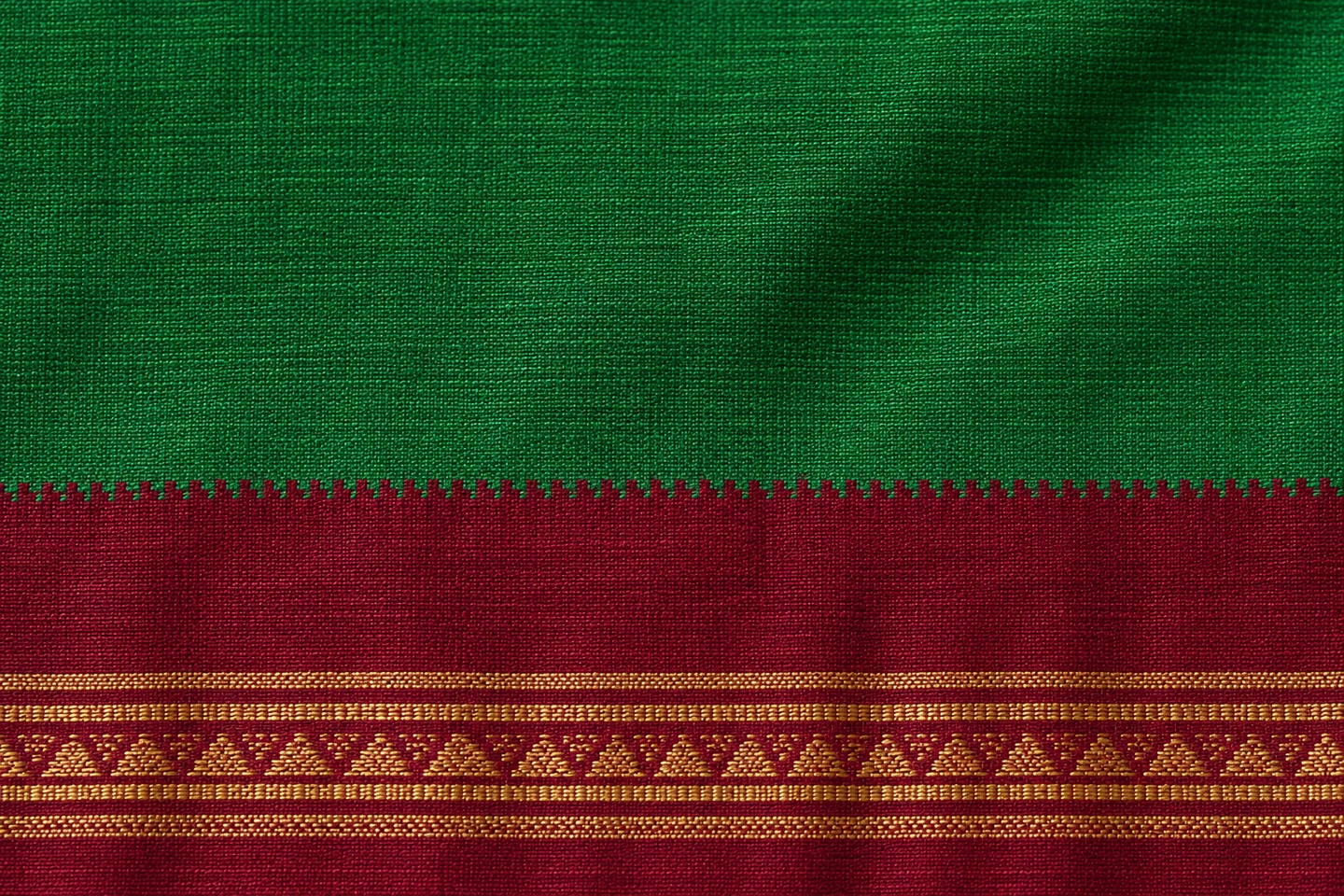
Your practical field guide to inspecting silk, separating handloom claims from fibre claims, checking marks, and asking ten useful questions.
THE SAREE ATLAS · ILLUSTRATED REFERENCE
Materials, marks and verification
Materials, marks and verification
AN INSPECTION SEQUENCE
What to inspect before you fall for the pallu
Work through this sequence with the actual saree fully opened. No single visual clue guarantees authenticity; use documentation when the claim affects the price.
01Identify the claimFibre, origin, handloom, pattern method and zari should not be conflated.
02Look at the whole sareeBody, both borders, selvedges, pallu, end finishing and visible condition.
03Ask what is verifiableApplicable label, producer identity and stated specifications on the invoice.
04Check the lived experienceWearability, pleating, weight, care requirements and seller return policy.
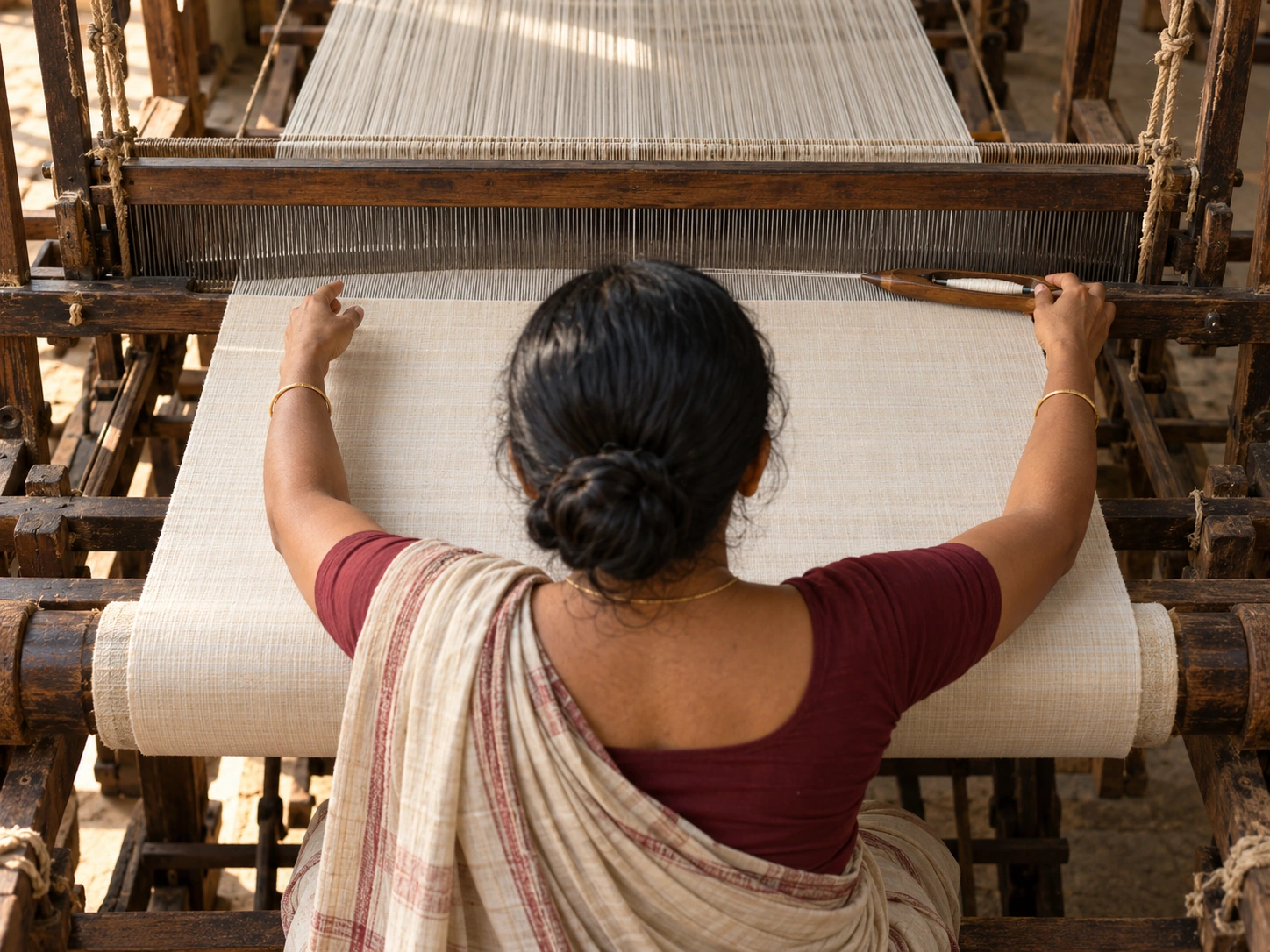
At the loom A weaver at the cloth’s working edge, with the shuttle in hand. On a handloom, every pass of the weft is made by hand and foot.
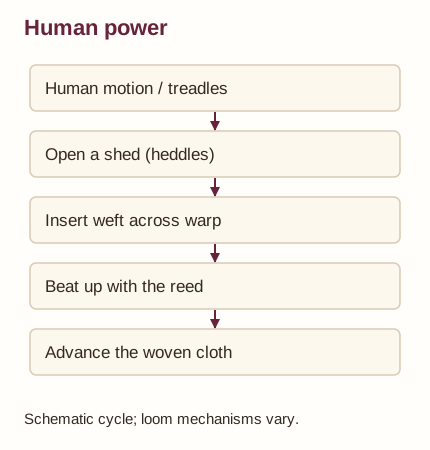
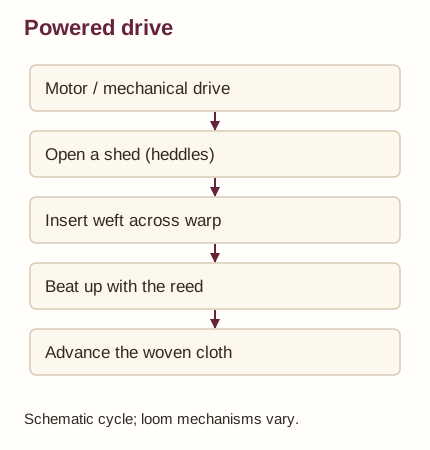
Human-powered / mechanically powered weaving
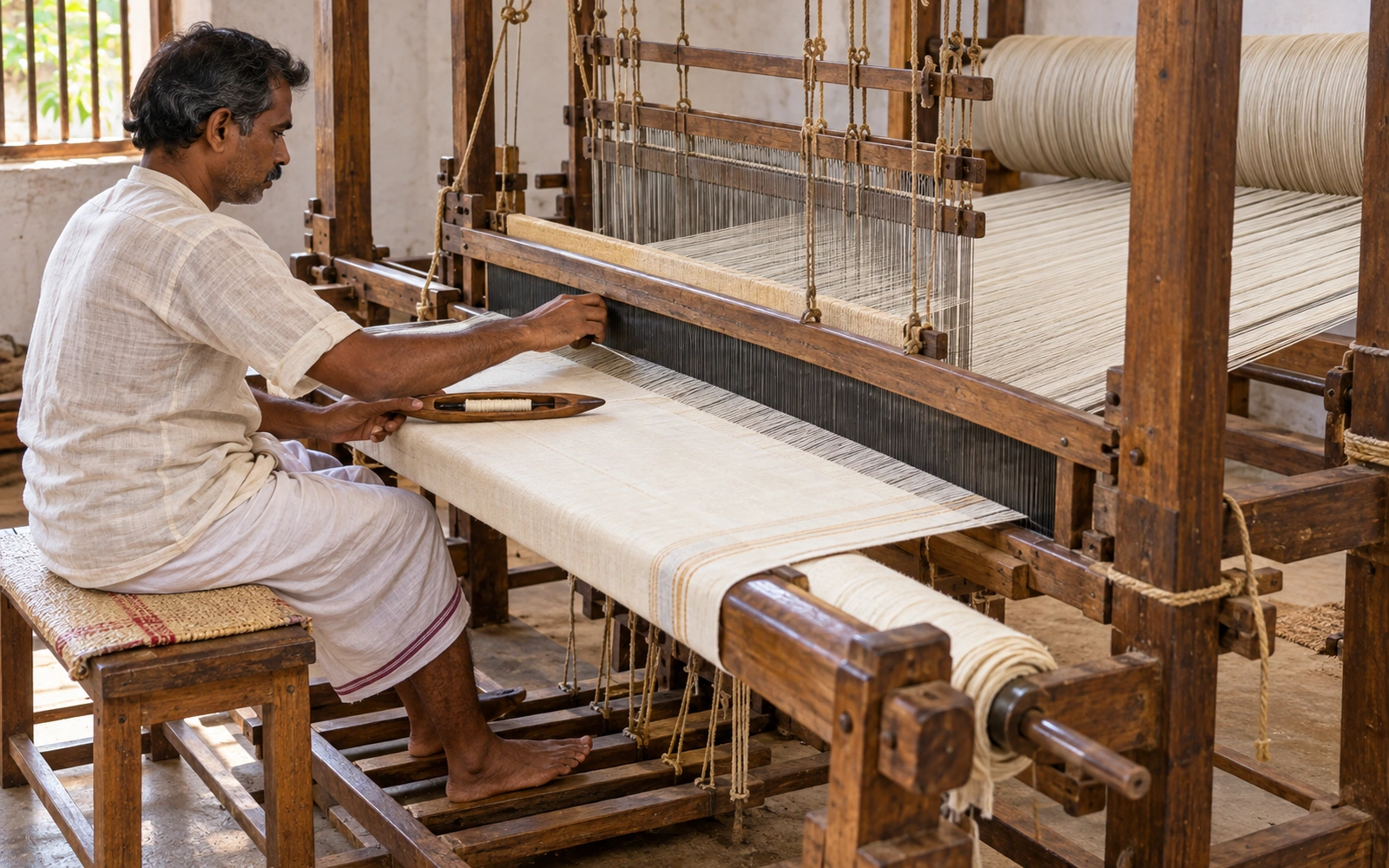
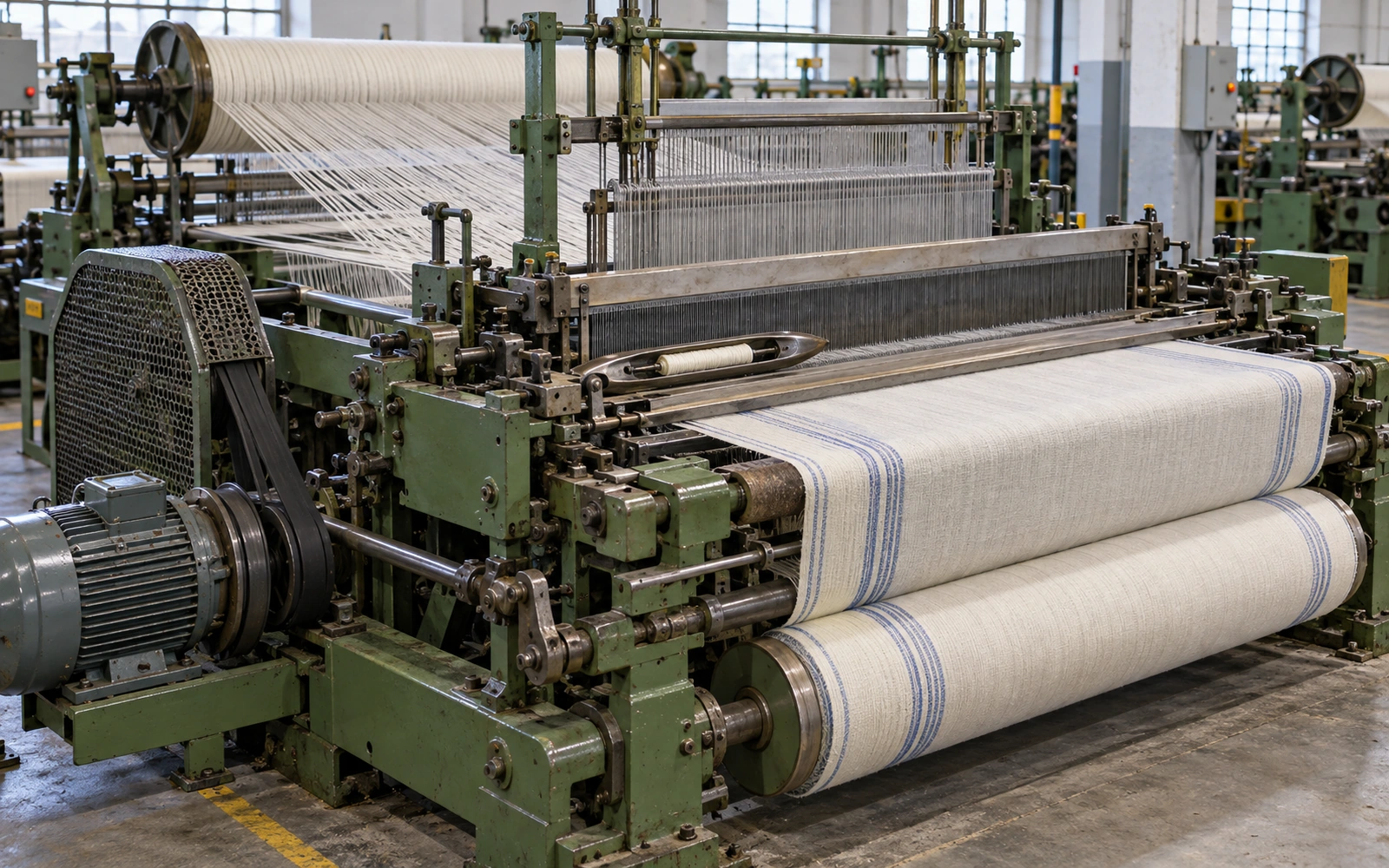
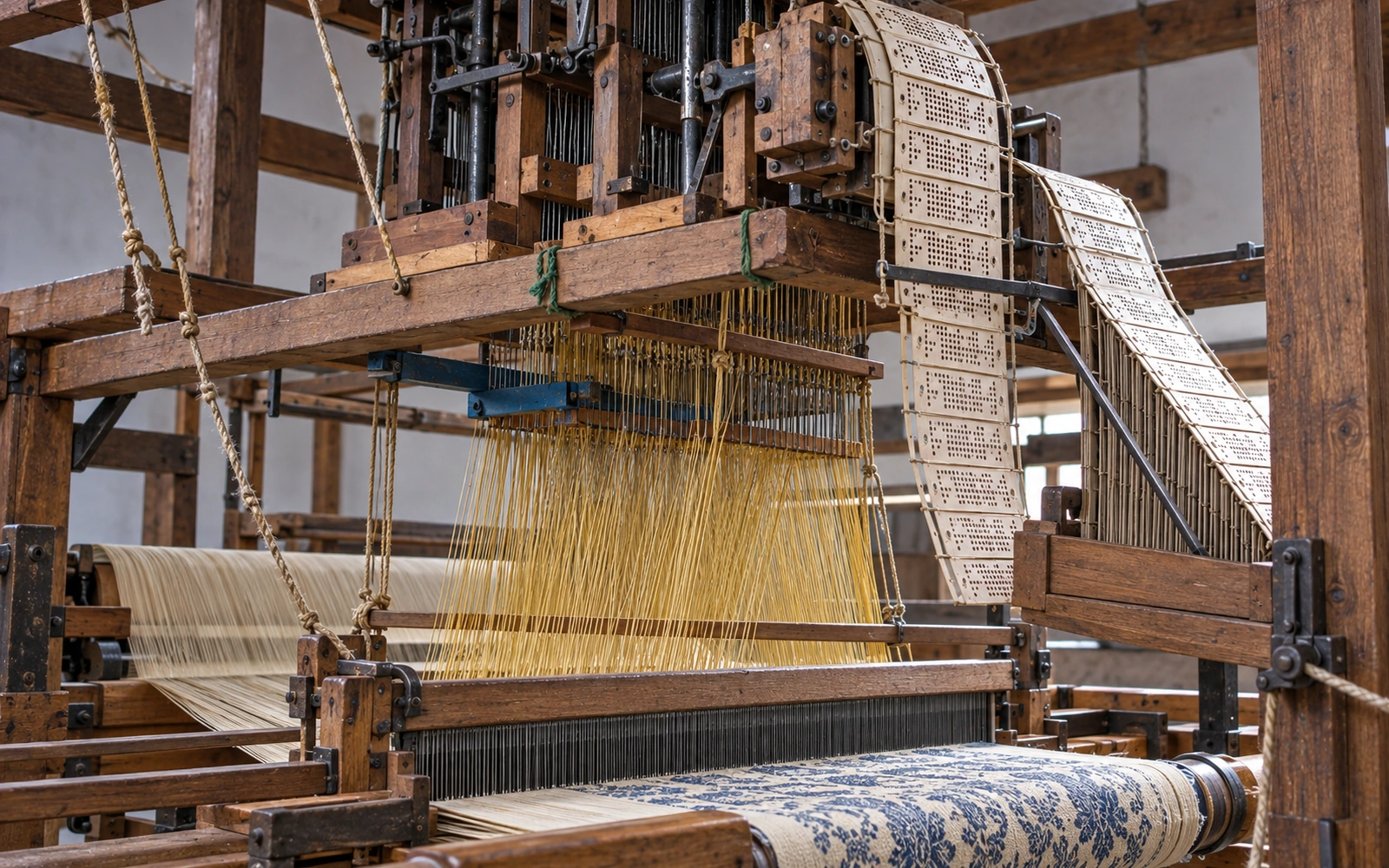
These original editorial illustrations show representative mechanisms; the diagrams explain the power source. They are not documentary photographs or proof of a particular textile’s origin.
Handloom — editorial illustrationHuman effort operates the weaving mechanism. Specific loom arrangements and assistance systems vary.Open full-size illustration
Powerloom — editorial illustrationMotorised drive assists repeated weaving motions. Actual industrial systems vary by model and fabric.Open full-size illustration
Jacquard pattern selection — editorial illustrationPunched-card control selects warp threads for a pattern; Jacquard itself does not tell you whether a loom is hand-powered or motor-driven.Open full-size illustration
The diagram shows the human-powered weaving sequence.On small screens, scroll the diagram sideways to inspect the labels.
The drive powers repeated weaving motions; loom systems vary.On small screens, scroll the diagram sideways to inspect the labels.
Worth checking: Jacquard describes pattern control; it does not by itself establish whether a loom is powered by hand or motor.
Woven pattern versus surface printing
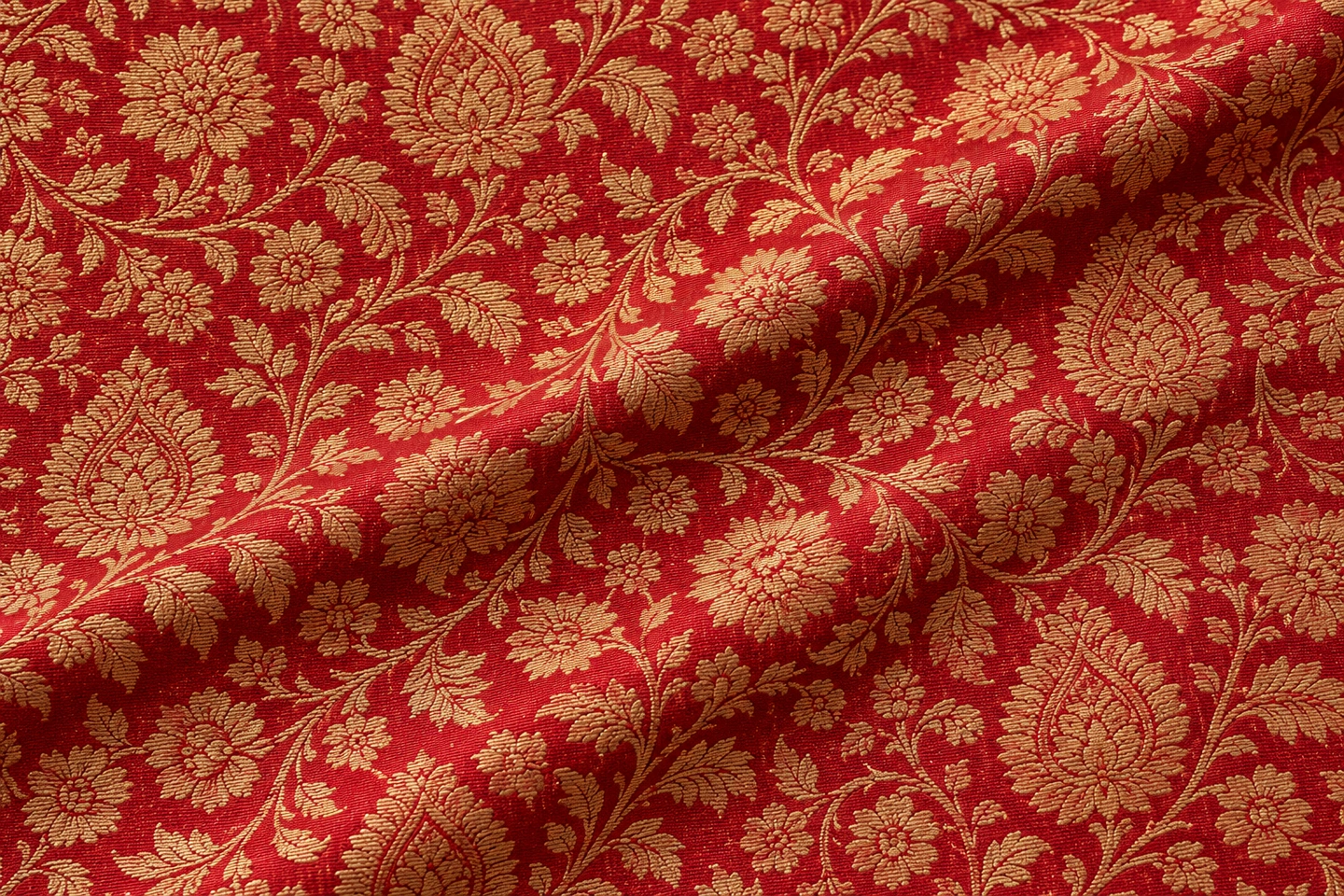
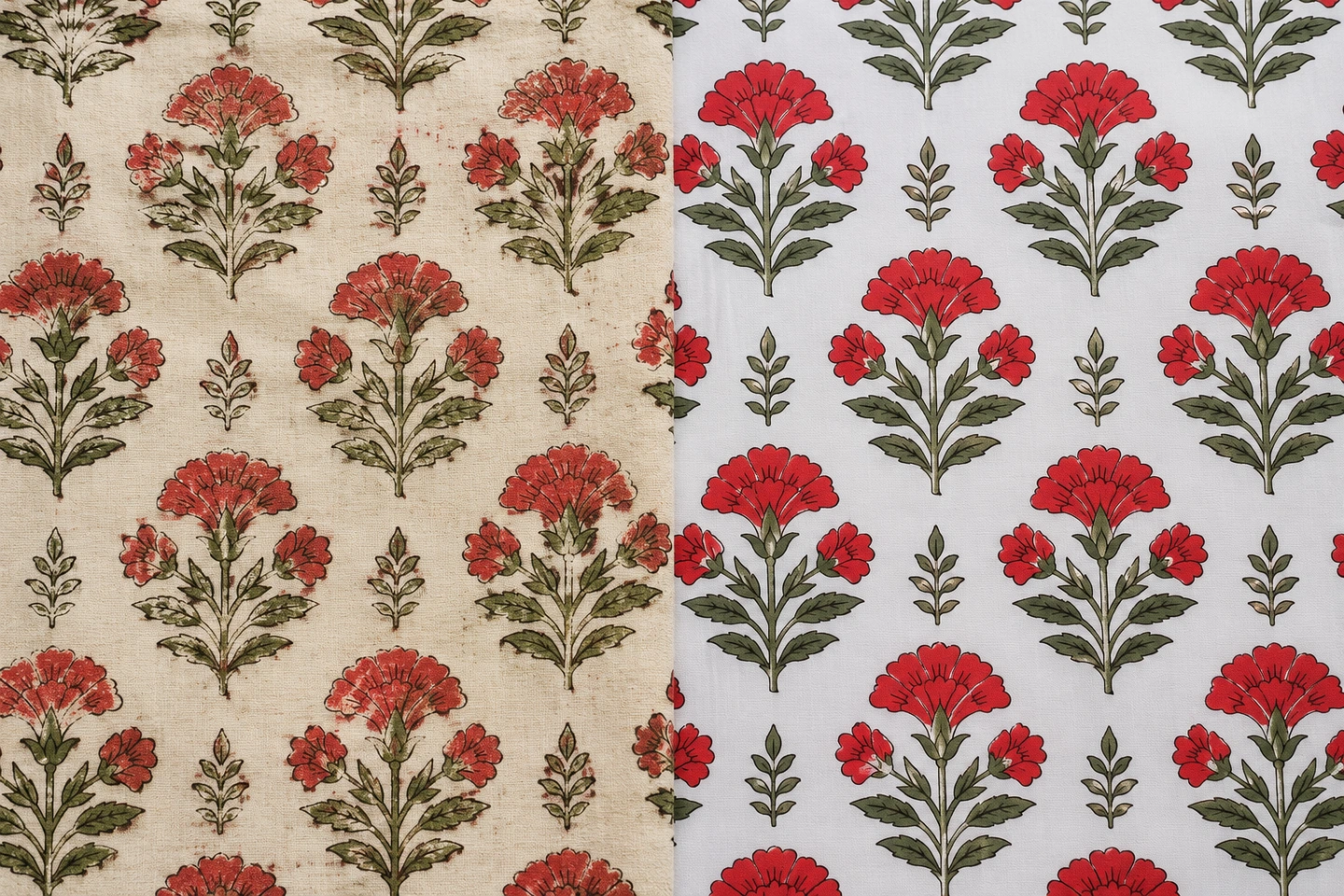
A pattern woven into a textile and a similar design printed onto the surface can be equally appealing, but the construction and work are different. The finished illustration here will show the structural distinction.
ILLUSTRATED STUDY
Woven ornament / surface print
Use the images as examples, then follow the process schematics.
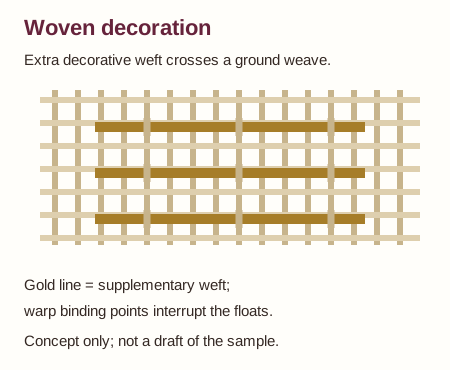
Woven brocade illustrationGold-coloured supplementary yarns form ornament within the textile.Open full-resolution image
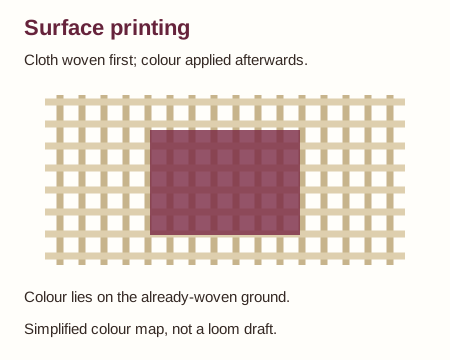
Surface-print illustrationColour repeats across the surface of a different cloth sample.Open full-resolution image
Supplementary yarns create the woven motif.On small screens, scroll the diagram sideways to inspect the labels.
Printing applies colour after ground-cloth production.On small screens, scroll the diagram sideways to inspect the labels.
Handloom means weaving powered through human operation; powerloom uses powered movement. A complicated pattern can be made on a handloom, including with a Jacquard pattern-control system. Do not assume that every intricate design must be machine-woven, or that an uneven edge is definitive proof of handloom.
Hand-operated and mechanically powered looms can both weave elaborate designs; a Jacquard attachment controls the selection of threads and is not, by itself, proof of powered weaving. Slubs, tiny variations and the reverse of a fabric may offer questions to investigate, but none is a dependable standalone test. Ask what kind of loom it was woven on, what supports that claim, and whether the seller will put it on the invoice.
Why handloom can cost more. A handloom saree carries the weaver’s time and skill — days for a plain piece, weeks or months for elaborate brocade, korvai or double ikat — and it sustains techniques that are slow or impractical to mechanise. Powerloom weaving is faster and usually more economical, and a well-made powerloom saree can be better value than a poorly woven handloom one. A handloom premium should therefore rest on evidence and visible workmanship, not on the word alone. More in the Buyer’s Field Guide.
For a premium handloom purchase, request the applicable label or producer information and ask the seller to place the handwoven claim in writing. A photographic illustration or a seller's confident description is not a manufacturing record.
Four different marks, four different claims
ILLUSTRATED STUDY
Four names, four different claims
Use the scheme appropriate to the claim you are trying to verify.
01 · scheme / registration
Silk Mark
Silk Mark Organisation of India (SMOI), a Central Silk Board initiative.
What it addresses
Assurance for 100% natural silk under its scheme.
What it does not establish
Does not certify zari purity, handloom method or regional origin.
Buyer verification
Each label carries a hologram and a unique number that traces the product to an authorised user. Ask the seller about their authorised-user status, keep the label with the bill — and remember that many genuine silks are sold without one.
Official reference information checked 16 October 2026.
Worth checking: Each scheme has a different scope. Check any claimed mark or registration using the appropriate official source.
A Silk Mark label is associated with verification of genuine silk composition under its applicable scheme; it does not automatically certify that a saree is handwoven or has precious-metal zari. Handloom-related labels address different claims. For costly sarees, use appropriate documentation, not only appearance-based “home tests”.
Mark or system
What it addresses
What it does not, by itself, prove
Official reference
Silk Mark
Under the Silk Mark Organisation of India scheme, a labelled product from an authorized user is represented as 100% natural silk.
Handloom origin, regional GI provenance, or the metal content of zari. A missing label does not, by itself, prove that a saree is synthetic.
How to check: Look for the appropriate original label or registration information, confirm the seller or producer through the relevant official channels when possible, and retain a detailed invoice. Beware of generic printed logos, QR codes that lead nowhere, and statements such as “Silk Mark means pure gold zari.” Schemes and their verification systems can change, so check the linked authorities before an expensive purchase.
Inspect the whole saree before paying
ILLUSTRATED STUDY
Inspect the cloth in front of you
Locate the regions first; then inspect both faces and the finishing.
123
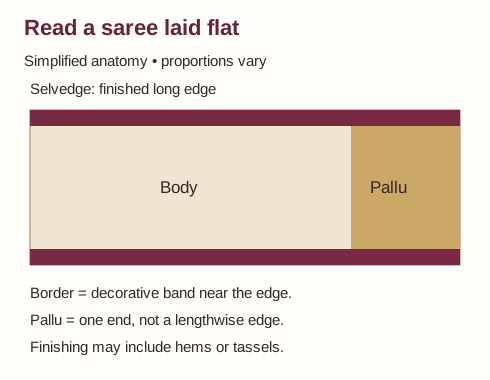
Body, pallu and border in a style illustrationPins mark visible areas only.
1 Body: inspect the ground for pulls or stains.
2 Pallu: inspect alignment and finishing.
3 Decorative border: inspect continuity and joins.
The selvedge is the finished lengthwise outer edge, distinct from the decorative border.On small screens, scroll the diagram sideways to inspect the labels.
A separate border-junction illustrationUseful for locating a junction, not proof of the full saree’s construction.Open full-resolution image
Inspect in person
Check pulls, broken yarns, stains, weak edges and irregular alignment under good light.
Finishing
Ask to see the hems, tassels and any repaired area.
Edges and joins
Examine both lengthwise edges, the joins and the finishing in person under good light.
Worth checking: Natural yarn irregularities are not necessarily defects. Ask which variations are intentional and which affect wear.
Ask to see the saree fully opened rather than judging only its showpiece fold. Examine the body, both long edges, pallu, end finishing, colour consistency and any areas the seller identifies as handwork. Where relevant, look for unwanted yarn pulls, stains, unstable-looking edges or damaged ornament. Do not mistake every handwoven irregularity for a defect: some are part of the fabric's character.
If an expensive feature explains the price—such as complex woven decoration, silk composition or precious-metal zari—request a clear description of that feature. “Looks genuine” is not a test. A claim on the invoice is valuable evidence of what was sold, though it is not an independent laboratory certificate.
Price depends on the actual material, work and seller—not merely on the saree's regional name. Price & Value gives a full method for comparing sarees of similar specifications and includes indicative 2026 price ranges.
A burn test performed on a safely obtained loose fibre sample by a competent person may offer limited clues about fibre behaviour; dyes, finishes and blends complicate the result. Never burn or pull threads from a saree. A video of another fabric is not evidence for the piece being sold.
The ring test mainly reflects thickness, flexibility and drape. A synthetic fabric can pass, while genuine silk can fail. Neither test proves natural silk, handloom production, origin, zari purity or GI status. For important claims, insist on clear specifications, relevant certifications and a descriptive invoice.